
Pulp Fiction, 1925 · page 123 of 172
Argosy All-Story Weekly — page 123: what you’re looking at
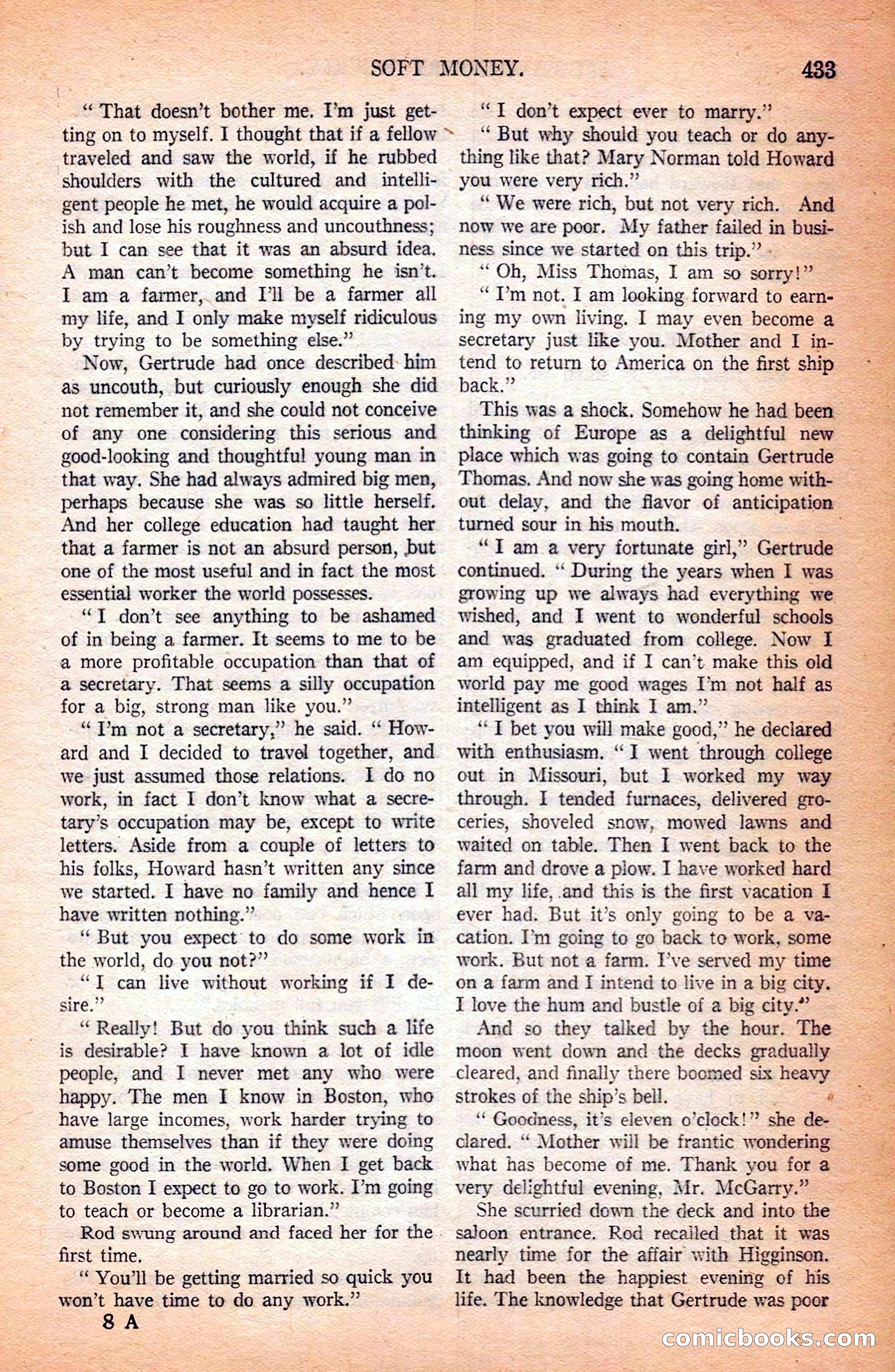
A restored page from Pulp Fiction, 1925. Page through the whole issue in the reader above.
📄 Transcribed text from this page (OCR, searchable)
Machine-transcribed from the original scan — historical spelling and the odd misread are preserved.
© That doesn’t bother me. I’m just get- ting on to myself. I thought that if a fellow traveled and saw the world, if he rubbed shoulders with the cultured and_intelli- gent people he met, he would acquire a pol- ish and lose his roughness and uncouthness; but I can see that it was an absurd idea. A man can’t become something he isn’t. I am a farmer,.and I'll be a farmer all my life, and I only make myself ridiculous by trying to be something else.” Now, Gertrude had once described: him as uncouth, but curiously enough she did not remember it, and she could not conceive of any one considering this serious and good-looking and thoughtful young man in that way. She had always admired big men, perhaps because she was so little herself. And her college education had taught her that a farmer is not an absurd person, but one of the most useful and in fact the most essential worker the world possesses. “JT don’t see anything to be ashamed of in being a farmer. It seems to me to be a more profitable occupation than that of a secretary. That seems a silly occupation for a big, strong man like you.” “Ym not a secretary,” he said. “ How- ard and I decided to travel together, and we just assumed those relations. I do no work, in fact I don’t know what a secre- tary’s occupation may be, except to write letters. Aside from a couple of letters to his folks, Howard hasn’t written any since we started. I have no family and hence I have written nothing.” ‘But you expect to do some work in the world, do you not?” “T can live without working if I de- sire.” “ Really! But do you think such a life is desirable? I have known a lot of idle people, and I never met any who were happy. The men I know in Boston, who have large incomes, work harder trying to amuse themselves than if they were doing some good in the world. When I get back to Boston I expect to go to work. I’m going to teach or become a librarian.” - SOFT MONEY. ~ Rod swung around and faced her for the . first time, “You'll be getting married so quick ou won't have time to do any work.” . - - — “ = — “Gree MSZ 5 pew SS Se . SS ein eee Se Ct en - - <a Jan F oy Te Ae - ae Sg no ee Ce. CR ms, S ETAL h —_ he wg EO <=> ‘But why should you ssick or ere thing like that? Mary Norman told Howat you were very rich.” : “We were rich, but not very aS ke now we are poor. My father failed in busi- ness since we started on this trip.” » “Oh, Miss Thomas, I am so sorry!” “T’m not. I am looking. forward to earn. ing my own living, I may even become secretary just like you. Mother and I in- tend to return to America on the first = back.” : This was a shock. Somehow he had beer thinking of Europe as a delightful new place which was going to contain Gertrude Thomas. And now s che: was going home with- — out delay, and the flavor of anticipation. turned sour in his mouth. “T am a very fortunate girl,” Gertrude continued. “‘ During the years when I was_ growing up we always had everything we wished, and I went to wonderful schools | and was graduated from college. Now a am equipped, and if I can’t make this old — world pay me good wages I’m not valk as intelligent as I think I am.” ‘IT bet you will make good,” he acciacee with enthusiasm. “I went through college out in Missouri, but 1 worked my w through. I tended furnaces, delivered gro- ceries, shoveled snow, mowed lawns an waited on table. Then I went back to th farm and drove a plow. I have worked hare all my life, and this is the first vacation I ever had. But it’s only going to be a va- — cation. I’m going to go back toe work, some work. But not a farm. I’ve served my time on a farm and I intend to live in a big city. — I love the hum and bustle of a big city.” And so they talked by the hour. The moon went down and the decks gradual, 2 cleared, and finally there boomed six neat strokes of the ship’s bell. ‘“ Goodness, it’s eleven o’clock!”? she de clared. “ Mother will be frantic wondering what has become of me. Thank you for a very delightful evening, Mr. McGarry.” re ee ~,