
Pulp Fiction, 1925 · page 102 of 172
Argosy All-Story Weekly — page 102: what you’re looking at
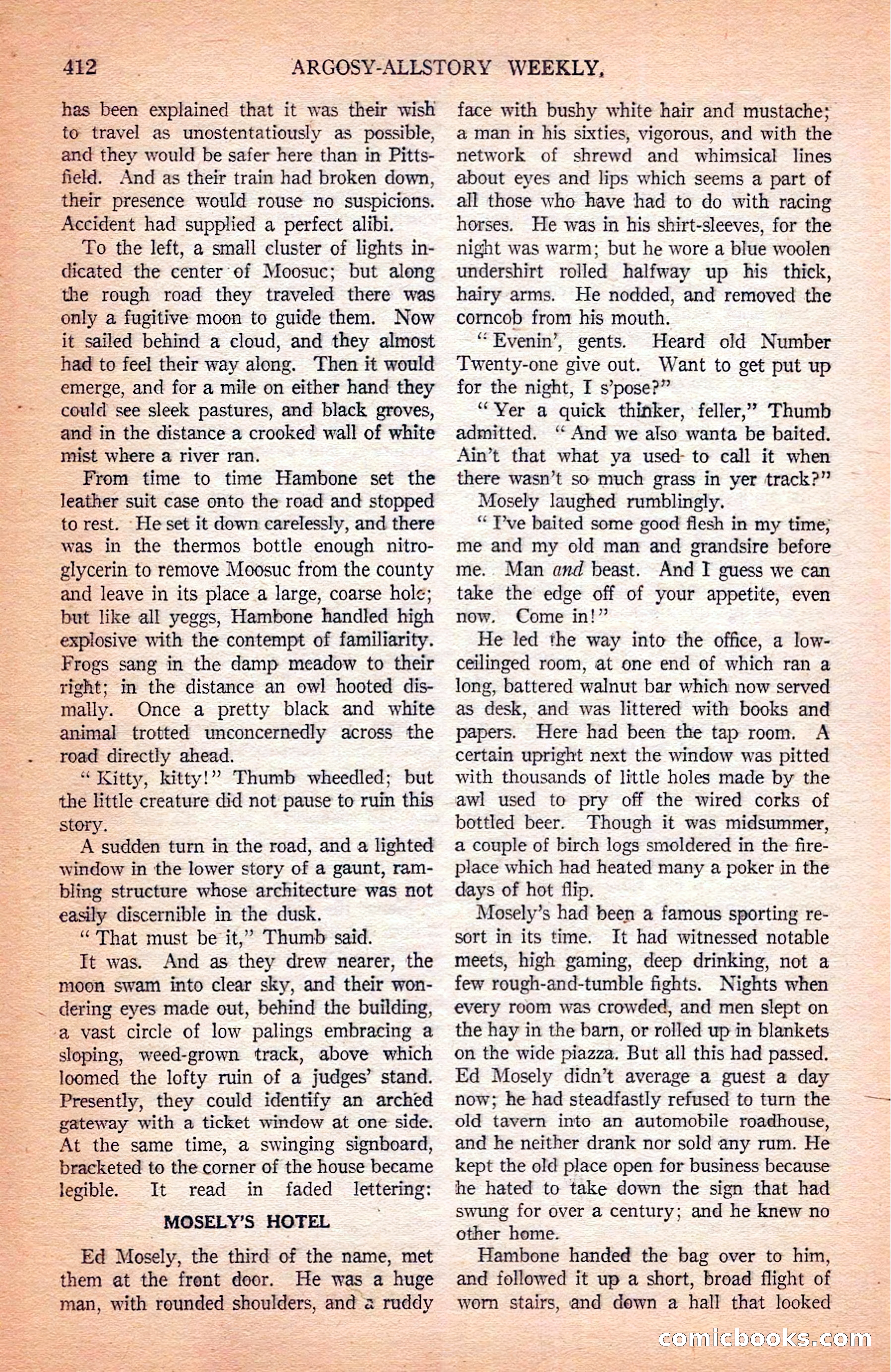
A restored page from Pulp Fiction, 1925. Page through the whole issue in the reader above.
📄 Transcribed text from this page (OCR, searchable)
Machine-transcribed from the original scan — historical spelling and the odd misread are preserved.
aie has been explained that it was their wish to travel as unostentatiously as possible, _and they would be safer here than in Pitts- field. And as their train had broken down, their presence would rouse no suspicions. _ Accident had supplied a perfect alibi. To the left, a small cluster of lights in- dicated the center'of Moosuc; but along the rough road they traveled there was only a fugitive moon to guide them. Now it sailed behind a cloud, and they almost had to feel their way along. Then it would emerge, and for a mile on either hand they could see sleek pastures, and black groves, and in the distance a crooked wall of white mist where a river ran. From time to time Hambone set the leather suit case onto the road and stopped to rest. _He set it down carelessly, and there was in the thermos bottle enough nitro- glycerin to remove Moosuc from the county and leave in its place a large, coarse hole; but like all yeggs, Hambone handled high explosive with the contempt of familiarity. Frogs sang in the damp meadow to their right; in the distance an owl hooted dis- mally. Once a pretty black and white animal trotted unconcernedly across the road directly ahead. “ Kitty, kitty!” Thumb wheedled; but the little creature did not pause to ruin this story. A sudden turn in the road, and a lighted window in the lower story of a gaunt, ram- bling structure whose architecture was not easily discernible in the dusk. “ That must be it,” Thumb said. It was. And as they drew nearer, the moon swam into clear sky, and their won- dering eyes made out, behind the building, ‘a vast circle of low palings embracing a = sloping, weed-grown track, above which loomed the lofty ruin of a judges’ stand. Presently, they could identify an arched gateway with a ticket window at one side. _ At the same time, a swinging signboard, _ bracketed to the corner of the house became legible. It read in faded lettering: MOSELY’S HOTEL Ed Mosely, the third of the name, met them at the frent door. He was a huge man, with rounded shoulders, and a2 ruddy ARGOSY-ALLSTORY WEEKLY, face with bushy white hair and mustache; a man in his sixties, vigorous, and with the network of shrewd and whimsical lines about eyes and lips which seems a part of all those who have had to do with racing horses. He was in his shirt-sleeves, for the night was warm; but he wore a blue woolen undershirt rolled halfway up his thick, hairy arms. He nodded, and removed the corncob from his mouth. ‘“Evenin’, gents. Heard old Number Twenty-one give out. Want to get put up for the night, I s’pose?” “Yer a quick thinker, feller,” Thumb admitted. ‘ And we also wanta be baited. Ain’t that what ya used- to call it when there wasn’t so much grass in yer track?” Mosely laughed rumblingly. ‘““ ve baited some good flesh in my time; me and my old man and grandsire before me. Man and beast. And I guess we can take the edge off of your appetite, even now. Come in!” He led the way into the office, a low- ceilinged room, at one end of which ran a long, battered walnut bar which now served as desk, and was littered with books and papers. Here had been the tap room. A certain upright next the window was pitted with thousands of little holes made by the awl used to pry off the wired corks of bottled beer. Though it was midsummer, a couple of birch logs smoldered in the fire- place which had heated many a poker in the days of hot flip. Mosely’s had been a famous sporting re- sort in its time. It had witnessed notable meets, high gaming, deep drinking, not a few rough-and-tumble fights. Nights when every room was crowded, and men slept on the hay in the barn, or rolled up in blankets on the wide piazza. But all this had passed. Ed Mosely didn’t average a guest a day now; he had steadfastly refused to turn the old tavern into an automobile roadhouse, and he neither drank nor sold any rum. He kept the old place open for business because he hated to take down the sign that had swung for over a century; and he knew no other home. Hambone handed the bag over to him, and followed it up a short, broad flight of worn stairs, and dewn a hall that looked — (6) oO COLMIE MOOS