
Pulp Fiction, 1925 · page 169 of 182
Argosy All-Story Weekly, April 4, 1925 — page 169: what you’re looking at
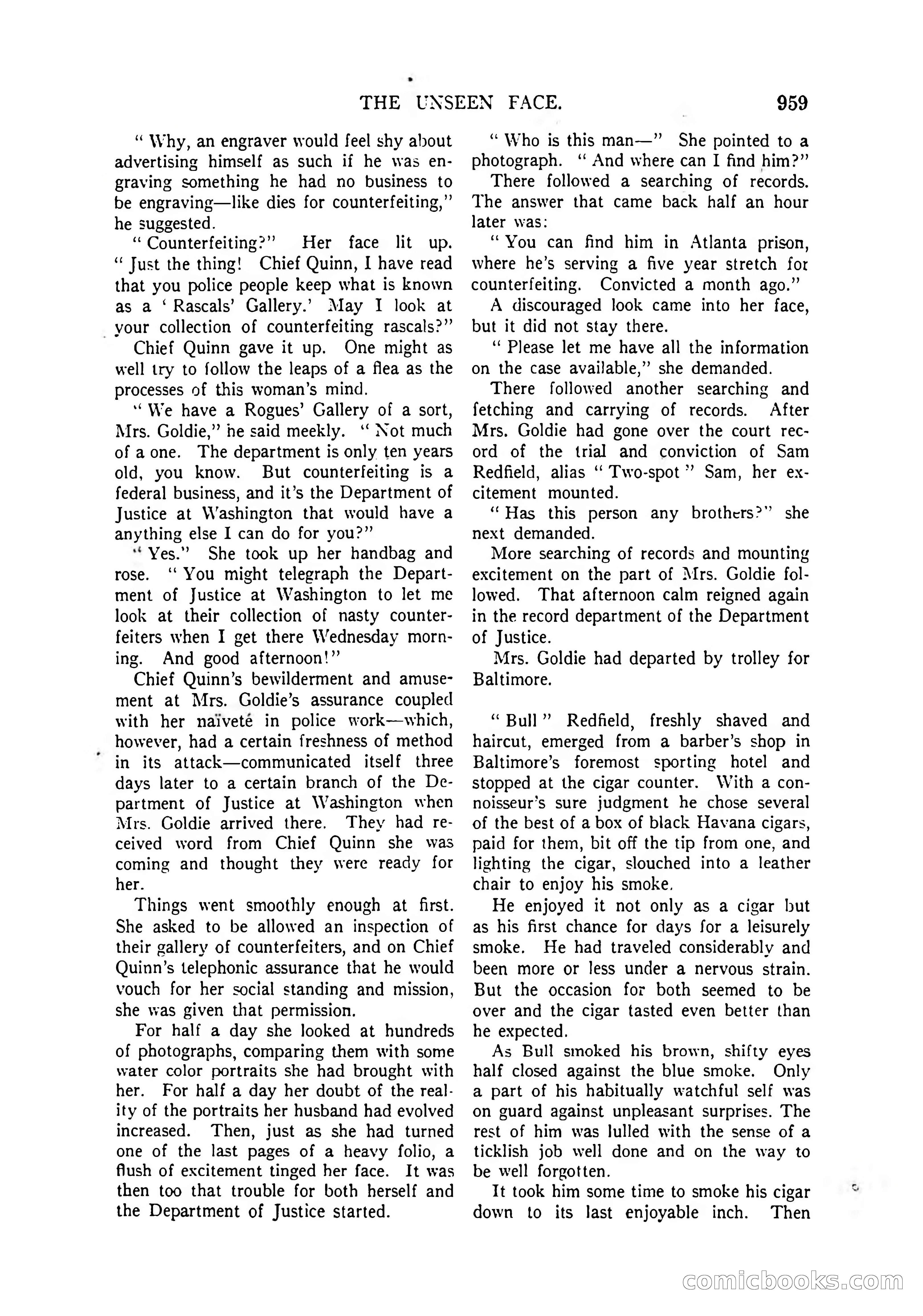
A restored page from Pulp Fiction, 1925. Page through the whole issue in the reader above.
📄 Transcribed text from this page (OCR, searchable)
Machine-transcribed from the original scan — historical spelling and the odd misread are preserved.
THE UNSEEN ‘Why, an engraver would feel shy about advertising himself as such if he was en- graving something he had no business to be engraving—like dies for counterfeiting,”’ he suggested. “Counterfeiting?” Her face lit up. “Just the thing! Chief Quinn, I have read that you police people keep what is known as a ‘ Rascals’ Gallery.’ May I look at your collection of counterfeiting rascals?” Chief Quinn gave it up. One might as well try to follow the leaps of a flea as the processes of this woman’s mind. ‘“We have a Rogues’ Gallery of a sort, Mrs. Goldie,” he said meekly. ‘‘ Not much of aone. The department Is only ten years old, you know. But counterfeiting is a federal business, and it’s the Department of Justice at Washington that would have a anything else I can do for you?” “Ves.” She took up her handbag and rose. ‘‘ You might telegraph the Depart- ment of Justice at Washington to let me look at their collection of nasty counter- feiters when I get there Wednesday morn- ing. And good afternoon!” Chief Quinn’s bewilderment and amuse- ment at Mrs. Goldie’s assurance coupled with her naivete in police work—which, however, had a certain freshness of method in its attack—communicated itself three days later to a certain branch of the De- partment of Justice at Washington when Mrs. Goldie arrived there. They had re- ceived word from Chief Quinn she was coming and thought they were ready for her. Things went smoothly enough at first. She asked to be allowed an inspection of their gallery of counterfeiters, and on Chief Quinn’s telephonic assurance that he would vouch for her social standing and mission, she was given that permission. For half a day she looked at hundreds of photographs, comparing them with some water color portraits she had brought with her. For half a day her doubt of the real- ity of the portraits her husband had evolved increased. Then, just as she had turned one of the last pages of a heavy folio, a flush of excitement tinged her face. It was then too that trouble for both herself and the Department of Justice started. FACE. 959 ‘Who is this man—” She pointed to a photograph. ‘ And where can I find him?” There followed a searching of records. The answer that came back half an hour later was: ‘You can find him in Atlanta prison, where he’s serving a five year stretch for counterfeiting. Convicted a month ago.” A discouraged look came into her face, but it did not stay there. ‘“ Please let me have all the information on the case available,” she demanded. There followed another searching and fetching and carrying of records. After Mrs. Goldie had gone over the court rec- ord of the trial and conviction of Sam Redfield, alias ‘‘ Two-spot ” Sam, her ex- citement mounted. ‘‘Has this person any brothers?” she next demanded. More searching of records and mounting excitement on the part of Mrs. Goldie fol- lowed. That afternoon calm reigned again in the record department of the Department of Justice. Mrs. Goldie had departed by trolley for Baltimore. “Bull” Redfield, freshly shaved and haircut, emerged from a barber’s shop in Baltimore’s foremost sporting hotel and Stopped at the cigar counter. With a con- noisseur’s sure judgment he chose several of the best of a box of black Havana cigars, paid for them, bit off the tip from one, and lighting the cigar, slouched into a leather chair to enjoy his smoke. He enjoyed it not only as a cigar but as his first chance for days for a leisurely smoke. He had traveled considerably and been more or less under a nervous strain. But the occasion for both seemed to be over and the cigar tasted even better than he expected. As Bull smoked his brown, shifty eyes half closed against the blue smoke. Only a part of his habitually watchful self was on guard against unpleasant surprises. The rest of him was lulled with the sense of a ticklish job well done and on the way to be well forgotten. It took him some time to smoke his cigar down to its last enjoyable inch. Then Conn lDOOlK