
Pulp Fiction, 1925 · page 20 of 184
Argosy All-Story Weekly, February 7, 1925 — page 20: what you’re looking at
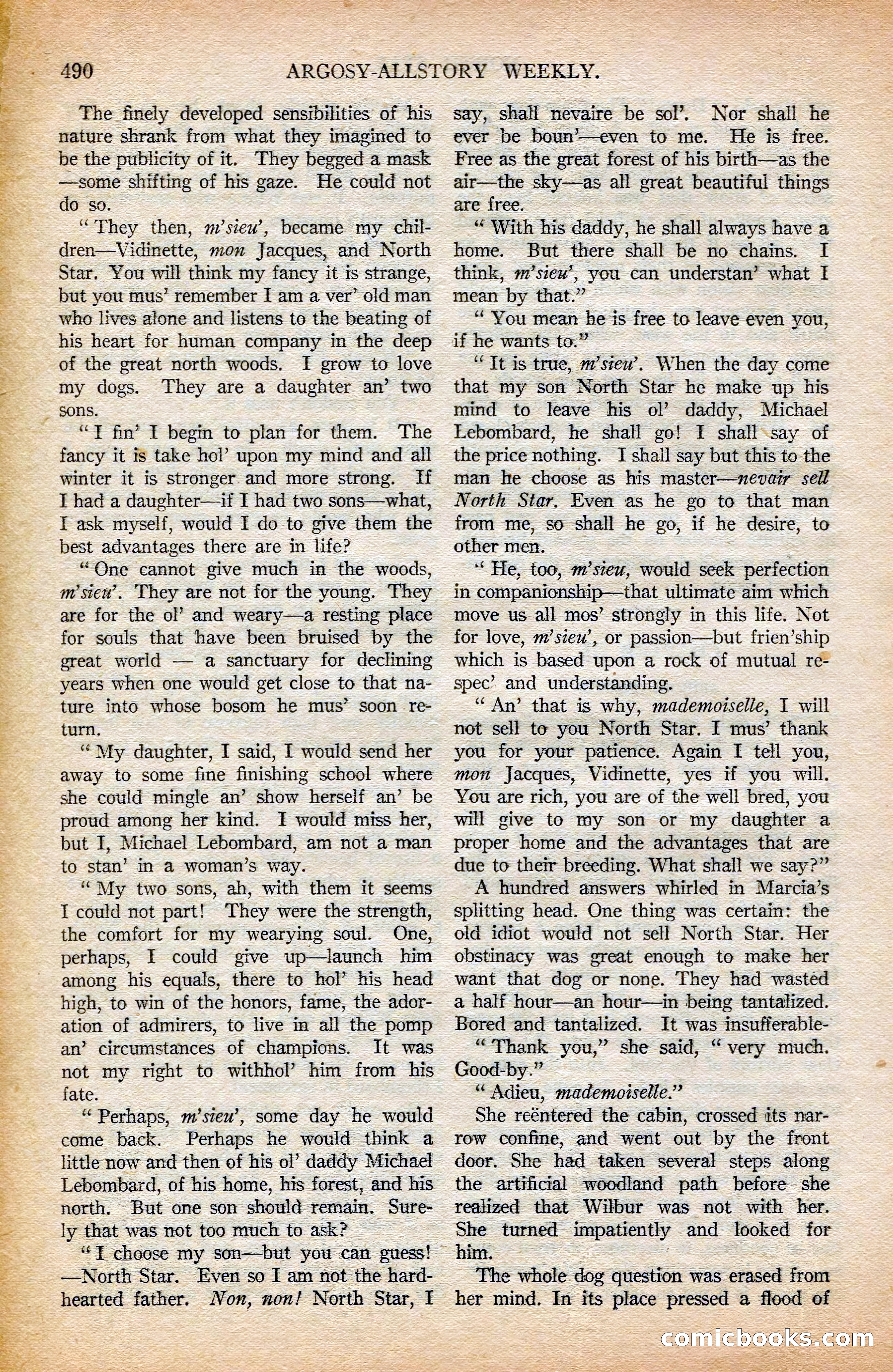
A restored page from Pulp Fiction, 1925. Page through the whole issue in the reader above.
📄 Transcribed text from this page (OCR, searchable)
Machine-transcribed from the original scan — historical spelling and the odd misread are preserved.
6 = - = = 490 : : : The finely developed sensibilities of his nature shrank from what they imagined to be the publicity of it. They begged a mask —some shifting of his gaze. He could not de -sq- 2. = “They then, m’sieu’, became my chil- dren—Vidinette, mon Jacques, and North Star. You will think my fancy it is strange, but you mus’ remember I am a ver’ old man who lives alone and listens to the beating of his heart for human company in the deep of the great north woods. I grow to love my dogs. They are a daughter an’ two sons. “YT fin’ I begin to plan for them. The fancy it is take hol’ upon my mind and all winter it is stronger. and more strong. If I had a daughter—if I had two sons—what, I ask myself, would I do to give them the best advantages there are in life? “One cannot give much in the woods, m' sien’. They are not for the young. They are for the ol’ and weary—a resting place for souls that have been bruised by the : great world — a sanctuary for declining : years when one would get close to that na- ture into whose bosom he mus’ soon re- turn. “My daughter, I said, I would send her away to some fine finishing school where she could mingle an’ show herself an’ be proud among her kind. FE would miss her, but I, Michael Lebombard, am not a man to stan’ in a woman’s way. “My two sons, ah, with them it seems I could not part! They were the strength, the comfort for my wearying soul. One, perhaps, I could give up—launch him among his equals, there to hol’ his head high, to win of the honors, fame, the ador- ation of admirers, to live in all the pomp an’ circumstances of champions. It was not my right to withhol’ him from his fate. “Perhaps, m’sieu’, some day he would come back. Perhaps he would think a little now and then of his ol’ daddy Michael Lebombard, of his home, his forest, and his north. But one son should remain. sure- ly that was not too much to ask? es . es — : = — 4 = x a Wt ee y s {4 ee | mi eke i of hth ee o : iF } —North Star. Even so I am not the Hard hearted father. NV On, non! North Star, I tit an tui at WS Ail dic ei Nog it (it “J choose my son—but you can guess! ARGOSY-ALLSTORY WEEKLY. say, shall nevaire be sol’. Nor shall he ever be boun’—even to me. He is free. Free as the great forest of his birth—as the air—the sky—as all great beautiful things are free. “With his daddy, he shall always have 2 home. But there shall be no chains. I think, ’siew’, you can understan’ what I mean by that.” “ You mean he is free to leave even you, if he wants to.” “Tt is true, m’siew’. When the day come that my son North Star he make up his mind to leave his ol’ daddy, Michael Lebombard, he shall go! I shall <say of the price nothing. J shall say but this to the man he choose as his master—nevair sell North Star, Even as he go to that man from me, so shall he go, if he desire, to other men. “He, too, m’steu, would seek perfection in companionship —that ultimate aim which move us all mos’ strongly in this life. Not for love, m’sieu’, or passion—but frien’ship which is based upon a rock of mutual re- spec’? and understanding. ‘An’ that is why, mademoziselle, 1 will not sell to you North Star. I mus’ thank you for your patience. Again [ tell you, mon Jacques, Vidinette, yes if you will. You are rich, you are of the well bred, you will give to my son or my daughter a proper home and the advantages that are due to their breeding. What shall we say?” A hundred answers whirled in Marcia’s splitting head. One thing was certain: the old idiot would not sell North Star. Her obstinacy was great enough to make her want that dog or none. They had wasted a half hour—an hour—in being tantalized. Bored and tantalized. It was msufferable- “Thank you,” she said, “very much. Good-by.” — “ Adieu, mademoiselle.” She reéntered the cabin, crossed its nar- row confine, and went out by the front door. She had taken several steps along the artificial woodland path before she realized that Wilbur was not with her. She turned impatiently and looked for him. The hele dog question was s erased from her mind. In its place pressed a flood of