
Pulp Fiction, 1925 · page 13 of 184
Argosy All-Story Weekly, February 7, 1925 — page 13: what you’re looking at
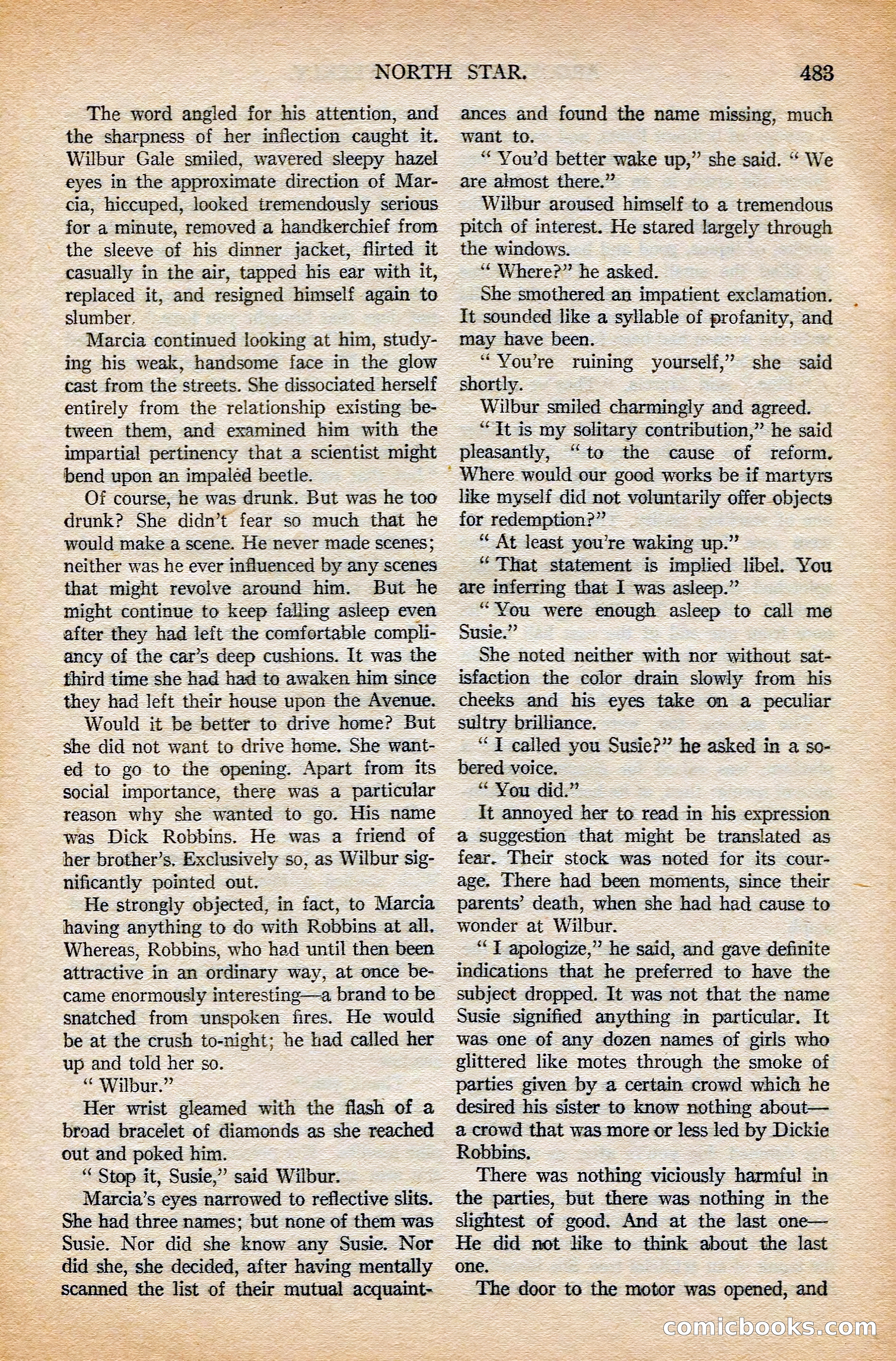
A restored page from Pulp Fiction, 1925. Page through the whole issue in the reader above.
📄 Transcribed text from this page (OCR, searchable)
Machine-transcribed from the original scan — historical spelling and the odd misread are preserved.
NORTH STAR. The — angled for his attention, and the sharpness of her inflection caught it. Wilbur Gale smiled, wavered sleepy hazel eyes in the approximate direction of Mar- cia, hiccuped, looked tremendously serious for a minute, removed a handkerchief from - the sleeve of his dinner jacket, flirted it casually in the air, tapped his ear with it, replaced it, and resigned himself again to slumber. Marcia continued looking at him, study- ing his weak, handsome face in the glow cast from the streets. She dissociated herself entirely from the relationship existing be- tween them, and examined him with the impartial pertinency that a scientist might bend upon an impaled beetle. Of course, he was drunk. But was he too drunk? She didn’t fear so much that he would make a scene. He never made scenes; neither was he ever influenced by any scenes that might revolve around him. might continue to keep falling asleep even after they had left the comfertable compli- ancy of the car’s deep cushions. Tt 5 was the third time she had had te awaken him since they had left their house upon the fe Would it be better to drive home? But _ She did not want to drive home. She want- ed to go to the opening. Apart from its social importance, there was a particular reason why she wanted to go. His name was Dick Robbins. He was a friend of her brother’s. Exclusively so, as Wilbur sig- nificantly pointed out. He strongly objected, in fact, to Marcia having anything to do with Robbins at all. Whereas, Robbins, who had until then been attractive in an ordinary way, at once be- came enormously interesting—a brand to be snatched from unspoken fires. He would be at the crush to-night; he had called her up and told her so. “ Wilbur.” Her wrist gleamed with the flash of a broad bracelet of diamonds as she reached out and poked him. | ‘Stop it, Susie,” said Wilbur. Marcia’s eyes narrowed to reflective slits. She had three names: but none of them was Susie. Nor did she “kn ew any Susie. Nor But he ‘ He did not like to thi 2 did she, she decided, after having mentally _ = scanned the list of their mutual acquaint-_ ances and found the name missing, much Want fo. _“ Vou’d better wake up,” she said. “ We = are almost there.” Wilbur aroused himself to a —— pitch of interest. He stared largely through the windows. “ Where?” he acied. She smothered an impatient exclamation. It sounded like a syllable of profanity, and may have been. “You're ruining yourself,” she said shortly. Wilbur smiled charmingly and agreed. “It is my solitary contribution,” he said pleasantly, “to the cause of reform. - Where would our goed works be if martyrs like myself did not ——— olfer_objects for redemption?” = “ At least you're waking up. ts “ That statement is implied libel. You are inferring that I was asleep.” “You were— enough asleep to = me Susie.” She noted neither with nor without sat- isfaction the color drain slowly =a his _ cheeks and ‘Ais. J take on a peculiar ‘sultry brillia ES = called you x Susie?” he eked i in a so- bends voice. it: annoyed 1 her to read in his expression @ suggestion that might be translated as fear. Their stock was noted for its cour- age. There had been moments, since their parents’ death, when she had had cause to wonder at Wilbur. “I apologize,” he said, and gave definite indications that he preferred to have the subject dropped. It was not that the name Susie signified anything in particular. It was one of any dozen names of girls who glittered like motes through the smoke of parties given by a certain crowd which he desired his sister to know nothing about— a. crowd that was more or less led by Dickie Robbins, There was nothing viciously harmful in the parties, but there was nothing in the slightest of good. And at the last one— ak about. the sas one. The door to the motor was ake Ecomicbooks-co