
Pulp Fiction, 1924 · page 87 of 166
Argosy All-Story Weekly — page 87: what you’re looking at
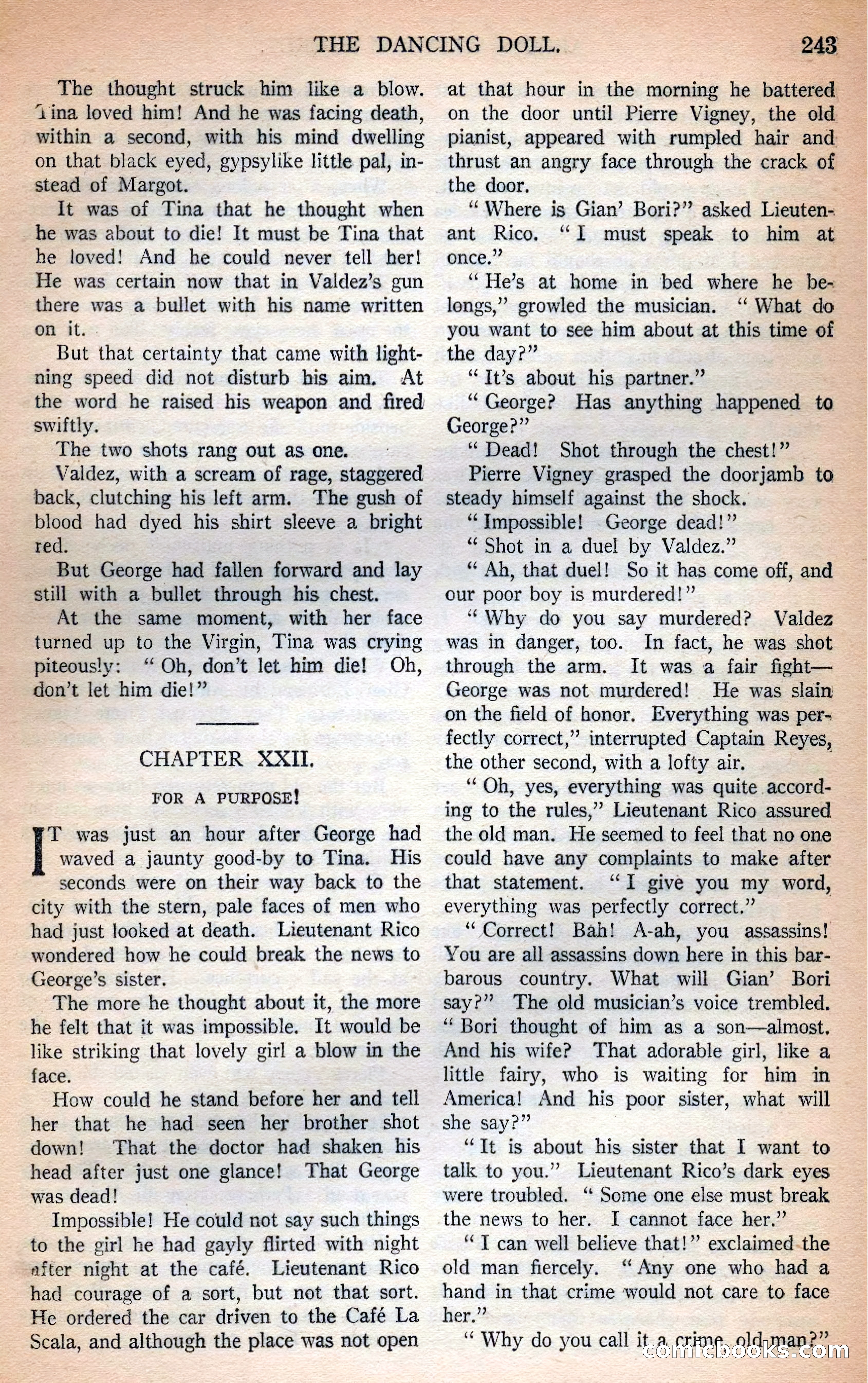
A restored page from Pulp Fiction, 1924. Page through the whole issue in the reader above.
📄 Transcribed text from this page (OCR, searchable)
Machine-transcribed from the original scan — historical spelling and the odd misread are preserved.
THE DANCING DOLL, peel ys 8) "Os si Lie re Ni 1 Le Cae ¥} ‘ ta alr aT ai The thought struck him like a blow. ‘ina loved him! And he was facing death, within a second, with his mind dwelling on that black eyed, gypsylike little pal, in- stead of Margot. It was of Tina that he thought when he was about to die! It must be Tina that he loved! And he could never tell her! He was certain now that in Valdez’s gun there was a bullet with his name written on it. . But that certainty that came with light- ning speed did not disturb his aim. At the word he raised his weapon and fired swiftly. The two shots rang out as one. Valdez, with a scream of rage, staggered back, clutching his left arm. The gush of blood had dyed his shirt sleeve a bright red. But George had fallen forward and lay still with a bullet through his chest. At the same moment, with her face turned up to the Virgin, Tina was crying piteous!y: “‘ Oh, don’t let him die! Oh, don’t let him die!” CHAPTER XXII, FOR A PURPOSE! T was just an hour after George had waved a jaunty good-by to Tina. His seconds were on their way back to the city with the stern, pale faces of men who had just looked at death. Lieutenant Rico wondered how he could break the news to George’s sister. The more he thought about it, the more he felt that it was impossible. It would be like striking that lovely girl a blow in the face. How could he stand before her and tell her that he had seen her brother shot down! That the doctor had shaken his head after just one glance! That George was dead! Impossible! He could not say such things to the girl he had gayly flirted with night after night at the café. Lieutenant Rico had courage of a sort, but not that sort. He ordered the car driven to the Café La Scala, and although the place was not open Sot -~ at that hour in the morning he battered on the door until Pierre Vigney, the old pianist, appeared with rumpled hair and thrust an angry face through the crack of the door, : | “Where is Gian’ Bori?” asked Lieuten- ant Rico. “I must speak to him at once.” “He’s at home in bed where he be- longs,” growled the musician. ‘‘ What do you want to see him about at this time of the day?” “It’s about his partner.” “George? Has anything happened to George?” ‘Dead! Shot through the chest!” Pierre Vigney grasped the doorjamb to steady himself against the shock. “Impossible! George dead!” “Shot in a duel by Valdez.” “ Ah, that duel! So it has come off, and our poor boy is murdered!” ‘“Why do you say murdered? Valdez was in danger, too. In fact, he was shot through the arm. It was a fair fight— George was not murdered! He was slain on the field of honor. Everything was per- fectly correct,” interrupted Captain Reyes, the other second, with a lofty air. | ‘Oh, yes, everything was quite accord- ing to the rules,” Lieutenant Rico assured the old man. He seemed to feel that no one could have any complaints to make after that statement. “I give you my word, everything was perfectly correct.” “Correct! Bah! A-ah, you assassins! You are all assassins down here in this bar- barous country. What will Gian’ Bori say?” The old musician’s voice trembled. ‘“ Bori thought of him as a son—almost. And his wife? That adorable girl, like a little fairy, who is waiting for him in America! And his poor sister, what will she say?” “Tt is about his sister that I want to talk to you.” Lieutenant Rico’s dark eyes were troubled. ‘t Some one else must break the news to her. I cannot face her.” ‘“‘T can well believe that!” exclaimed-the old man fiercely. “Any one who had a hand in that crime would not care to face her.” “ Why do you call it.a, crime, old man? Pe ee