
Pulp Fiction, 1924 · page 74 of 166
Argosy All-Story Weekly — page 74: what you’re looking at
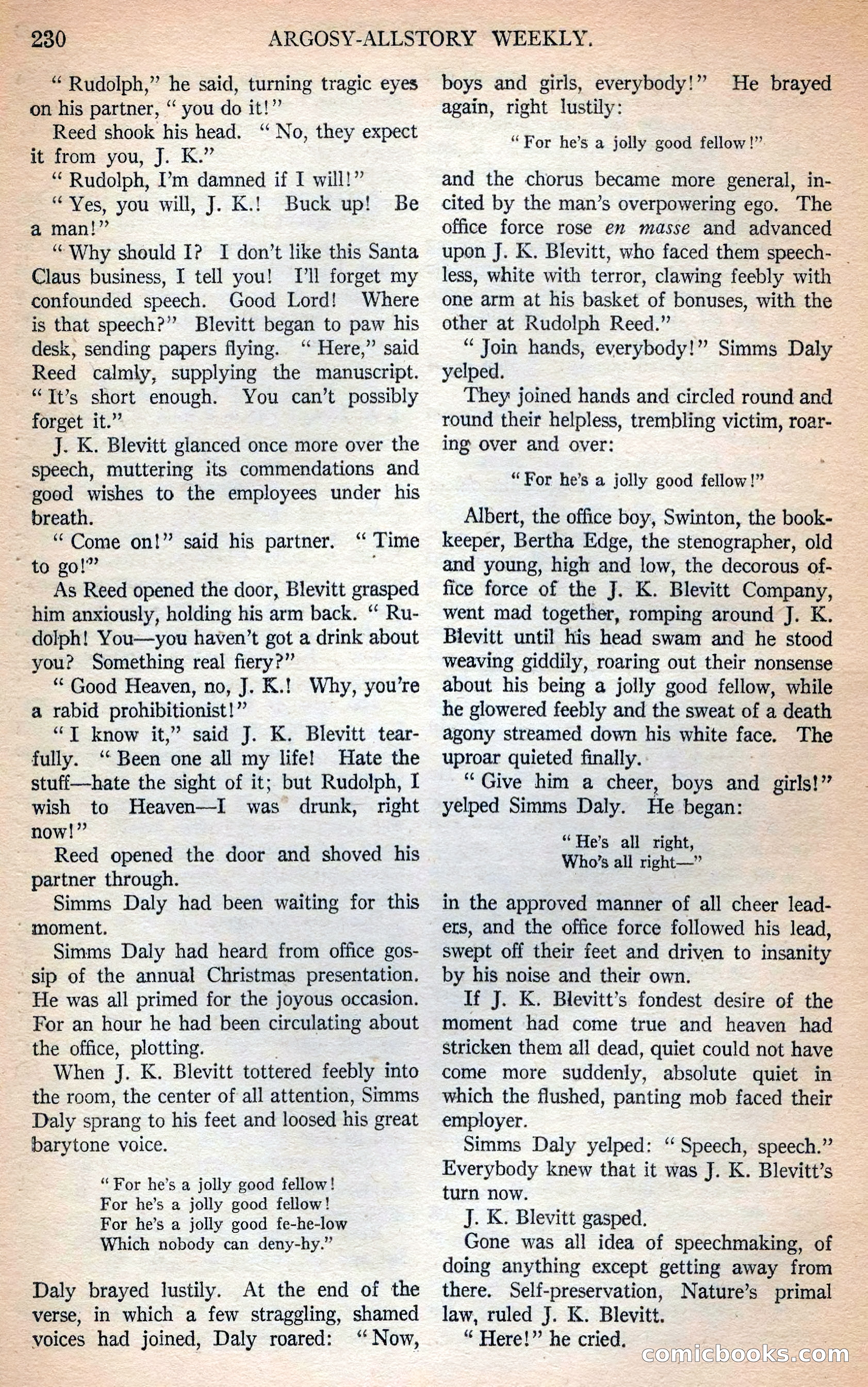
A restored page from Pulp Fiction, 1924. Page through the whole issue in the reader above.
📄 Transcribed text from this page (OCR, searchable)
Machine-transcribed from the original scan — historical spelling and the odd misread are preserved.
230 “ Rudolph,” he said, turning tragic eyes on his partner, “ you do it!” Reed shook his head. “No, they expect it from you, J. K.” “Rudolph, ?m damned if I will!” “Yes, you will, J. K.!| Buck up! a man!” “Why should I? I don’t like this Santa Claus business, I tell you! Ill forget my confounded speech. Good Lord! Where is that speech?” Blevitt began to paw his desk, sending papers flying. “ Here,” said Reed calmly, supplying the manuscript. “It’s short enough. You can’t possibly forget it.” J. K. Blevitt glanced once more over the speech, muttering its commendations and ~ good wishes to the employees under his breath. “Come on!” said his partner. ~ to go!” As Reed opened the door, Blevitt grasped him anxiously, holding his arm back. “ Ru- dolph! You—you haven’t got a drink about you? Something real fiery?” “Good Heaven, no, J. K.! Why, you’re a rabid prohibitionist!” “T know it,” said J. K. Blevitt tear- fully. ‘‘ Been one all my life! Hate the stuff—hate the sight of it; but Rudolph, I wish to Heaven—I was drunk, right now!” Reed opened the door and shoved his partner through. Simms Daly had been waiting for this ' moment. Simms Daly had heard from office gos- sip of the annual Christmas presentation. ~ He was all primed for the joyous occasion. For an hour he had been circulating about the office, plotting. When I. K. Blevitt tottered feebly into the room, the center of all attention, Simms Daly sprang to his feet and loosed his great barytone voice. Be “ Time “For he’s a jolly good fellow! For he’s a jolly good fellow! For he’s a jolly good fe-he-low Which nobody can deny-hy.” Daly brayed lustily. At the end of the verse, in which a few straggling, shamed voices had joined, Daly roared: ‘ Now, ARGOSY-ALLSTORY WEEKLY. boys and girls, everybody!” again, right lustily: He brayed “For he’s a jolly good fellow!” and the chorus became more general, in- cited by the man’s overpowering ego. The office force rose en masse and advanced upon J. K. Blevitt, who faced them speech- | less, white with terror, clawing feebly with one arm at his basket of bonuses, with the other at Rudolph Reed.” “ Join hands, everybody!” Simms Daly — yelped. They joined hands and circled round and round their helpless, trembling victim, roar- ing over and over: “For he’s a jolly good fellow!” Albert, the office boy, Swinton, the book- keeper, Bertha Edge, the stenographer, old and young, high and low, the decorous of- fice force of the J. K. Blevitt Company, went mad together, romping around J. K. Bievitt until his head swam and he stood weaving giddily, roaring out their nonsense about his being a jolly good fellow, while he glowered feebly and the sweat of a death agony streamed down his white face. The uproar quieted finally. “Give him a cheer, boys and girls!” yelped Simms Daly. He began: “ He’s all right, Who’s all right—” in the approved manner of all cheer lead- ers, and the office force followed his lead, swept off their feet and driven to insanity by his noise and their own. If J. K. Blevitt’s fondest desire of the moment had come true and heaven had stricken them all dead, quiet could not have come more suddenly, absolute quiet in which the flushed, panting mob faced their employer. Simms Daly yelped: ‘“ Speech, speech.” Everybody knew that it was J. K. Pieeses turn now. J. K. Blevitt gasped. Gone was all idea of speechmaking, of doing anything except getting away from there. Self-preservation, Nature’s primal law, ruled J. K. Blevitt. “ Here!” he cried. Ean OmMmicbooksscom