
Pulp Fiction, 1924 · page 16 of 166
Argosy All-Story Weekly — page 16: what you’re looking at
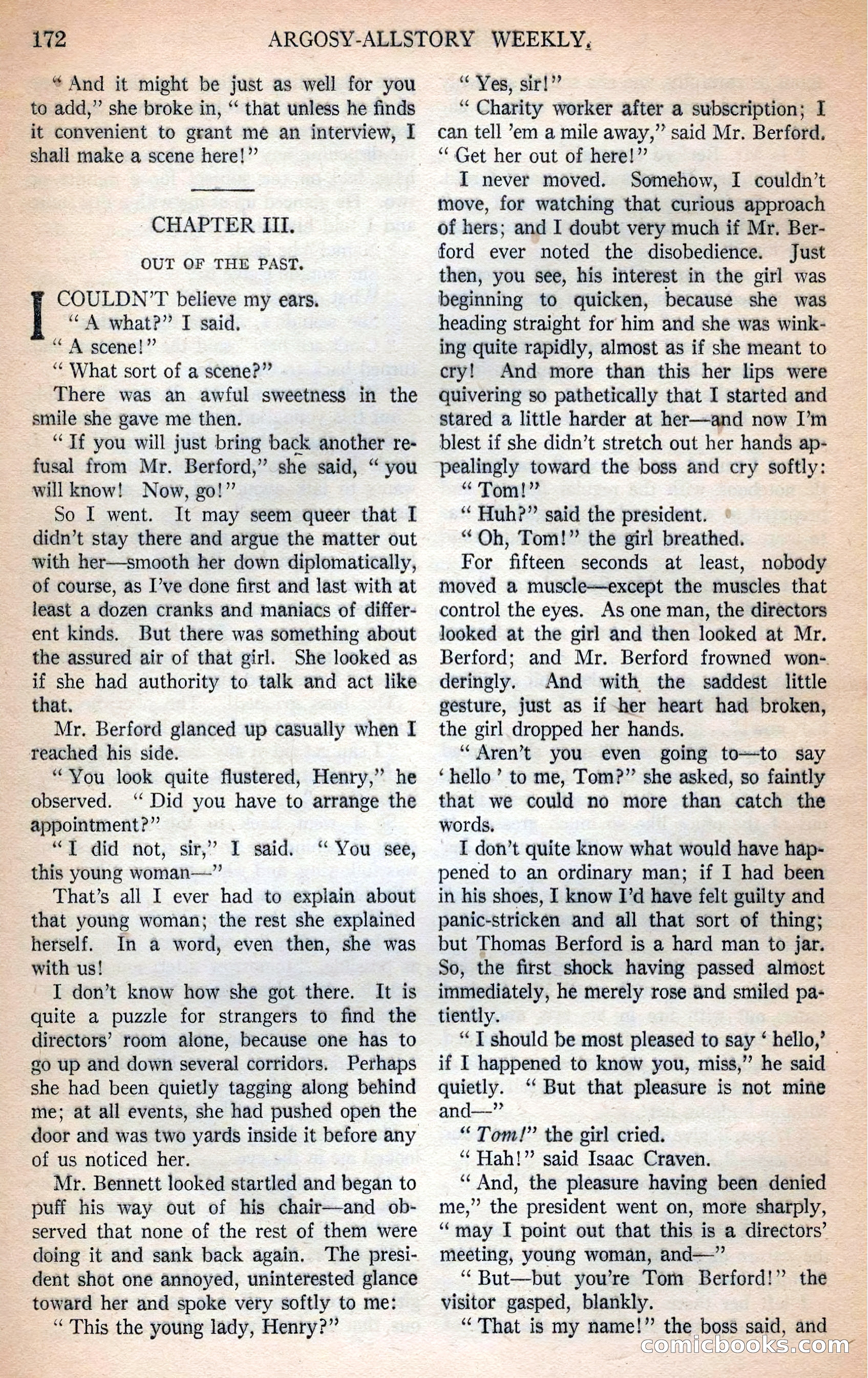
A restored page from Pulp Fiction, 1924. Page through the whole issue in the reader above.
📄 Transcribed text from this page (OCR, searchable)
Machine-transcribed from the original scan — historical spelling and the odd misread are preserved.
172 “ And it might be just as well for you _ to add,” she broke in, “ that unless he finds it convenient to grant me an interview, I shall make a scene here!” CHAPTER III. OUT OF THE PAST. COULDN’T believe my ears. “A what?” I said. “A scene!” ‘“‘ What sort of a scene?” There was an awful sweetness in the smile she gave me then. “Tf you will just bring back another re- fusal from Mr. Berford,” she said, “ you will know! Now, go!” So I went. It may seem queer that I didn’t stay there and argue the matter out with her—smooth her down diplomatically, of course, as I’ve done first and last with at least a dozen cranks and maniacs of differ- ent kinds. But there was something about the assured air of that girl. She looked as if she had authority to talk and act like that. Mr. Berford glanced up casually when I reached his side. “Vou look quite flustered, Henry,” he observed. ‘‘ Did you have to arrange the appointment?” “I did not, sir,’ I said. this young woman—”’ That’s all I ever had to explain about that young woman; the rest she explained herself. In a word, even then, she was with us! I don’t know how she got there. It is quite a puzzle for strangers to find the directors’ room alone, because one has to go up and down several corridors. Perhaps she had been quietly tagging along behind me; at all events, she had pushed open the “You see, door and was two yards inside it before any of us noticed her. Mr. Bennett looked startled and began to puff his way out of his chair—and ob- served that none of the rest of them were doing it and sank back again. The presi- dent shot one annoyed, uninterested glance toward her and spoke very softly to me: “This the young lady, Henry?” ARGOSY-ALLSTORY WEEKLY, “Yes, sir!” “Charity worker after a subscription; I can tell ’em a mile away,” said Mr. Berford. ““ Get her out of here!” I never moved. Somehow, I couldn’t move, for watching that curious approach of hers; and I doubt very much if Mr. Ber- ford ever noted the disobedience. Just then, you see, his interest in the girl was beginning to quicken, because she was heading straight for him and she was wink- ing quite rapidly, almost as if she meant to cry! And more than this her lips were quivering so pathetically that I started and stared a little harder at her—and now I’m blest if she didn’t stretch out her hands ap- pealingly toward the boss and cry softly: ¢¢ Tom! >) ‘“ Huh?” said the president. “Oh, Tom!” the girl breathed. For fifteen seconds at least, nobody moved a muscle—except the muscles that control the eyes. As one man, the directors looked at the girl and then looked at Mr. Berford; and Mr. Berford frowned won- deringly. And with the saddest little gesture, just aS if her heart had broken, the girl dropped her hands. ‘“Aren’t you even going toto say ‘hello’ to me, Tom?” she asked, so faintly that we could no more than catch the words. I don’t quite know what would have hap- pened to an ordinary man; if I had been in his shoes, I know I’d have felt guilty and panic-stricken and all that sort of thing; but Thomas Berford is a hard man to jar. So, the first shock having passed almost immediately, he merely rose and smiled pa- tiently. “T should be most pleased to say ‘ hello,’ if I happened to know you, miss,” he said quietly. ‘“ But that pleasure is not mine and—’”’ | “ Tom!” the girl cried. ‘“‘ Hah!” said Isaac Craven. ‘“‘ And, the pleasure having been denied me,” the president went on, more sharply, “may I point out that this is a directors’ meeting, young woman, and—” ‘“But—but you’re Tom Berford!” the visitor gasped, blankly. “That is my name!” the boss said, and CONNIE IOOKKSs(E@)