
Pulp Fiction, 1924 · page 142 of 166
Argosy All-Story Weekly — page 142: what you’re looking at
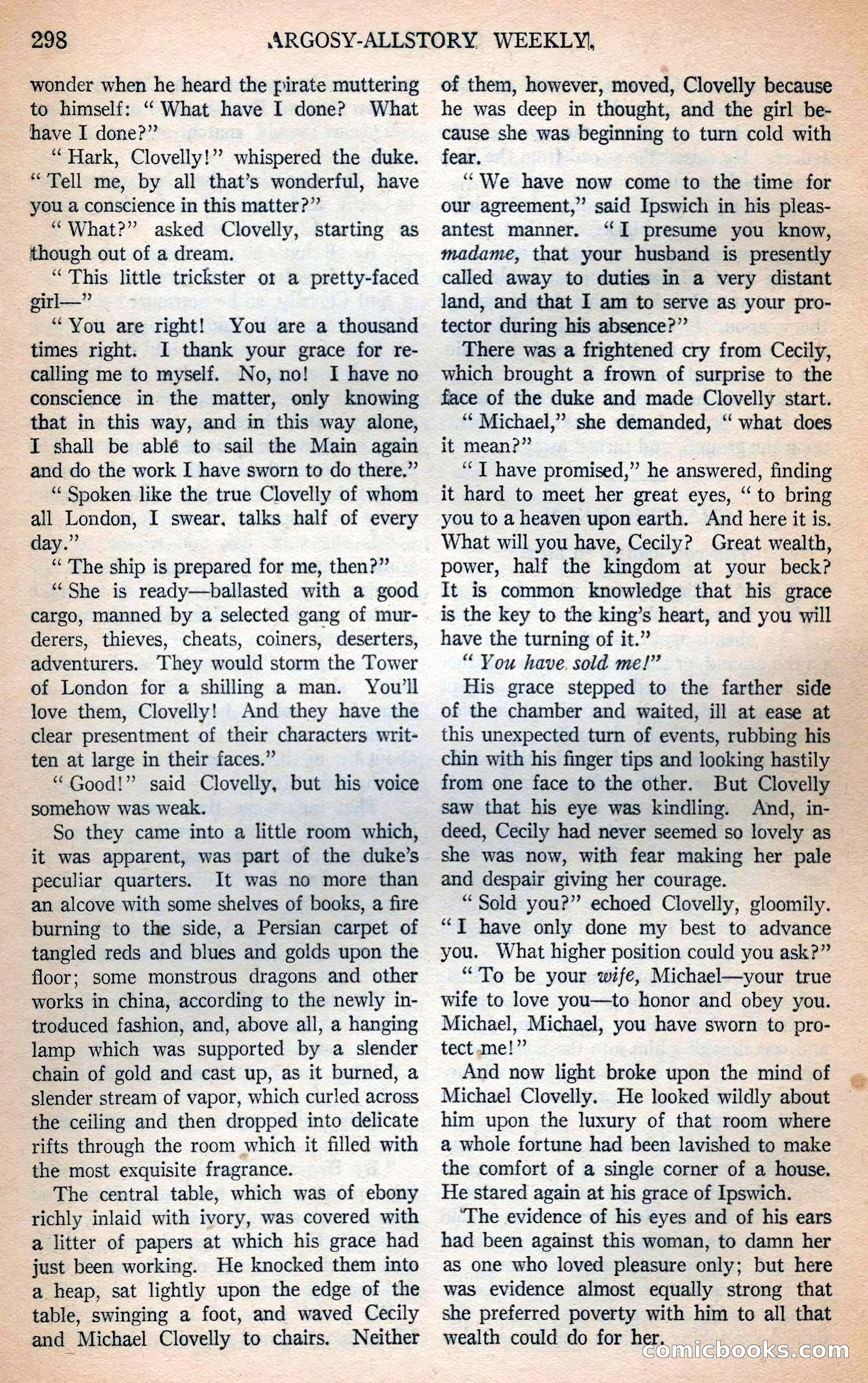
A restored page from Pulp Fiction, 1924. Page through the whole issue in the reader above.
📄 Transcribed text from this page (OCR, searchable)
Machine-transcribed from the original scan — historical spelling and the odd misread are preserved.
998 wonder when he heard the pirate muttering to himself: “What have I done? What have I done?” “Hark, Clovelly!” whispered the duke. “Tell me, by all that’s wonderful, have you a conscience in this matter?” “What?” asked Clovelly, starting as though out of a dream. “This little trickster ot a pretty-faced girl—”’ “You are right! You are a thousand times right. I thank your grace for re- calling me to myself. No, no! I have no conscience in the matter, only knowing that in this way, and in this way alone, I shall be ablé to sail the Main again and do the work I have sworn to do there.” “Spoken like the true Clovelly of whom all London, I swear, talks half of every day.” “The ship is prepared for me, then?” “She is ready—ballasted with a good cargo, manned by a selected gang of mur- derers, thieves, cheats, coiners, deserters, adventurers. They would storm the Tower of London for a shilling a man. You'll love them, Clovelly! And they have the clear presentment of their characters writ- ten at large in their faces.” “Good!” said Clovelly, but his voice somehow was weak. So they came into a little room which, it was apparent, was part of the duke’s peculiar quarters. It was no more than an alcove with some shelves of books, a fire burning to the side, a Persian carpet of tangled reds and blues and golds upon the floor; some monstrous dragons and other works in china, according to the newly in- troduced fashion, and, above all, a hanging lamp which was supported by a slender chain of gold and cast up, as it burned, a slender stream of vapor, which curled across the ceiling and then dropped into delicate rifts through the room which it filled with the most exquisite fragrance. The central table, which was of ebony richly inlaid with ivory, was covered with a litter of papers at which his grace had just been working. He knocked them into a heap, sat lightly upon the edge of the table, swinging a foot, and waved Cecily and Michael Clovelly to chairs. Neither ARGOSY-ALLSTORY. WEEKLY, of them, however, moved, Clovelly because he was deep in thought, and the girl be- cause she was beginning to turn cold with fear. “We have now come to the time for our agreement,” said Ipswich in his pleas- antest manner. “I presume you know, madame, that your husband is presently called away to duties in a very distant land, and that I am to serve as your pro- tector during his absence?” There was a frightened cry from Cecily, which brought a frown of surprise to the face of the duke and made Clovelly start. “* Michael,” she demanded, “‘ what does it mean?” ‘T have promised,” he answered, finding it hard to meet her great eyes, “ to bring you to a heaven upon earth. And here it is, What will you have, Cecily? Great wealth, power, half the kingdom at your beck? It is common knowledge that his grace is the key to the king’s heart, and you will have the turning of it.” “ You have. sold me!” His grace stepped to the farther side of the chamber and waited, ill at ease at this unexpected turn of events, rubbing his chin with his finger tips and looking hastily from one face to the other. But Clovelly saw that his eye was kindling. And, in- deed, Cecily had never seemed so lovely as she was now, with fear making her pale and despair giving her courage. “Sold you?” echoed Clovelly, gloomily. “TY have only done my best to advance you. What higher position could you ask?” “To be your wife, Michael—your true wife to love you—to honor and obey you. Michael, Michael, you have sworn to pro- tect me!” And now light broke upon the mind of Michael Clovelly. He looked wildly about him upon the luxury of that room where a whole fortune had been lavished to make the comfort of a single corner of a house, He stared again at his grace of Ipswich. ‘The evidence of his eyes and of his ears had been against this woman, to damn her as one who loved pleasure only; but here was evidence almost equally strong that she preferred poverty with him to all that wealth could do for 2 eo (Ss=-com