
Pulp Fiction, 1924 · page 105 of 166
Argosy All-Story Weekly — page 105: what you’re looking at
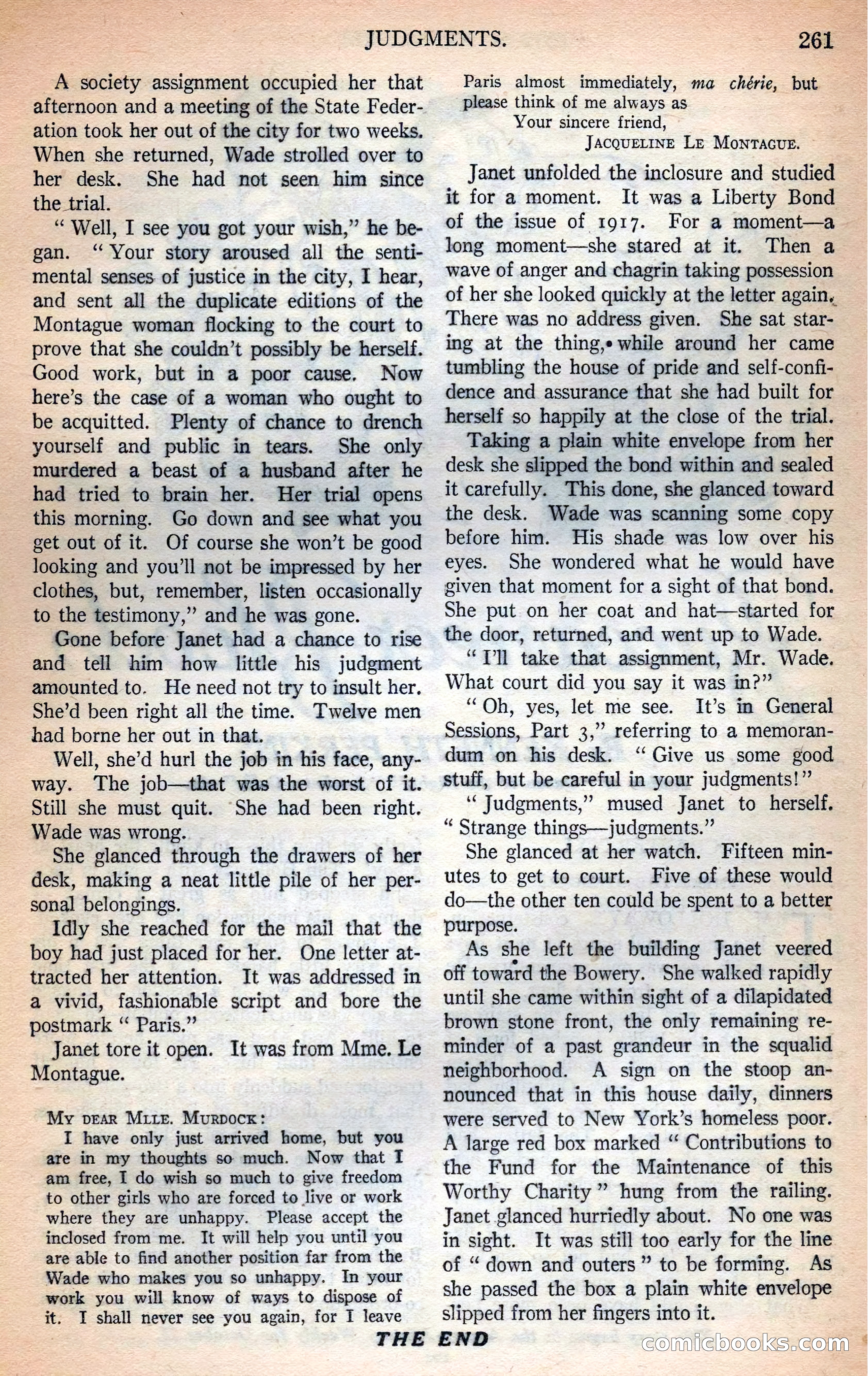
A restored page from Pulp Fiction, 1924. Page through the whole issue in the reader above.
📄 Transcribed text from this page (OCR, searchable)
Machine-transcribed from the original scan — historical spelling and the odd misread are preserved.
JUDGMENTS. A society assignment occupied her that afternoon and a meeting of the State Feder- ation took her out of the city for two weeks. When she returned, Wade strolled over to her desk. She had not seen him since the trial. “Well, I see you got your wish,” he be- gan. “ Your story aroused all the senti- mental senses of justice in the city, I hear, and sent all the duplicate editions of the Montague woman flocking to the court to prove that she couldn’t possibly be herself. Good work, but in a poor cause, Now here’s the case of a woman who ought to be acquitted. Plenty of chance to drench yourself and public in tears. She only murdered a beast of a husband after he had tried to brain her. Her trial opens this morning. Go down and see what you get out of it. Of course she won’t be good looking and you’ll not be impressed by her clothes, but, remember, listen occasionally to the testimony,” and he was gone. Gone before Janet had a chance to rise and tell him how little his judgment amounted to. He need not try to insult her. She’d been right all the time. Twelve men had borne her out in that. Well, she’d hurl the job in his face, any- way. The job—that was the worst of it. Still she must quit. “She had been right. Wade was wrong. She glanced through the drawers of her desk, making a neat little pile of her per- sonal belongings. Idly she reached for the mail that the boy had just placed for her. One letter at- tracted her attention. It was addressed in a vivid, fashionable script and bore the postmark “ Paris.” Janet tore it open. It was from Mme. Le Montague. My pvrear Mire. Murpocr: I have only just arrived home, but you are in my thoughts so much. Now that I am free, I do wish so much to give freedom to other girls who are forced to live or work where they are unhappy. Please accept the inclosed from me. It will help you until you are able to find another position far from the Wade who makes you so unhappy. In your work you will know of ways to dispose of it. I shall never see you again, for I leave THE END 261 Paris almost immediately, ma chérie, but please think of me always as Your sincere friend, JACQUELINE LE MoNTAGUE. ~ Janet unfolded the inclosure and studied it for a moment. It was a Liberty Bond of the issue of 1917. For a moment—a long moment—she stared at it. Then a wave of anger and chagrin taking possession of her she looked quickly at the letter again, There was no address given. She sat star- ing at the thing,e while around her came tumbling the house of pride and self-confi- dence and assurance that she had built for herself so happily at the close of the trial. Taking a plain white envelope from her desk she slipped the bond within and sealed it carefully. This done, she glanced toward the desk. Wade was scanning some copy before him. His shade was low over his eyes. She wondered what he would have given that moment for a sight of that bond. She put on her coat and hat—started for the door, returned, and went up to Wade. “Tl take that assignment, Mr. Wade. What court did you say it was m?” ‘““Oh, yes, let me see. It’s in General Sessions, Part 3,” referring to a memoran- dum on his desk. ‘‘ Give us some good stuff, but be careful in your judgments!” ‘‘ Judgments,” mused Janet to herself. “ Strange things—judgments.” She glanced at her watch. Fifteen min- utes to get to court. Five of these would do—the other ten could be spent to a better purpose. As she left the building Janet veered off toward the Bowery. She walked rapidly until she came within sight of a dilapidated brown stone front, the only remaining re- minder of a past grandeur in the squalid neighborhood. A sign on the stoop an- nounced that in this house daily, dinners were served to New York’s homeless poor. A large red box marked “ Contributions to the Fund for the Maintenance of this Worthy Charity ” hung from the railing. Janet glanced hurriedly about. No one was in sight. It was still too early for the line of “ down and outers” to be forming. As she passed the box a plain white envelope slipped from her fingers into it. Gomichooks.;com