
Pulp Fiction, 1924 · page 89 of 180
Argosy All-Story Weekly — page 89: what you’re looking at
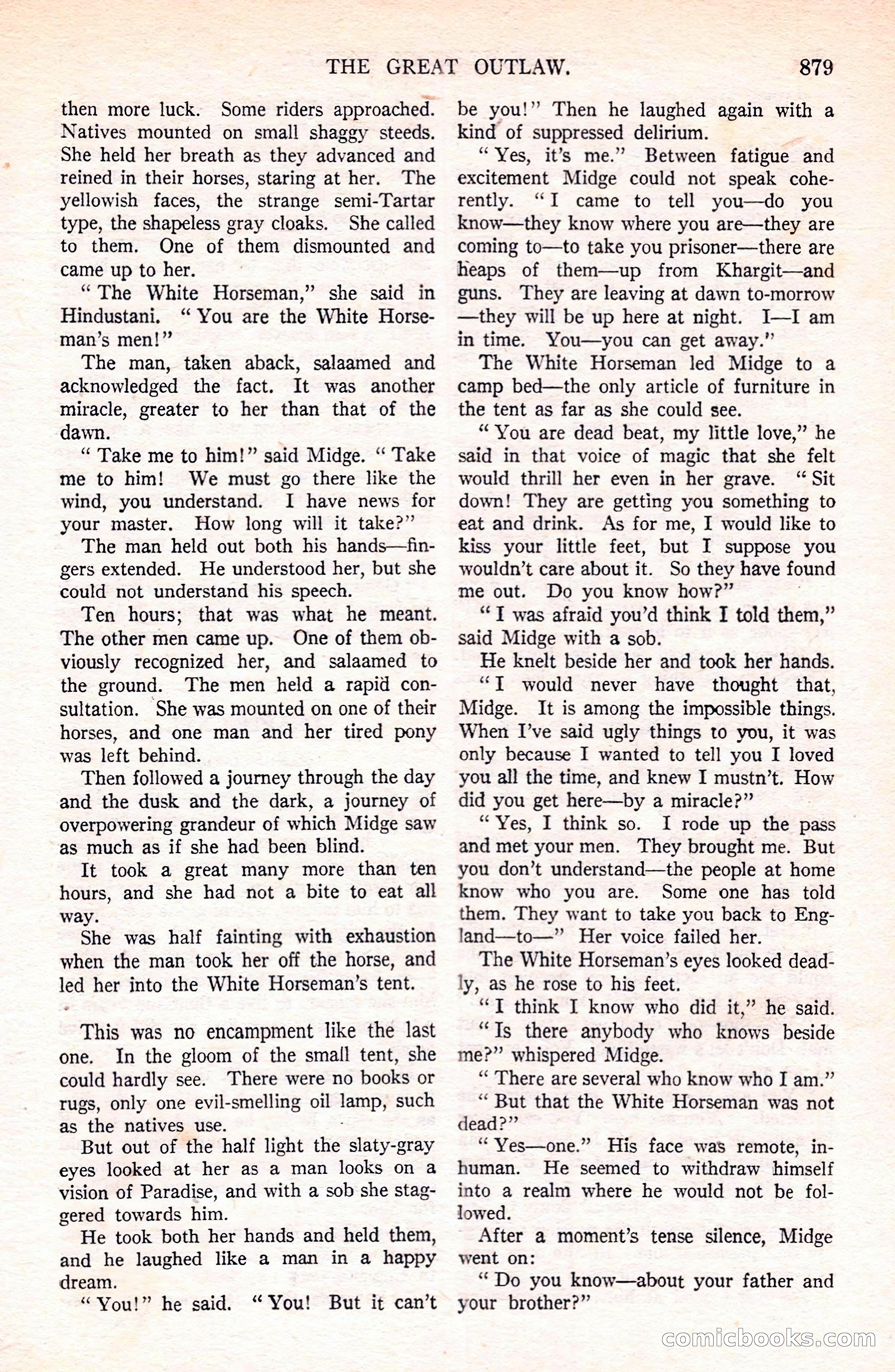
A restored page from Pulp Fiction, 1924. Page through the whole issue in the reader above.
📄 Transcribed text from this page (OCR, searchable)
Machine-transcribed from the original scan — historical spelling and the odd misread are preserved.
THE GREAT OUTLAW. then more luck. Some riders approached. Natives mounted on small shaggy steeds. She held her breath as they advanced and reined in their horses, staring at her. The yellowish faces, the strange semi-Tartar type, the shapeless gray cloaks. She called to them. One of them dismounted and came up to her. “The White Horseman,” she said in Hindustani. “ You are the White Horse- man’s men!” The man, taken aback, salaamed and acknowledged the fact. It was another miracle, greater to her than that of the dawn. “Take me to him!” said Midge. “ Take me to him! We must go there like the wind, you understand. I have news for your master. How long will it take?” The man held out both his hands—fin- gers extended. He understood her, but she could not understand his speech. Ten hours; that was what he meant. The other men came up. One of them ob- viously recognized her, and salaamed to the ground. The men held a rapid con- sultation. She was mounted on one of their horses, and one man and her tired pony was left behind. Then followed a journey through the day and the dusk and the dark, a journey of overpowering grandeur of which Midge saw as much as if she had been blind. It took a great many more than ten hours, and she had not a bite to eat all way. She was half fainting with exhaustion when the man took her off the horse, and led her into the White Horseman’s tent. This was no encampment like the last one. In the gloom of the small tent, she could hardly see. There were no books or rugs, only one evil-smelling oil ty. such as the natives use. But out of the half light the slaty-gray eyes looked at her as a man looks on a vision of Paradise, and with a sob she stag- gered towards him. He took both her hands and held them, and he laughed like a man in a happy dream. “Vou!” he said. “ You! But it can’t 879 be you!” Then he laughed again with a kind of suppressed delirium. “Yes, it’s me.” Between fatigue and excitement Midge could not speak cohe- rently. “I came to tell you—do you know—they know where you are—they are coming to—to take you prisoner—there are heaps of them—up from Khargit—and guns. They are leaving at dawn to-morrow —they will be up here at night. I—I am in time. You—you can get away.” The White Horseman led Midge to a camp bed—the only article of furniture in the tent as far as she could see. “You are dead beat, my little love,” he said in that voice of magic that she felt would thrill her even in her grave. “Sit down! They are getting you something to eat and drink. As for me, I would like to kiss your little feet, but I suppose you wouldn’t care about it. So they have found me out. Do you know how?” “TI was afraid you’d think I told them,” said Midge with a sob. He knelt beside her and took her hands. “I would never have thought that, Midge. It is among the impossible things. When I’ve said ugly things to you, it was only because I wanted to tell you I loved you all the time, and knew I mustn’t. How did you get here—by a miracle?” “Yes, I think so. I rode up the pass and met your men. They brought me. But you don’t understand—the people at home know who you are. Some one has told them. They want to take you back to Eng- land—to—” Her voice failed her. The White Horseman’s eyes looked dead- ly, as he rose to his feet. “T think I know who did it,” he said. “Ts there anybody who knows beside me?” whispered Midge. ‘“‘ There are several who know who I am.” ‘“ But that the White Horseman was not dead?” ‘““Yes—one.” His face was remote, in- human. He seemed to withdraw himself into a realm where he would not be fol- lowed. After a moment’s tense silence, Midge went on: “Do you know—about your father and your brother?” Oo COMIIcloo SCO) nn