
Pulp Fiction, 1924 · page 86 of 180
Argosy All-Story Weekly — page 86: what you’re looking at
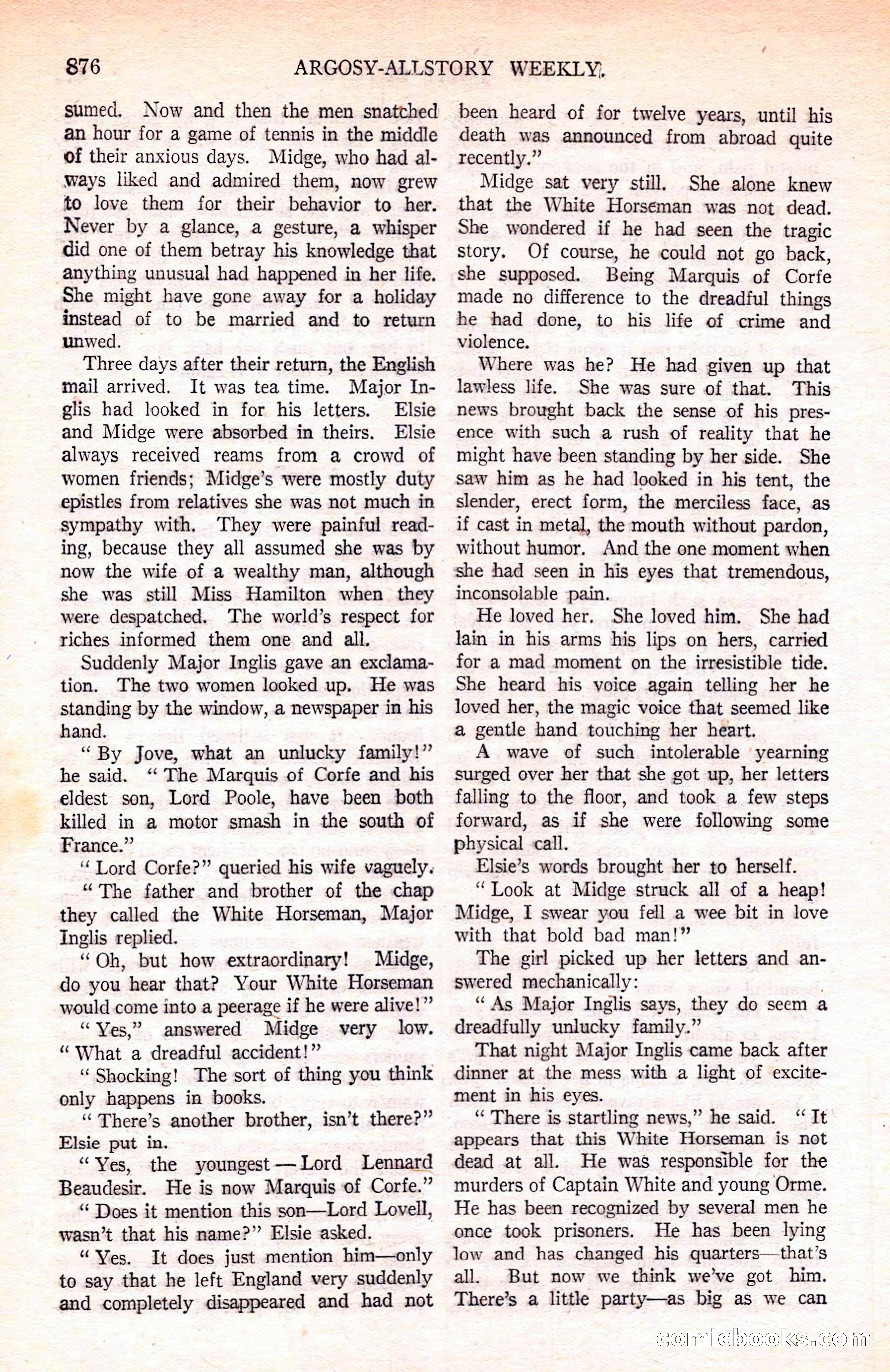
A restored page from Pulp Fiction, 1924. Page through the whole issue in the reader above.
📄 Transcribed text from this page (OCR, searchable)
Machine-transcribed from the original scan — historical spelling and the odd misread are preserved.
376 sumed. Now and then the men snatched an hour for a game of tennis in the middle of their anxious days. Midge, who had al- ways liked and admired them, now grew to love them for their behavior to her. Never by a glance, a gesture, a whisper did one of them betray his knowledge that anything unusual had happened in her life. She might have gone away for a holiday instead of to be married and to return unwed. Three days after their return, the English mail arrived. It was tea time. Major In- glis had looked in for his letters. Elsie and Midge were absorbed in theirs. Elsie always received reams from a crowd of women friends; Midge’s were mostly duty epistles from relatives she was not much in sympathy with. They were painful read- ing, because they all assumed she was by now the wife of a wealthy man, although she was still Miss Hamilton when they were despatched. The world’s respect for riches informed them one and all. Suddenly Major Inglis gave an exclama- tion. The two women looked up. He was standing by the window, a newspaper in his hand. “By Jove, what an unlucky family!” he said. ‘‘ The Marquis of Corfe and his eldest son, Lord Poole, have been both killed in a motor smash in the south of France.” “ Lord Corfe?” queried his wife vaguely. “The father and brother of the chap they called the White Horseman, Major inglis replied. “Oh, but how extraordinary! Midge, do you hear that? Your White Horseman would come into a peerage if he were alive!” “Ves,” answered Midge very low. “What a dreadful accident!” “ Shocking! The sort of thing you think only happens in books. ‘‘There’s another brother, isn’t there?” Elsie put in. “Yes, the youngest—-Lord Lennard Beaudesir. He is now Marquis of Corfe.” “ Does it mention this son—Lord Lovell, wasn’t that his name?” Elsie asked. “Ves. It does just mention him—only to say that he left England very suddenly and completely disappeared and had not ARGOSY-ALLSTORY WEEKLY. been heard of for twelve years, until his death was announced from abroad quite recently.” Midge sat very still. She alone knew that the White Horseman was not dead. She wondered if he had seen the tragic story. Of course, he could not go back, she supposed. Being Marquis of Corfe made no difference to the dreadful things he had done, to his life of crime and violence. Where was he? He had given up that lawless life. She was sure of that. This news brought back the sense of his pres- ence with such a rush of reality that he might have been standing by her side. She saw him as he had looked in his tent, the slender, erect form, the merciless face, as if cast in metal, the mouth without pardon, without humor. And the one moment when she had seen in his eyes that tremendous, inconsolable pain. He loved her. She loved him. She had lain in his arms his lips on hers, carried for a mad moment on the irresistible tide. She heard his voice again telling her he loved her, the magic voice that seemed like a gentle hand touching her heart. A wave of such intolerable yearning surged over her that she got up, her letters falling to the floor, and took a few steps forward, as if she were following some physical call. Elsie’s words brought her to herself. “Look at Midge struck all of a heap! Midge, I swear you fell a wee bit in love with that bold bad man!” The girl picked up her letters and an- swered mechanically: 3 “As Major Inglis says, they do seem a dreadfully unlucky family.” That night Major Inglis came back after dinner at the mess with a light of excite- ment in his eyes. ‘“ There is startling news,” he said. ‘ It appears that this White Horseman is not dead at all. He was responsible for the murders of Captain White and young Orme. He has been recognized by several men he once took prisoners. He has been lying low and has changed his quarters—that’s all. But now we think we’ve got him. There’s a little party—as big as we can Oo COMCLOO SS C@