
Pulp Fiction, 1924 · page 83 of 180
Argosy All-Story Weekly — page 83: what you’re looking at
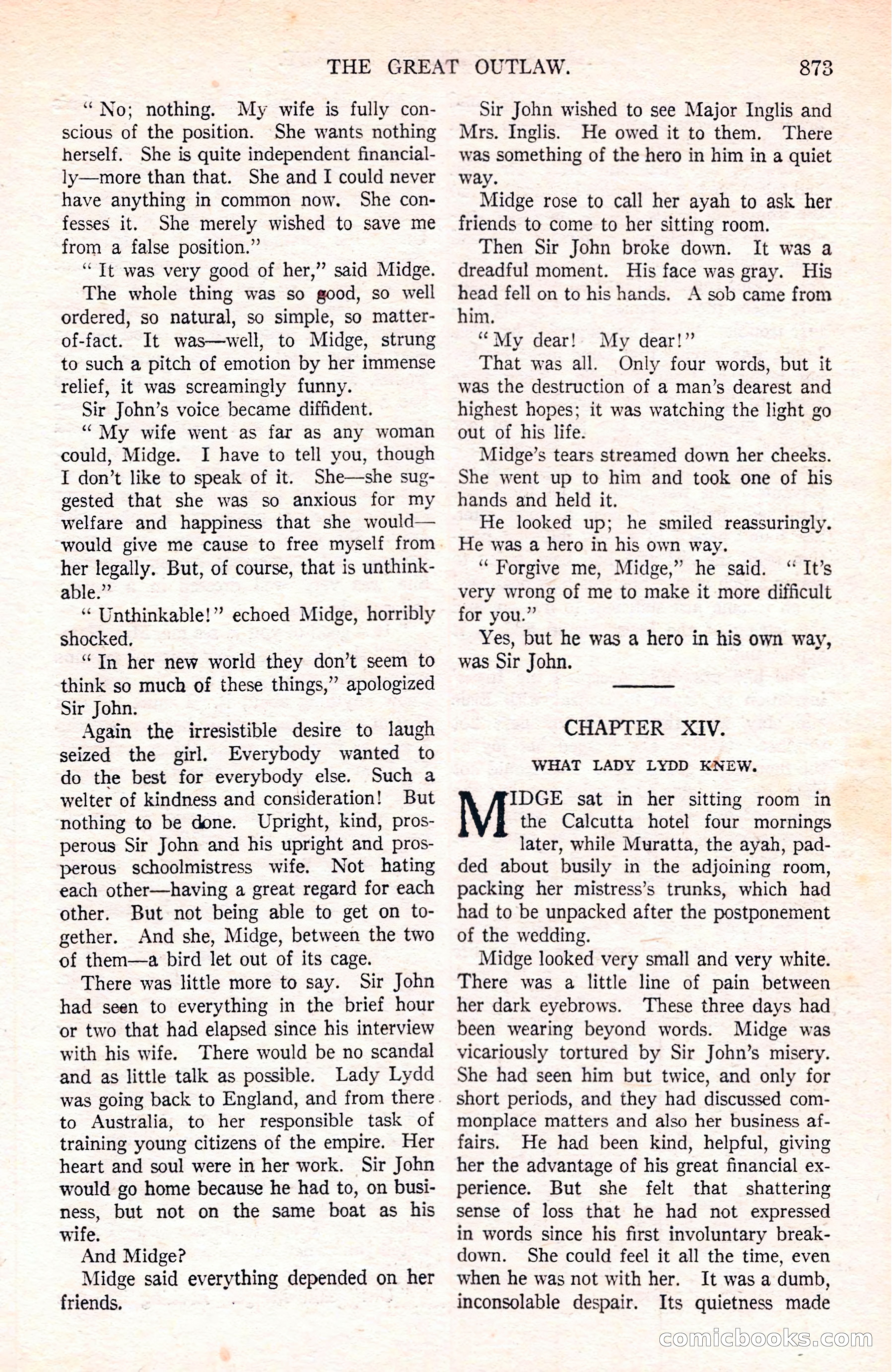
A restored page from Pulp Fiction, 1924. Page through the whole issue in the reader above.
📄 Transcribed text from this page (OCR, searchable)
Machine-transcribed from the original scan — historical spelling and the odd misread are preserved.
THE GREAT OUTLAW. “No; nothing. My wife is fully con- scious of the position. She wants nothing herself. She is quite independent financial- ly—more than that. She and I could never have anything in common now. She con- fesses it. She merely wished to save me from a false position.” “Tt was very good of her,” said Midge. The whole thing was so good, so well ordered, so natural, so simple, so matter- of-fact. It was—well, to Midge, strung to such a pitch of emotion by her immense relief, it was screamingly funny. Sir John’s voice became diffident. ‘““ My wife went as far as any woman could, Midge. I have to tell you, though I don’t like to speak of it. She—she sug- gested that she was so anxious for my welfare and happiness that she would— would give me cause to free myself from her legally. But, of course, that is unthink- able.” “ Unthinkable!” echoed Midge, horribly shocked, “In her new world they don’t seem to think so much of these things,” apologized Sir John. Again the irresistible desire to laugh seized the girl. Everybody wanted to do the best for everybody else. Such a welter of kindness and consideration! But nothing to be done. Upright, kind, pros- perous Sir John and his upright and pros- perous schoolmistress wife. Not hating each other—having a great regard for each other. But not being able to get on to- gether. And she, Midge, between the two of them—a bird let out of its cage. There was little more to say. Sir John had seen to everything in the brief hour or two that had elapsed since his interview with his wife. There would be no scandal and as little talk as possible. Lady Lydd was going back to England, and from there. to Australia, to her responsible task of training young citizens of the empire. Her heart and soul were in her work. Sir John would go home because he had to, on busi- ness, but not on the same boat as his wife. And Midge? Midge said everything depended on her friends. 878 Sir John wished to see Major Inglis and Mrs. Inglis. He owed it to them. There was something of the hero in him in a quiet way. Midge rose to call her ayah to ask her friends to come to her sitting room. Then Sir John broke down. It was a dreadful moment. His face was gray. His head fell on to his hands. A sob came from him. “My dear! My dear!” That was all. Only four words, but it was the destruction of a man’s dearest and highest hopes; it was watching the light go out of his life. Midge’s tears streamed down her cheeks. She went up to him and took one of his hands and held it. He looked up; he smiled reassuringly. He was a hero in his own way. ‘Forgive me, Midge,” he said. ‘“ It’s very wrong of me to make it more difficult for you.” Yes, but he was a hero in his own way, was Sir John. CHAPTER XIV. WHAT LADY LYDD KNEW. IDGE sat in her sitting room in the Calcutta hotel four mornings later, while Muratta, the ayah, pad- ded about busily in the adjoining room, packing her mistress’s trunks, which had had to be unpacked after the postponement of the wedding. Midge looked very small and very white. There was a little line of pain between her dark eyebrows. These three days had been wearing beyond words. Midge was vicariously tortured by Sir John’s misery. She had seen him but twice, and only for short periods, and they had discussed com- monplace matters and also her business af- fairs. He had been kind, helpful, giving her the advantage of his great financial ex- perience. But she felt that shattering sense of loss that he had not expressed in words since his first involuntary break- down. She could feel it all the time, even when he was not with her. It was a dumb, inconsolable despair. Its quietness made Comiclbooks.€©