
Pulp Fiction, 1924 · page 76 of 180
Argosy All-Story Weekly — page 76: what you’re looking at
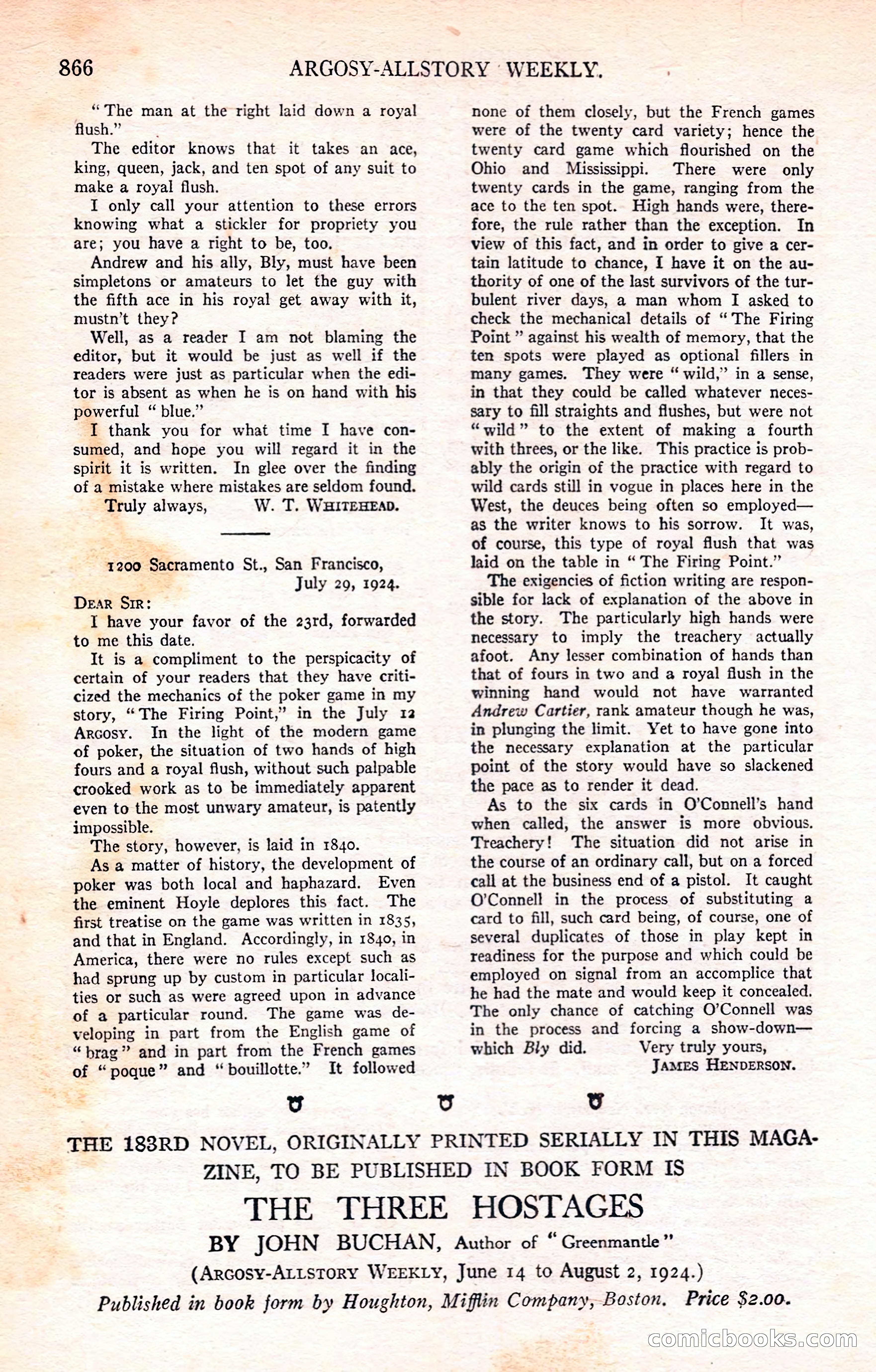
A restored page from Pulp Fiction, 1924. Page through the whole issue in the reader above.
📄 Transcribed text from this page (OCR, searchable)
Machine-transcribed from the original scan — historical spelling and the odd misread are preserved.
866 “The man at the right laid down a royal flush.” : The editor knows that it takes an ace, king, queen, jack, and ten spot of any suit to make a royal flush. I only call your attention to these errors knowing what a stickler for propriety you are; you have a right to be, too. Andrew and his ally, Bly, must have been simpletons or amateurs to let the guy with the fifth ace in his royal get away with it, mustn’t they? Well, as a reader I am not blaming the editor, but it would be just as well if the readers were just as particular when the edi- tor is absent as when he is on hand with his powerful “ blue.” IT thank you for what time I have con- sumed, and hope you will regard it in the spirit it is written. In glee over the finding of a mistake where mistakes are seldom found. Truly always, W. T. WHITEHEAD. 1200 Sacramento St., San Francisco, July 29, 1924. Dear Sir: I have your favor of the 23rd, forwarded to me this date. It is a compliment to the perspicacity of certain of your readers that they have criti- cized the mechanics of the poker game in my story, “The Firing Point,” in the July 12 Arcosy. In the light of the modern game of poker, the situation of two hands of high fours and a royal flush, without such palpable crooked work as to be immediately apparent even to the most unwary amateur, is patently impossible. The story, however, is laid in 1840. As a matter of history, the development of poker was both local and haphazard. Even the eminent Hoyle deplores this fact. The first treatise on the game was written in 1835, and that in England. Accordingly, in 1840, in America, there were no rules except such as had sprung up by custom in particular locali- ties or such aS were agreed upon in advance of a particular round. The game was de- veloping in part from the English game of “brag” and in part from the French games of “poque” and “bouillotte.” It followed Le} Le} ARGOSY-ALLSTORY WEEKLY. none of them closely, but the French games were of the twenty card variety; hence the twenty card game which flourished on the Ohio and Mississippi. There were only twenty cards in the game, ranging from the ace to the ten spot. High hands were, there- fore, the rule rather than the exception. In view of this fact, and in order to give a cer- tain latitude to chance, I have it on the au- thority of one of the last survivors of the tur- bulent river days, a man whom I asked to check the mechanical details of “The Firing Point ” against his wealth of memory, that the ten spots were played as optional fillers in many games. They were “ wild,” in a sense, in that they could be called whatever neces- sary to fill straights and flushes, but were not “wild” to the extent of making a fourth with threes, or the like. This practice is prob- ably the origin of the practice with regard to wild cards still in vogue in places here in the West, the deuces being often so employed— as the writer knows to his sorrow. It was, of course, this type of royal flush that was laid on the table in “ The Firing Point.” The exigencies of fiction writing are respon- sible for lack of explanation of the above in the story. The particularly high hands were necessary to imply the treachery actually afoot. Any lesser combination of hands than that of fours in two and a royal flush in the winning hand would not have warranted Andrew Cartier, rank amateur though he was, in plunging the limit. Yet to have gone into the necessary explanation at the particular point of the story would have so slackened the pace as to render it dead. As to the six cards in O’Connell’s hand when called, the answer is more obvious. Treachery! The situation did not arise in the course of an ordinary call, but on a forced call at the business end of a pistol. It caught O’Connell in the process of substituting a card to fill, such card being, of course, one of several duplicates of those in play kept in readiness for the purpose and which could be employed on signal from an accomplice that he had the mate and would keep it concealed. The only chance of catching O’Connell was in the process and forcing a show-down— which Bly did. Very truly yours, JAMES HENDERSON. v THE 183RD NOVEL, ORIGINALLY PRINTED SERIALLY IN THIS MAGA- ZINE, TO BE PUBLISHED IN BOOK FORM IS THE THREE HOSTAGES BY JOHN BUCHAN, Author of “ Greenmantle’’ (ArcoSY-ALLSTORY WEEKLY, June 14 to August 2, 1924.) Published in book form by Houghton, Mifflin Company, Boston. Price $2.00. comicbooks C©