
Pulp Fiction, 1924 · page 63 of 180
Argosy All-Story Weekly — page 63: what you’re looking at
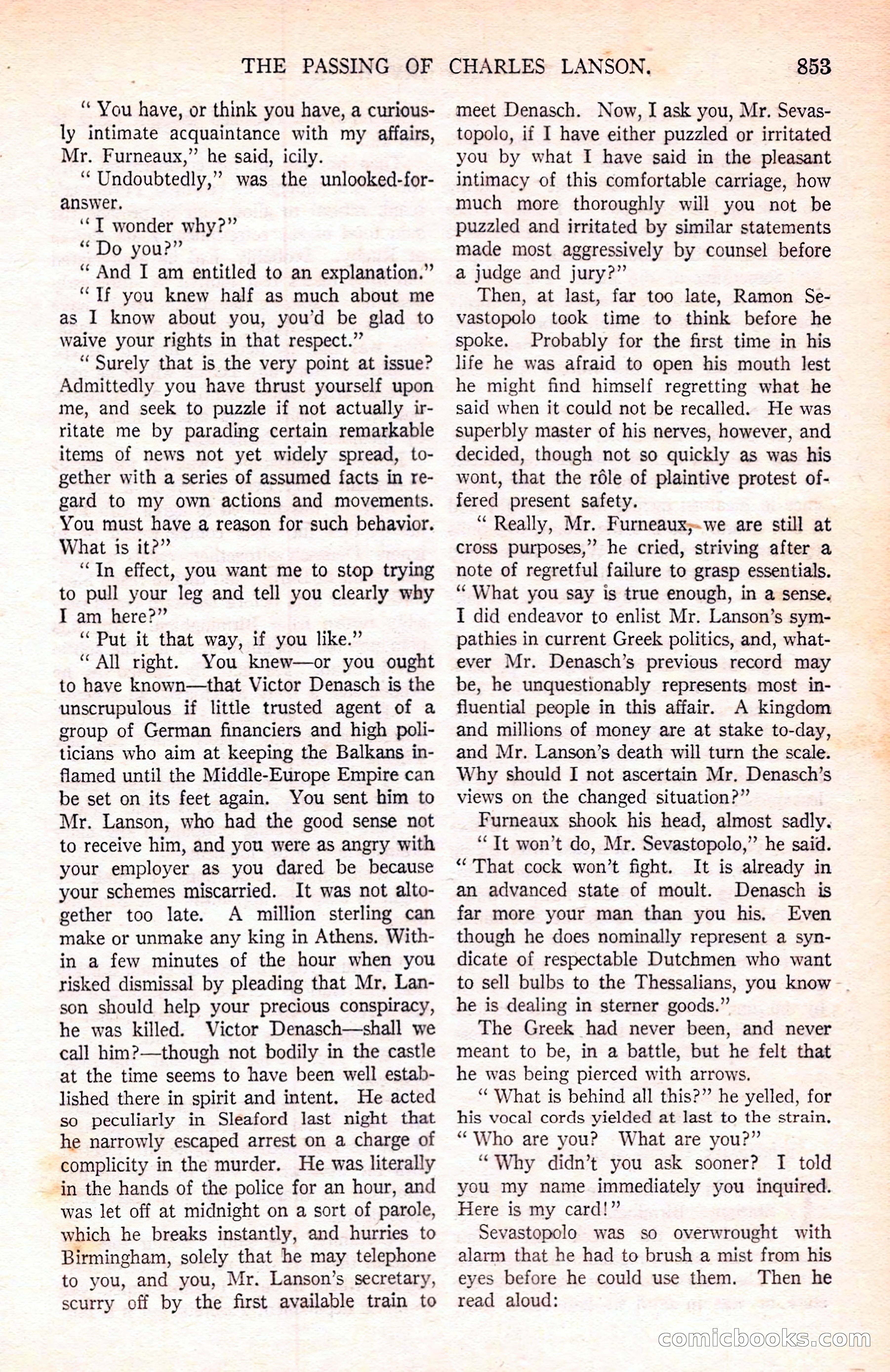
A restored page from Pulp Fiction, 1924. Page through the whole issue in the reader above.
📄 Transcribed text from this page (OCR, searchable)
Machine-transcribed from the original scan — historical spelling and the odd misread are preserved.
THE PASSING OF “ You have, or think you have, a curious- ly intimate acquaintance with my affairs, Mr. Furneaux,” he said, icily. “Undoubtedly,” was the unlooked-for- answer, ‘“T wonder why?” “Do you?” “And I am entitled to an explanation.” “Tf you knew half as much about me as I know about you, you’d be glad to waive your rights in that respect.” “Surely that is the very point at issue? Admittedly you have thrust yourself upon me, and seek to puzzle if not actually ir- ritate me by parading certain remarkable items of news not yet widely spread, to- gether with a series of assumed facts in re- gard to my own actions and movements. You must have a reason for such behavior. What 1s it?” “In effect, you want me to stop trying to pull your leg and tell you clearly why I am here?” “Put it that way, if you like.” ‘All right. You knew—or you ought to have known—that Victor Denasch is the unscrupulous if little trusted agent of a group of German financiers and high poli- ticians who aim at keeping the Balkans in- flamed until the Middle-Europe Empire can be set on its feet again. You sent him to Mr. Lanson, who had the good sense not to receive him, and you were as angry with your employer as you dared be because your schemes miscarried. It was not alto- gether too late. A million sterling can make or unmake any king in Athens. With- in a few minutes of the hour when you risked dismissal by pleading that Mr, Lan- son should help your precious conspiracy, he was killed. Victor Denasch—shall we call him?—though not bodily in the castle at the time seems to have been well estab- lished there in spirit and intent. He acted so peculiarly in Sleaford last night that he narrowly escaped arrest on a charge of complicity in the murder. He was literally ‘in the hands of the police for an hour, and was let off at midnight on a sort of parole, which he breaks instantly, and hurries to Birmingham, solely that he may telephone to you, and you, Mr. Lanson’s secretary, scurry off by the first available train to CHARLES LANSON, 853 meet Denasch. Now, I ask you, Mr. Sevas- topolo, if I have either puzzled or irritated you by what I have said in the pleasant intimacy of this comfortable carriage, how much more thoroughly will you not be puzzled and irritated by similar statements made most aggressively by counsel before a judge and jury?” Then, at last, far too late, Ramon Se- vastopolo took time to think before he spoke. Probably for the first time in his life he was afraid to open his mouth lest he might find himself regretting what he said when it could not be recalled. He was superbly master of his nerves, however, and decided, though not so quickly as was his wont, that the réle of plaintive protest of- fered present safety. “ Really, Mr. Furneaux;-we are still at cross purposes,” he cried, striving after a note of regretful failure to grasp essentials. “What you say is true enough, in a sense. I did endeavor to enlist Mr. Lanson’s sym- pathies in current Greek politics, and, what- ever Mr. Denasch’s previous record may be, he unquestionably represents most in- fluential people in this affair. A kingdom and millions of money are at stake to-day, and Mr. Lanson’s death will turn the scale. Why should I not ascertain Mr. Denasch’s views on the changed situation?” Furneaux shook his head, almost sadly. “Tt won’t do, Mr. Sevastopolo,” he said. “That cock won’t fight. It is already in an advanced state of moult. Denasch is far more your man than you his. Even though he does nominally represent a syn- dicate of respectable Dutchmen who want to sell bulbs to the Thessalians, you know -- he is dealing in sterner goods.” The Greek had never been, and never meant to be, in a battle, but he felt that he was being pierced with arrows. ‘“‘ What is behind all this?” he yelled, for his vocal cords yielded at last to the strain, “Who are you? What are you?” “Why didn’t you ask sooner? I told you my name immediately you inquired. Here is my card!” Sevastopolo was so overwrought with alarm that he had to brush a mist from his eyes before he could use them. Then he read aloud: oO COMiICcloo <SHiGO