
Pulp Fiction, 1924 · page 61 of 180
Argosy All-Story Weekly — page 61: what you’re looking at
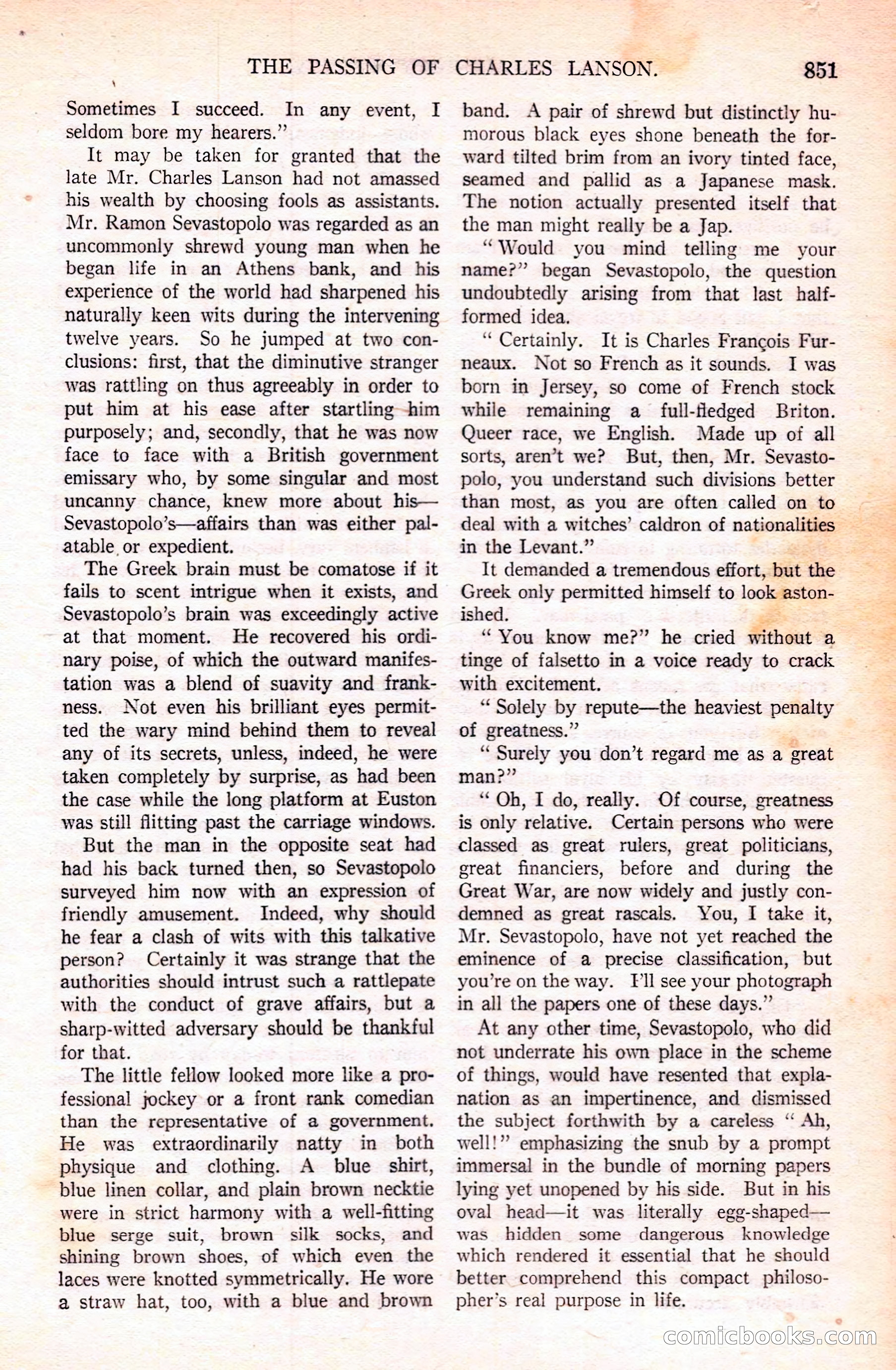
A restored page from Pulp Fiction, 1924. Page through the whole issue in the reader above.
📄 Transcribed text from this page (OCR, searchable)
Machine-transcribed from the original scan — historical spelling and the odd misread are preserved.
THE PASSING OF \ Sometimes I succeed. In any event, I seldom bore my hearers.” It may be taken for granted that the late Mr. Charles Lanson had not amassed his wealth by choosing fools as assistants. Mr. Ramon Sevastopolo was regarded as an uncommonly shrewd young man when he began life in an Athens bank, and his experience of the world had sharpened his naturally keen wits during the intervening twelve years. So he jumped at two con- clusions: first, that the diminutive stranger was rattling on thus agreeably in order to put him at his ease after startling -him purposely; and, secondly, that he was now face to face with a British government emissary who, by some singular and most uncanny chance, knew more about his— Sevastopolo’s—affairs than was either pal- atable or expedient. The Greek brain must be comatose if it fails to scent intrigue when it exists, and Sevastopolo’s brain was exceedingly active at that moment. He recovered his ordi- nary poise, of which the outward manifes- tation was a blend of suavity and frank- ness. Not even his brilliant eyes permit- ted the wary mind behind them to reveal any of its secrets, unless, indeed, he were taken completely by surprise, as had been the case while the long platform at Euston was still flitting past the carriage windows. But the man in the opposite seat had had his back turned then, so Sevastopolo surveyed him now with an expression of friendly amusement. Indeed, why should he fear a clash of wits with this talkative person? Certainly it was strange that the authorities should intrust such a rattlepate with the conduct of grave affairs, but a sharp-witted adversary should be thankful for that. The little fellow looked more like a pro- fessional jockey or a front rank comedian than the representative of a government. He was extraordinarily natty in both physique and clothing. A _ blue shirt, blue linen collar, and plain brown necktie were in strict harmony with a well-fitting blue serge suit, brown silk socks, and shining brown shoes, of which even the laces were knotted symmetrically. He wore a straw hat, too, with a blue and brown CHARLES LANSON. 851 band. A pair of shrewd but distinctly hu- morous black eyes shone beneath the for- ward tilted brim from an ivory tinted face, seamed and pallid as a Japanese mask. The notion actually presented itself that the man might really be a Jap. “Would you mind telling me your name?” began Sevastopolo, the question undoubtedly arising from that last half- formed idea. ‘Certainly. It is Charles Francois Fur- neaux. Not so French as it sounds. I was born in Jersey, so come of French stock while remaining a full-fledged Briton. Queer race, we English. Made up of all sorts, aren’t we? But, then, Mr. Sevasto- polo, you understand such divisions better than most, as you are often called on to deal with a witches’ caldron of napensiaae in the Levant.” It demanded a tremendous effort, but the Greek only permitted himself to lookeetens ished. “You know me?” he cried Fthont a tinge of falsetto in a voice ready to crack with excitement. | “Solely by repute—the heaviest penalty of greatness.” “Surely you don’t regard me as a great man?” “Oh, I do, really. Of course, greatness is only relative. Certain persons who were classed as great rulers, great politicians, great financiers, before and during the Great War, are now widely and justly con- demned as great rascals. You, I take it, Mr. Sevastopolo, have not yet reached the eminence of a precise classification, but you’re on the way. Pll see your photograph in all the papers one of these days.” At any other time, Sevastopolo, who did not underrate his own place in the scheme of things, would have resented that expla- nation as an impertinence, and dismissed the subject forthwith by a careless ‘ Ah, well!” emphasizing the snub by a prompt immersal in the bundle of morning papers lying yet unopened by his side. But in his oval head—it was literally egg-shaped— was hidden some dangerous knowledge which rendered it essential that he should better comprehend this compact philoso- pher’s real purpose in life. Oo comlicbooks.€® I = — =~ inn