
Pulp Fiction, 1924 · page 39 of 180
Argosy All-Story Weekly — page 39: what you’re looking at
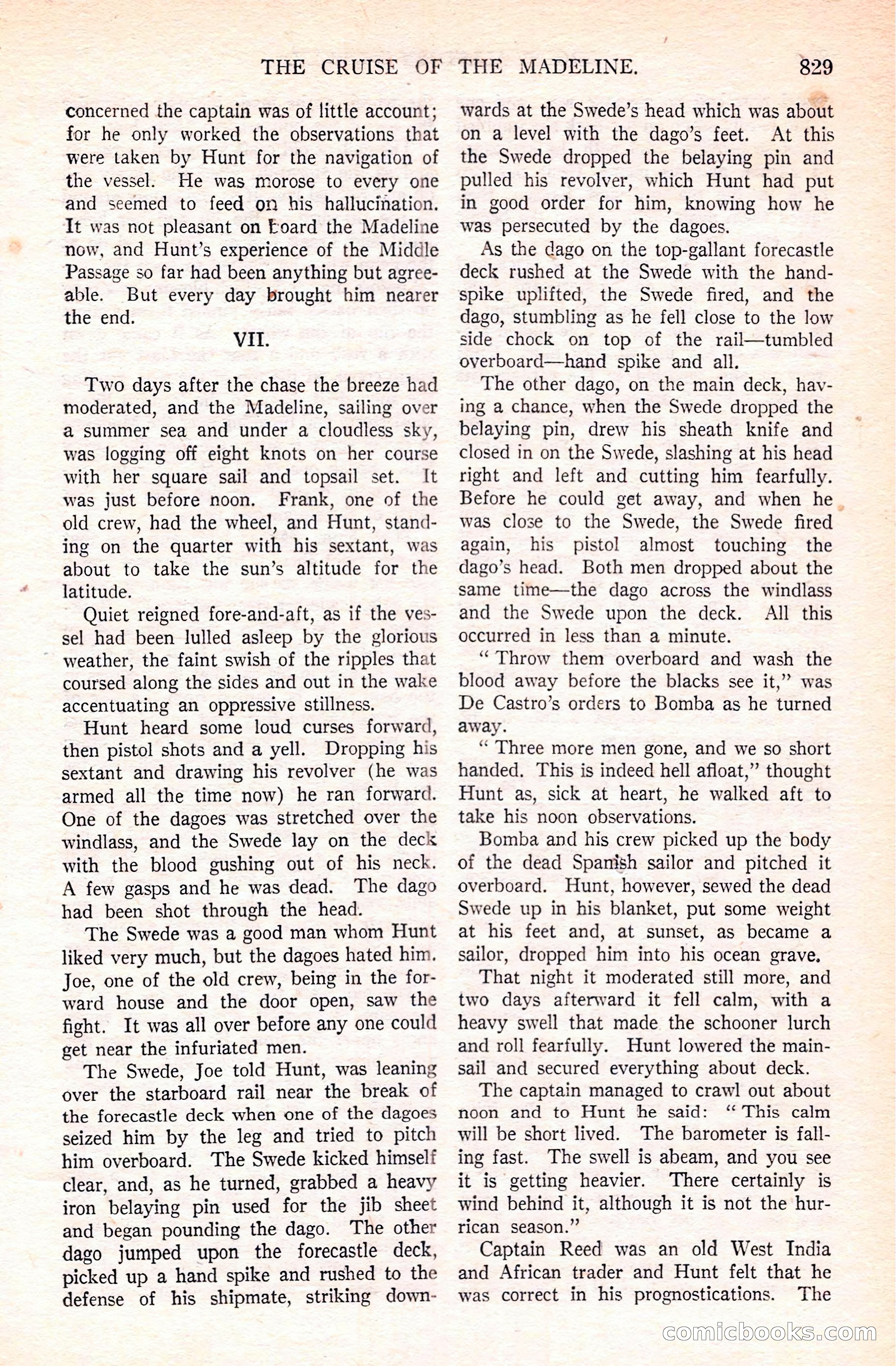
A restored page from Pulp Fiction, 1924. Page through the whole issue in the reader above.
📄 Transcribed text from this page (OCR, searchable)
Machine-transcribed from the original scan — historical spelling and the odd misread are preserved.
THE CRUISE OF concerned the captain was of little account; for he only worked the observations that were taken by Hunt for the navigation of the vessel. He was morose to every one and seemed to feed on his hallucination. It was not pleasant on Foard the Madeline now, and Hunt’s experience of the Middle Passage so far had been anything but agree- able. But every day brought him nearer the end. VII. Two days after the chase the breeze had moderated, and the Madeline, sailing over a summer sea and under a cloudless sky, was logging off eight knots on her course with her square sail and topsail set. It was just before noon. Frank, one of the old crew, had the wheel, and Hunt, stand- ing on the quarter with his sextant, was about to take the sun’s altitude for the latitude. Quiet reigned fore-and-aft, as if the ves- sel had been lulled asleep by the glorious weather, the faint swish of the ripples that coursed along the sides and out in the wake accentuating an oppressive stillness. Hunt heard some loud curses forward, then pistol shots and a yell. Dropping his sextant and drawing his revolver (he was armed all the time now) he ran forward. One of the dagoes was stretched over the windlass, and the Swede lay on the deck with the blood gushing out of his neck. A few gasps and he was dead. The dago had been shot through the head. The Swede was a good man whom Hunt liked very much, but the dagoes hated him. Joe, one of the old crew, being in the for- ward house and the door open, saw the fight. It was all over before any one could get near the infuriated men. The Swede, Joe told Hunt, was leaning over the starboard rail near the break of the forecastle deck when one of the dagoes seized him by the leg and tried to pitch him overboard. The Swede kicked himself clear, and, as he turned, grabbed a heavy iron belaying pin used for the jib sheet and began pounding the dago. The other dago jumped upon the forecastle deck, picked up a hand spike and rushed to the defense of his shipmate, striking down- THE MADELINE. 829 wards at the Swede’s head which was about on a level with the dago’s feet. At this the Swede dropped the belaying pin and pulled his revolver, which Hunt had put in good order for him, knowing how he was persecuted by the dagoes. As the dago on the top-gallant forecastle deck rushed at the Swede with the hand- spike uplifted, the Swede fired, and the dago, stumbling as he fell close to the low side chock on top of the rail—tumbled overboard—hand spike and all. The other dago, on the main deck, hav- ing a chance, when the Swede dropped the belaying pin, drew his sheath knife and closed in on the Swede, slashing at his head right and left and cutting him fearfully. Before he could get away, and when he. was close to the Swede, the Swede fired again, his pistol almost touching the dago’s head. Both men dropped about the same time—the dago across the windlass and the Swede upon the deck. All this occurred in less than a minute. “Throw them overboard and wash the blood away before the blacks see it,’ was De Castro’s orders to Bomba as he turned away. ‘“ Three more men gone, and we so short handed. This is indeed hell afloat,” thought Hunt as, sick at heart, he walked aft to take his noon observations. Bomba and his crew picked up the body of the dead Spanish sailor and pitched it overboard. Hunt, however, sewed the dead Swede up in his blanket, put some weight at his feet and, at sunset, as became a sailor, dropped him into his ocean grave, That night it moderated still more, and two days afterward it fell calm, with a heavy swell that made the schooner lurch and roll fearfully. Hunt lowered the main- sail and secured everything about deck. The captain managed to crawl out about noon and to Hunt he said: ‘ This calm will be short lived. The barometer is fall- ing fast. The swell is abeam, and you see it is getting heavier. There certainly is wind behind it, although it is not the hur- rican season.” Captain Reed was an old West India and African trader and Hunt felt that he was correct in his prognostications. The oO Comicbool S CO