
Pulp Fiction, 1924 · page 22 of 180
Argosy All-Story Weekly — page 22: what you’re looking at
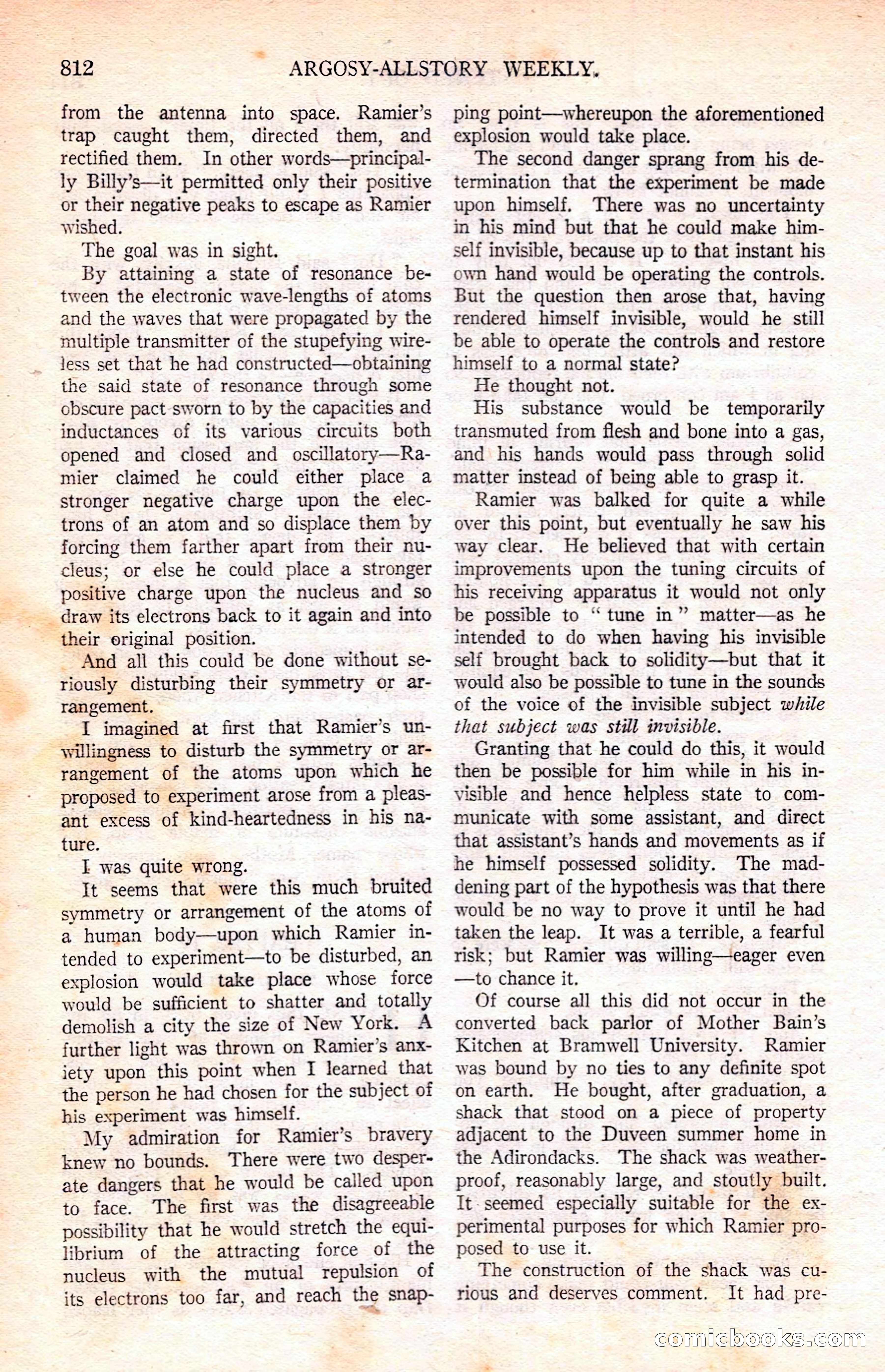
A restored page from Pulp Fiction, 1924. Page through the whole issue in the reader above.
📄 Transcribed text from this page (OCR, searchable)
Machine-transcribed from the original scan — historical spelling and the odd misread are preserved.
812 from the antenna into space. Ramier’s trap caught them, directed them, and rectified them. In other words—principal- ly Billy’s—it permitted only their positive or their negative peaks to escape as Ramier wished. The goal was in sight. By attaining a state of resonance be- tween the electronic wave-lengths of atoms and the waves that were propagated by the multiple transmitter of the stupefying wire- less set that he had constructed—obtaining the said state of resonance through some obscure pact sworn to by the capacities and inductances of its various circuits both opened and closed and oscillatory—Ra- mier claimed he could either place a stronger negative charge upon the elec- trons of an atom and so displace them by forcing them farther apart from their nu- cleus; or else he could place a stronger positive charge upon the nucleus and so ___ draw its electrons back to it again and into their original position. _ And all this could be done without se- riously disturbing their symmetry or ar- rangement. I imagined at first that Ramier’s un- willingness to disturb the symmetry or ar- rangement of the atoms upon which he proposed to experiment arose from a pleas- ant excess of kind-heartedness in his na- ture. I was quite wrong. It seems that were this much bruited symmetry or arrangement of the atoms of a human body—upon which Ramier in- tended to experiment—to be disturbed, an explosion would take place whose force would be sufficient to shatter and totally demolish a city the size of New York. A further light was thrown on Ramier’s anx- iety upon this point when I learned that the person he had chosen for the subject of his experiment was himself. My admiration for Ramier’s bravery knew no bounds. There were two desper- ate dangers that he would be called upon to face. The first was the disagreeable possibility that he would stretch the equi- librium of the attracting force of the nucleus with the mutual repulsion of its electrons too far, and reach the snap- ARGOSY-ALLSTORY WEEKLY. ping point—whereupon the aforementioned explosion would take place. The second danger sprang from his de- termination that the experiment be made upon himself. There was no uncertainty in his mind but that he could make him- self invisible, because up to that instant his own hand would be operating the controls. But the question then arose that, having rendered himself invisible, would he still be able to operate the controls and restore himself to a normal state? He thought not. His substance would be_ temporarily transmuted from flesh and bone into a gas, and his hands would pass through solid matter instead of being able to grasp it. Ramier was balked for quite a while over this point, but eventually he saw his way clear. He believed that with certain improvements upon the tuning circuits of his receiving apparatus it would not only be possible to “tune in” matter—as he intended to do when having his invisible self brought back to solidity—but that it would also be possible to tune in the sounds of the voice of the invisible subject while that subject was still invisible. Granting that he could do this, it would then be possible for him while in his in- visible and hence helpless state to com- municate with some assistant, and direct that assistant’s hands and movements as if he himself possessed solidity. The mad- dening part of the hypothesis was that there would be no way to prove it until he had taken the leap. It was a terrible, a fearful risk; but Ramier was willing—eager even —to chance it. Of course all this did not occur in the converted back parlor of Mother Bain’s Kitchen at Bramwell University. Ramier was bound by no ties to any definite spot on earth. He bought, after graduation, a shack that stood on a piece of property adjacent to the Duveen summer home in the Adirondacks. The shack was weather- proof, reasonably large, and stoutly built. It- seemed especially suitable for the ex- perimental purposes for which Ramier pro- posed to use it. ; The construction of the shack was cu- rious and deserves comment. It had pre- oO ComicoookSs.€©