
Pulp Fiction, 1924 · page 146 of 180
Argosy All-Story Weekly — page 146: what you’re looking at
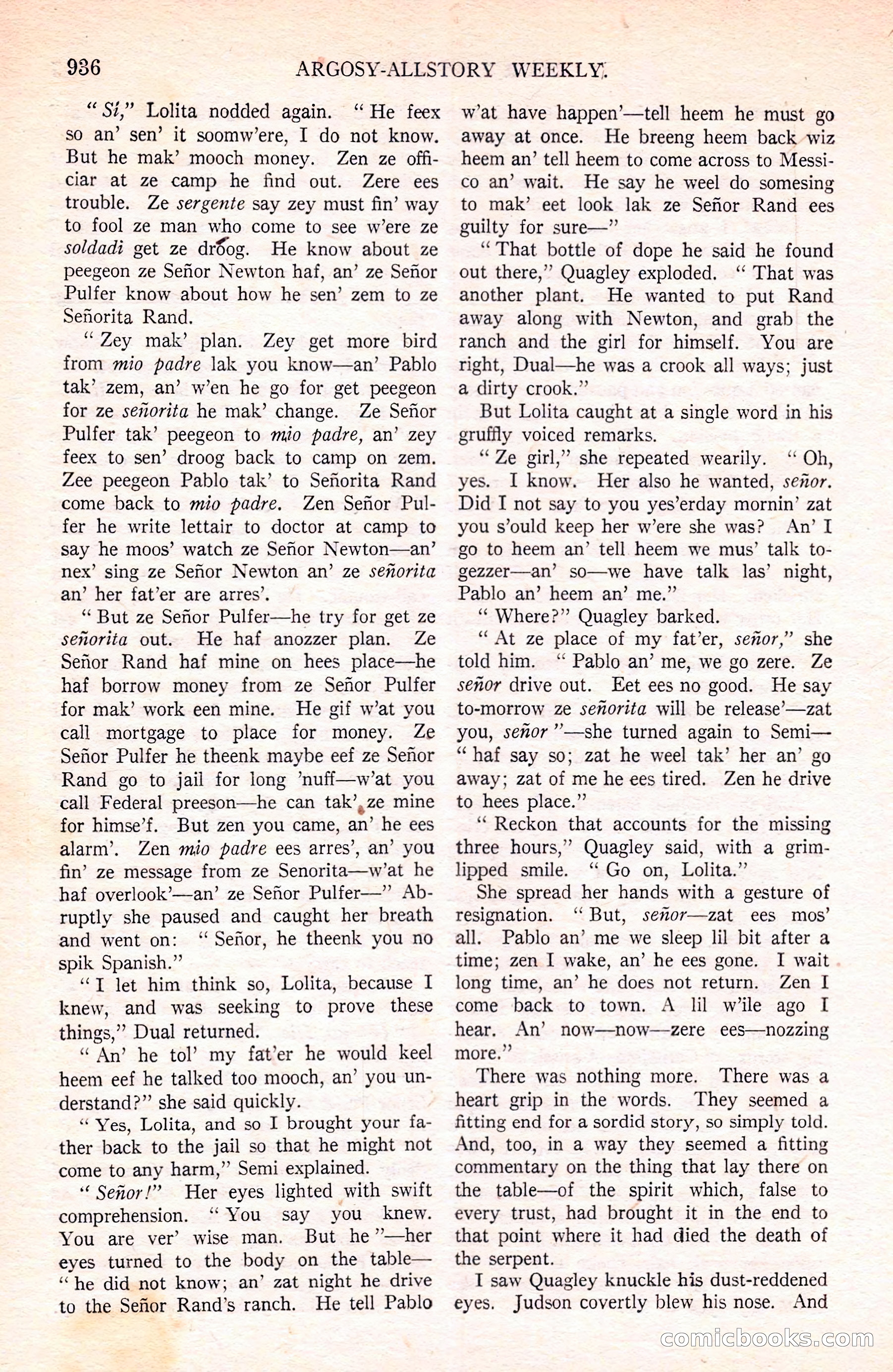
A restored page from Pulp Fiction, 1924. Page through the whole issue in the reader above.
📄 Transcribed text from this page (OCR, searchable)
Machine-transcribed from the original scan — historical spelling and the odd misread are preserved.
936 “ Si,” Lolita nodded again. “He feex so an’ sen’ it soomw’ere, I do not know. But he mak’ mooch money. Zen ze offi- ciar at ze camp he find out. Zere ees trouble. Ze sergente say zey must fin’ way to fool ze man who come to see w’ere ze soldadi get ze dr6og. He know about ze peegeon ze Senor Newton haf, an’ ze Senor Pulfer know about how he sen’ zem to ze Senorita Rand. “Zey mak’ plan. Zey get more bird from mio padre lak you know—an’ Pablo tak’ zem, an’ w’en he go for get peegeon for ze senorita he mak’ change. Ze Sefor Pulfer tak’ peegeon to mio padre, an’ zey feex to sen’ droog back to camp on zem. Zee peegeon Pablo tak’ to Senorita Rand come back to mio padre. Zen Senor Pul- fer he write lettair to doctor at camp to say he moos’ watch ze Senor Newton—an’ nex’ sing ze Senor Newton an’ ze senorita an’ her fat’er are arres’. “ But ze Senor Pulfer—he try for get ze senorita out. He haf anozzer plan. Ze Senor Rand haf mine on hees place—he haf borrow money from ze Senor Pulfer for mak’ work een mine. He gif w’at you call mortgage to place for money. Ze Senor Pulfer he theenk maybe eef ze Senor Rand go to jail for long *nuff—w’at you call Federal preeson—he can tak’,ze mine for himse’f. But zen you came, an’ he ees alarm’. Zen mio padre ees arres’, an’ you fin’ ze message from ze Senorita—w’at he haf overlook’—an’ ze Sefor Pulfer—’’ Ab- ruptly she paused and caught her breath and went on: “Senor, he theenk you no spik Spanish.” ‘“T let him think so, Lolita, because I knew, and was seeking to prove these things,” Dual returned. “ An’ he tol’ my fat’er he would keel heem eef he talked too mooch, an’ you un- derstand?” she said quickly. “Yes, Lolita, and so I brought your fa- ther back to the jail so that he might not come to any harm,” Semi explained. ‘Senor!’ Her eyes lighted with swift comprehension. ‘‘ You say you knew. You are ver’ wise man. But he’—her eyes turned to the body on the table— “he did not know; an’ zat night he drive to the Sefior Rand’s ranch. He tell Pablo ARGOSY-ALLSTORY WEEKLY. w’at have happen’—tell heem he must go away at once. He breeng heem back wiz heem an’ tell heem to come across to Messi- co an’ wait. He say he weel do somesing to mak’ eet look lak ze Senor Rand ees guilty for sure—” “That bottle of dope he said he found out there,” Quagley exploded. ‘‘ That was another plant. He wanted to put Rand away along with Newton, and grab the ranch and the girl for himself. You are right, Dual—he was a crook all ways; just a dirty crook.” But Lolita caught at a single word in his gruffly voiced remarks. “Ze girl,” she repeated wearily. ‘‘ Oh, yes. I know. Her also he wanted, senor. Did I not say to you yes’erday mornin’ zat you s’ould keep her w’ere she was? An’ I go to heem an’ tell heem we mus’ talk to- gezzer—an’ so—we have talk las’ night, Pablo an’ heem an’ me.” ‘““ Where?” Quagley barked. ‘““At ze place of my fat’er, senor,” she told him. ‘“ Pablo an’ me, we go zere. Ze senor drive out. Eet ees no good. He say to-morrow ze senorita will be release’—zat you, senor ’’—she turned again to Semi— “haf say so; zat he weel tak’ her an’ go away; zat of me he ees tired. Zen he drive to hees place.” ‘““ Reckon that accounts for the missing three hours,’ Quagley said, with a grim- lipped smile. ‘Go on, Lolita.” She spread her hands with a gesture of resignation. ‘‘ But, senzor—zat ees mos’ all. Pablo an’ me we sleep lil bit after a time; zen I wake, an’ he ees gone. I wait long time, an’ he does not return. Zen [ come back to town. A lil wile ago I hear. An’ now—now—zere ees—nozzing more.” There was nothing more. There was a heart grip in the words. They seemed a fitting end for a sordid story, so simply told. And, too, in a way they seemed a fitting commentary on the thing that lay there on the table—of the spirit which, false to every trust, had brought it in the end to that point where it had died the death of the serpent. I saw Quagley knuckle his dust-reddened eyes. Judson covertly blew his nose. And comicbooks (©