
Pulp Fiction, 1924 · page 87 of 168
Argosy All-Story Weekly — page 87: what you’re looking at
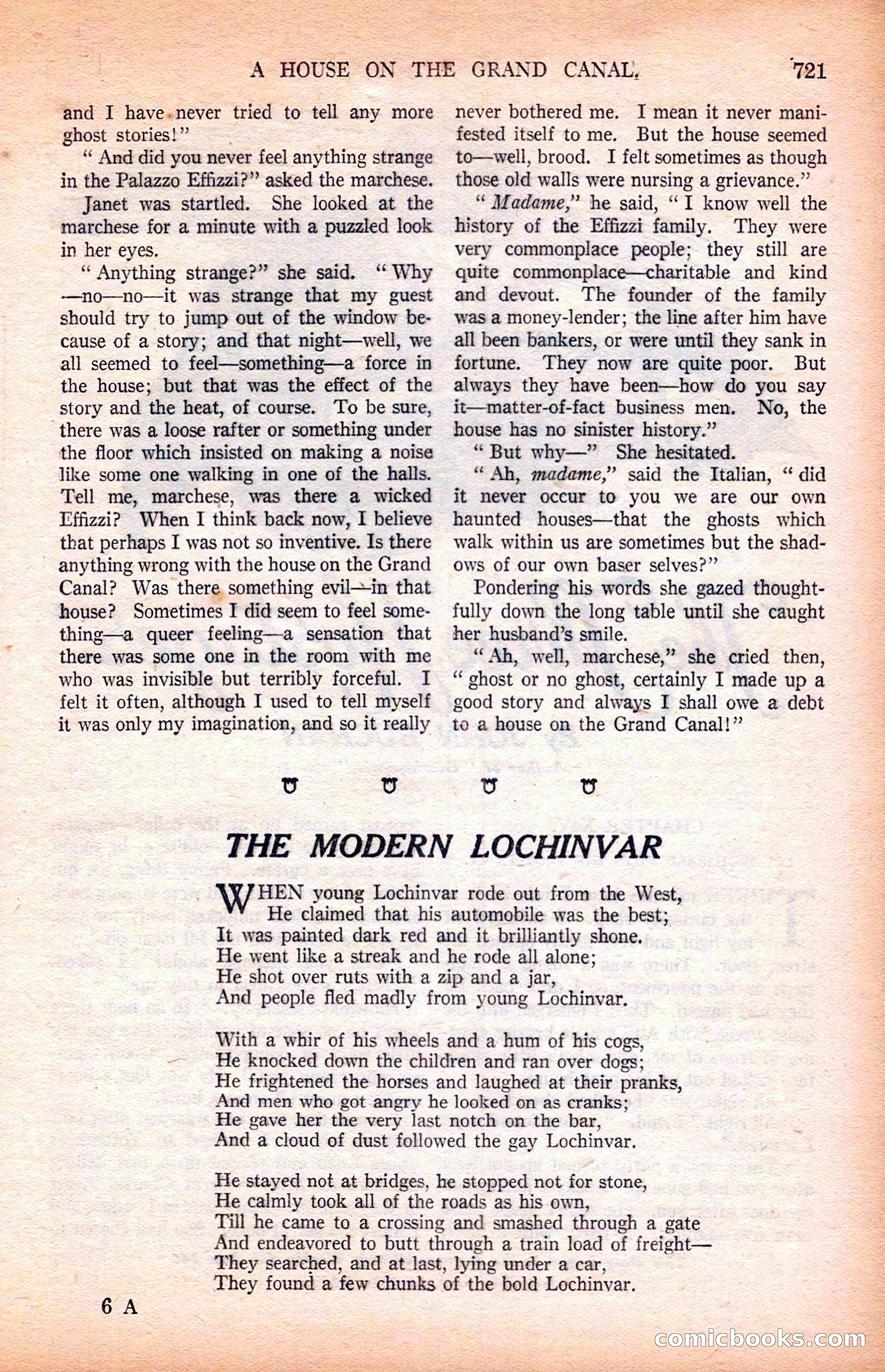
A restored page from Pulp Fiction, 1924. Page through the whole issue in the reader above.
📄 Transcribed text from this page (OCR, searchable)
Machine-transcribed from the original scan — historical spelling and the odd misread are preserved.
Qe - » ee a il ne ~- s i". em “aS me - = ates ‘and I have.«never tried to tell any more ghost stories!” ““ And did you never feel anything strange in the Palazzo Effizzi?” asked the marchese. Janet was startled. She looked at the marchese for a minute with a puzzled look in her eyes. “Anything strange?” she said. ‘“‘ Why —no—no—it was strange that my guest should try to jump out of the window be- cause of a story; and that night—well, we all seemed to feel—something—a force in the house; but that was the effect of the story and the heat, of course. To be sure, there was a loose rafter or something under the floor which insisted on making a noise like some one walking in one of the halls. Tell me, marchese, was there a wicked Uffizzi? When I think back now, I believe that perhaps I was not so inventive. Is there anything wrong with the house on the Grand Canal? Was there something evil—in that house? Sometimes I did seem to feel some- thing—a queer feeling—a sensation that there was some one in the room with me who was invisible but terribly forceful. I felt it often, although I used to tell myself it was only my imagination, and so it really U U A HOUSE ON THE GRAND CANAL, 721 never bothered me. I mean it never mani- fested itself tome. But the house seemed to—well, brood. I felt sometimes as though those old walls were nursing a grievance.” “ Madame,” he said, ‘I know well the history of the Effizzi family. They were very commonplace people; they still are quite commonplace—charitable and kind and devout. The founder of the family was a money-lender; the line after him have all been bankers, or were until they sank in fortune. They now are quite poor. But always they have been—how do you say it—matter-of-fact business men. No, the house has no sinister history.” “But why—” She hesitated. “Ah, madame,” said the Italian, ‘‘ did it never occur tO you we are our own haunted houses—that the ghosts which walk within us are sometimes but the shad- ows of our own baser selves?” Pondering his words she gazed thought- fully down the long table until she caught her husband’s smile. ‘Ah, well, marchese,” she cried then, “ghost or no ghost, certainly I made up a good story and always I shall owe a debt to a house on the Grand Canal!” eS u THE MODERN LOCHINVAR | W HEN young Lochinvar rode out from the West, He claimed that his automobile was the best; It was painted dark red and it brilliantly shone. He went like a streak and he rode all alone; He shot over ruts with a zip and a jar, And people fled madly from young Lochinvar. With a whir of his wheels and a hum of his cogs, He knocked down the children and ran over dogs; He frightened the horses and laughed at their pranks, And men who got angry he looked on as cranks; He gave her the very last notch on the bar, And a cloud of dust followed the gay Lochinvar. He stayed not at bridges, he stopped not for stone, He calmly took all of the roads as his own, Till he came to a crossing and smashed through a gate And endeavored to butt through a train load of freight— They searched, and at last, lying under a car, They found a few chunks of the bold Lochinvar. CONMC DOOKSsCO