
Pulp Fiction, 1924 · page 69 of 168
Argosy All-Story Weekly — page 69: what you’re looking at
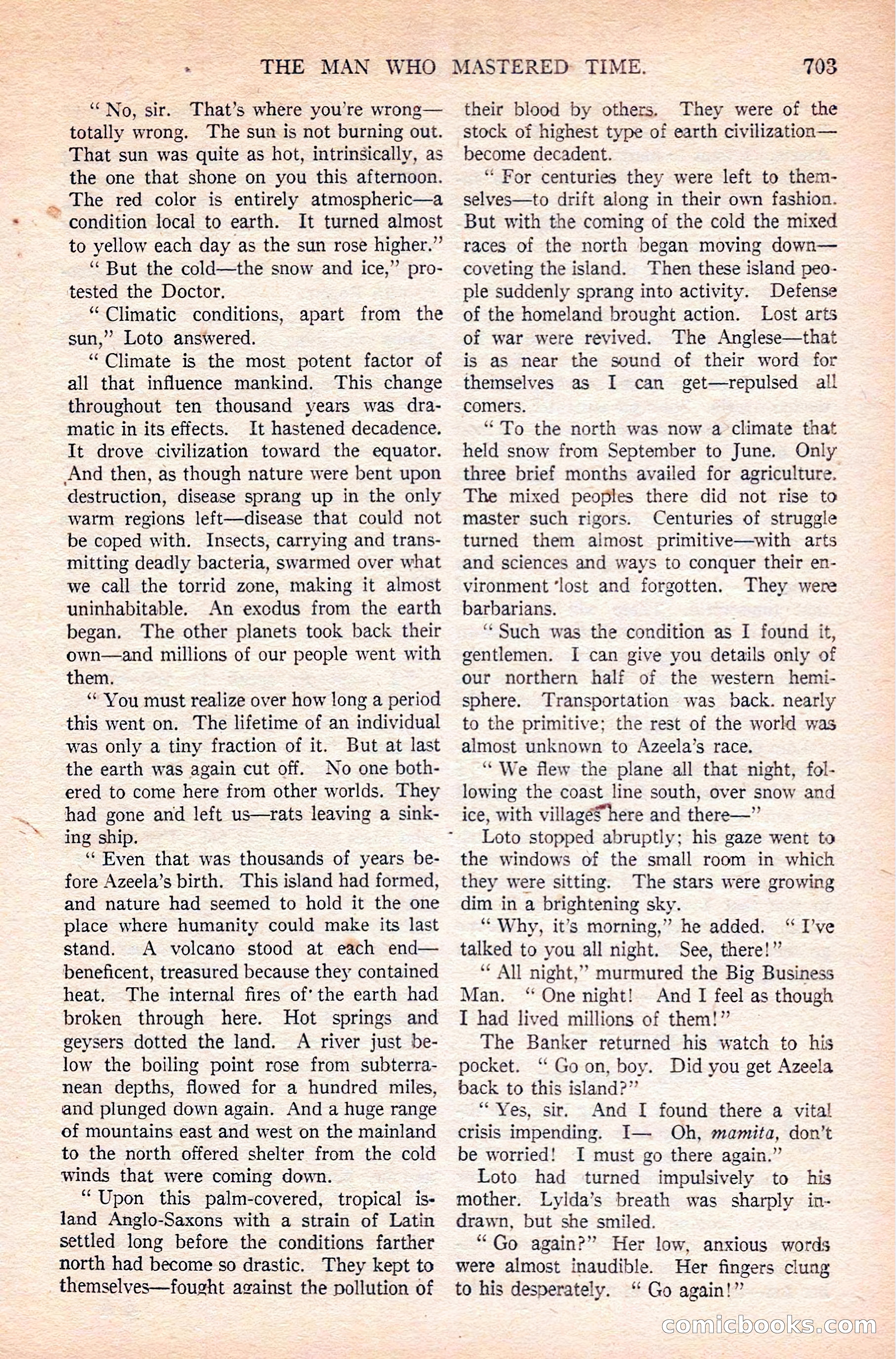
A restored page from Pulp Fiction, 1924. Page through the whole issue in the reader above.
📄 Transcribed text from this page (OCR, searchable)
Machine-transcribed from the original scan — historical spelling and the odd misread are preserved.
. THE MAN WHO MASTERED: TIME. ‘““No, sir. That’s where you’re wrong— totally wrong. The sun is not burning out. That sun was quite as hot, intrinsically, as the one that shone on you this afternoon. _ The red color is entirely atmospheric—a ~ condition local to earth. It turned almost to yellow each day as the sun rose higher.” ‘‘ But the cold—the snow and ice,” pro- tested the Doctor. “Climatic conditions, apart from the sun,” Loto answered. “Climate is the most potent factor of all that influence mankind. This change throughout ten thousand years was dra- matic in its effects. It hastened decadence. It drove civilization toward the equator. And then, as though nature were bent upon destruction, disease sprang up in the only warm regions left—disease that could not be coped with. Insects, carrying and trans- mitting deadly bacteria, swarmed over what we call the torrid zone, making it almost uninhabitable. An exodus from the earth began. The other planets took back their own—and millions of our people went with them. “You must realize over how long a period this went on. The lifetime of an individual was only a tiny fraction of it. But at last the earth was again cut off. No one both- ered to come here from other worlds. They had gone and left us—rats leaving a sink- ing ship. ‘‘ Even that was thousands of years be- fore Azeela’s birth. This island had formed, and nature had seemed to hold it the one place where humanity could make its last stand. A volcano stood at each end— beneficent, treasured because they contained heat. The internal fires of’ the earth had broken through here. Hot springs and geysers dotted the land. A river just be- low the boiling point rose from subterra- nean depths, flowed for a hundred miles, and plunged down again. And a huge range of mountains east and west on the mainland to the north offered shelter from the cold winds that were coming down. “Upon this palm-covered, tropical is- land Anglo-Saxons with a strain of Latin settled long before the conditions farther north had become so drastic. They kept to themselves—fought against the pollution of 7038 their blood by others. They were of the stock of highest type of earth civilization— become decadent. “ For centuries they were left to them- selves—to drift along in their own fashion. But with the coming of the cold the mixed races of the north began moving down— coveting the island. Then these island peo- ple suddenly sprang into activity. Defense of the homeland brought action. Lost arts of war were revived. The Anglese—that is as near the sound of their word for themselves as I can get—repulsed all comers. “To the north was now a-climate that held snow from September to June. Only three brief months availed for agriculture. The mixed peoples there did not rise to master such rigors. Centuries of struggle turned them almost primitive—with arts and sciences and ways to conquer their en- vironment ‘lost and forgotten. They were barbarians. “Such was the condition as I found it, gentlemen. I can give you details only of our northern half of the western hemi- sphere. Transportation was back. nearly to the primitive; the rest of the world was almost unknown to Azeela’s race. “We flew the plane all that night, fol- lowing the coast line south, over snow and ice, with villagé here and there—”’ Loto stopped abruptly; his gaze went to the windows of the small room in which they were sitting. The stars were growing dim in a brightening sky. ‘** Why, it’s morning,” he added. “ I’ve talked to you all night. See, there!” ‘* All night,” murmured the Big Business Man. “One night! And I feel as though I had lived millions of them!” The Banker returned his watch to his pocket. ‘“ Goon, boy. Did you get Azeela back to this island?” “Yes, sir. And I found there a vital crisis impending. I— Oh, mamita, don’t be worried! I must go there again.” Loto had turned impulsively to his mother. Lylda’s breath was sharply in- drawn, but she smiled. “Go again?” Her low, anxious words were almost inaudible. Her fingers clung to his desperately. ‘“ Go again!” oO CoOmmicbooo Ss (C@