
Pulp Fiction, 1924 · page 56 of 168
Argosy All-Story Weekly — page 56: what you’re looking at
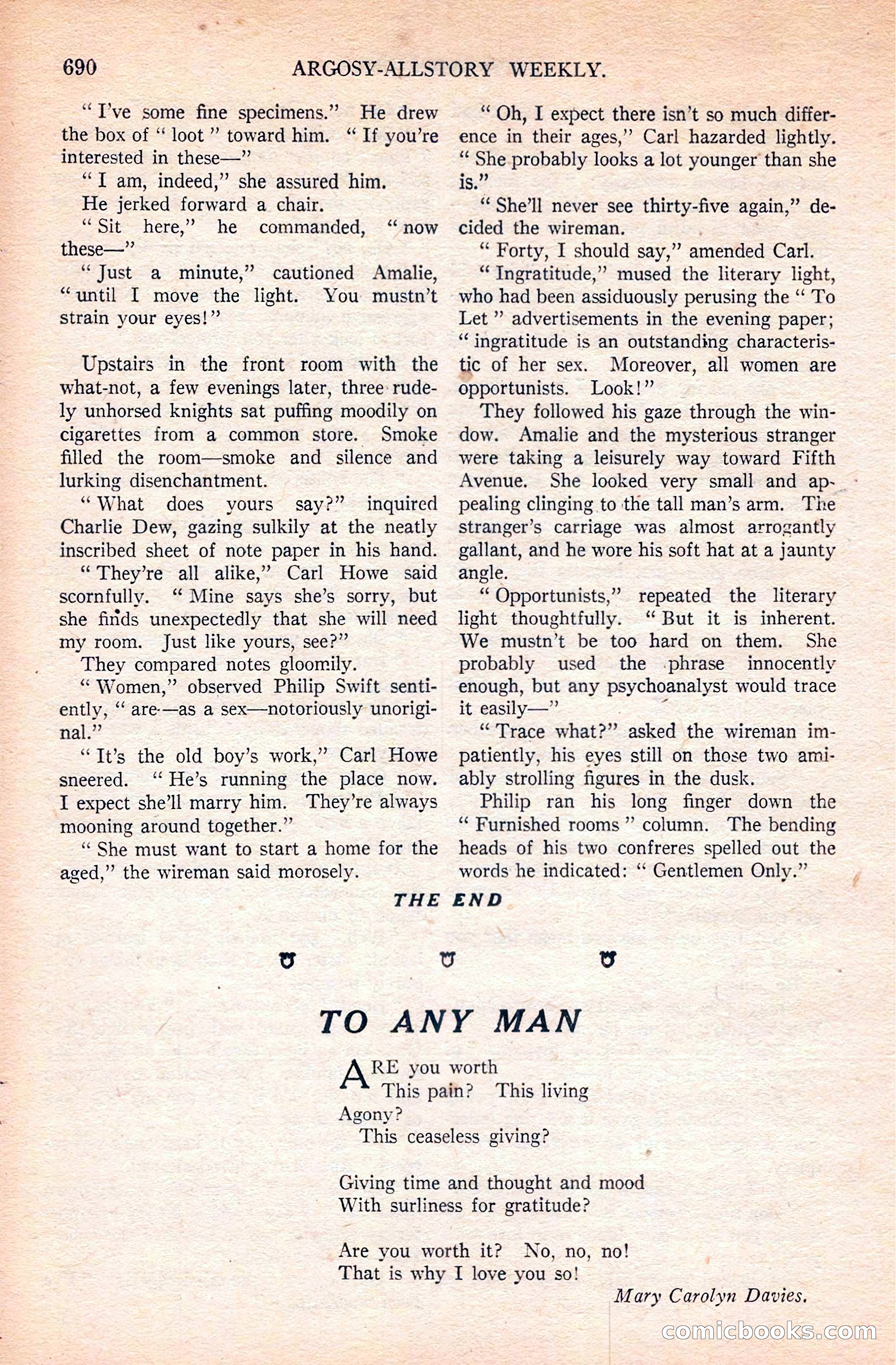
A restored page from Pulp Fiction, 1924. Page through the whole issue in the reader above.
📄 Transcribed text from this page (OCR, searchable)
Machine-transcribed from the original scan — historical spelling and the odd misread are preserved.
690 ‘““T’ve some fine specimens.” He drew the box of “loot” toward him. “ If you’re interested in these—”’ ‘““T am, indeed,” she assured him. He jerked forward a chair. “Sit here,’ he commanded, these—” ‘“ Just a minute,” cautioned Amalie, “until I move the light. You mustn’t strain your eyes!” ““ now Upstairs in the front room with the what-not, a few evenings later, three rude- ly unhorsed knights sat puffing moodily on cigarettes from a common store. Smoke filled the room—smoke and silence and lurking disenchantment. “What does yours say?” inquired Charlie Dew, gazing sulkily at the neatly inscribed sheet of note paper in his hand. “They’re all alike,” Carl Howe said scornfully. ‘‘ Mine says she’s sorry, but she finds unexpectedly that she will need my room. Just like yours, see?” They compared notes gloomily. “Women,” observed Philip Swift senti- ently, ‘‘ are—as a sex—notoriously unorigi- nal.” “Tt’s the old boy’s work,” Carl Howe sneered. ‘‘ He’s running the place now. I expect she’ll marry him. They’re always mooning around together.” ‘She must want to start a home for the aged,” the wireman said morosely. THE U ARGOSY-ALLSTORY WEEKLY. “Qh, I expect there isn’t so much differ- ence in their ages,’ Carl hazarded lightly. ‘* She probably looks a lot younger than she is.” “* She’ll never see thirty-five again,” de- cided the wireman. “Forty, I should say,”’ amended Carl. “* Ingratitude,” mused the literary light, who had been assiduously perusing the ‘‘ To Let ” advertisements in the evening paper; ‘ ingratitude is an outstanding characteris- tic of her sex. Moreover, all women are opportunists. Look!” They followed his gaze through the win- dow. Amalie and the mysterious stranger were taking a leisurely way toward Fifth Avenue. She looked very small and ap- pealing clinging to the tall man’s arm. The stranger’s carriage was almost arrogantly gallant, and he wore his soft hat at a jaunty angle. “Opportunists,” repeated the literary light thoughtfully. “ But it is inherent. We mustn’t be too hard on them. She probably used the -phrase innocently enough, but any psychoanalyst would trace it easily—”’ = “Trace what?” asked the wireman im- patiently, his eyes still on those two ami- ably strolling figures in the dusk. Philip ran his long finger down the ‘“‘ Furnished rooms” column. The bending heads of his two confreres spelled out the words he indicated: ‘“‘ Gentlemen Only.” END Le} TO ANY MAN RE you worth This pain? Agony? This living This ceaseless giving? Giving time and thought and mood With surliness for gratitude? Are you worth it? No, no, no! That is why I love you so! Mary Carolyn Davies. S oO GOMIGDOO (S@)