
Pulp Fiction, 1924 · page 47 of 168
Argosy All-Story Weekly — page 47: what you’re looking at
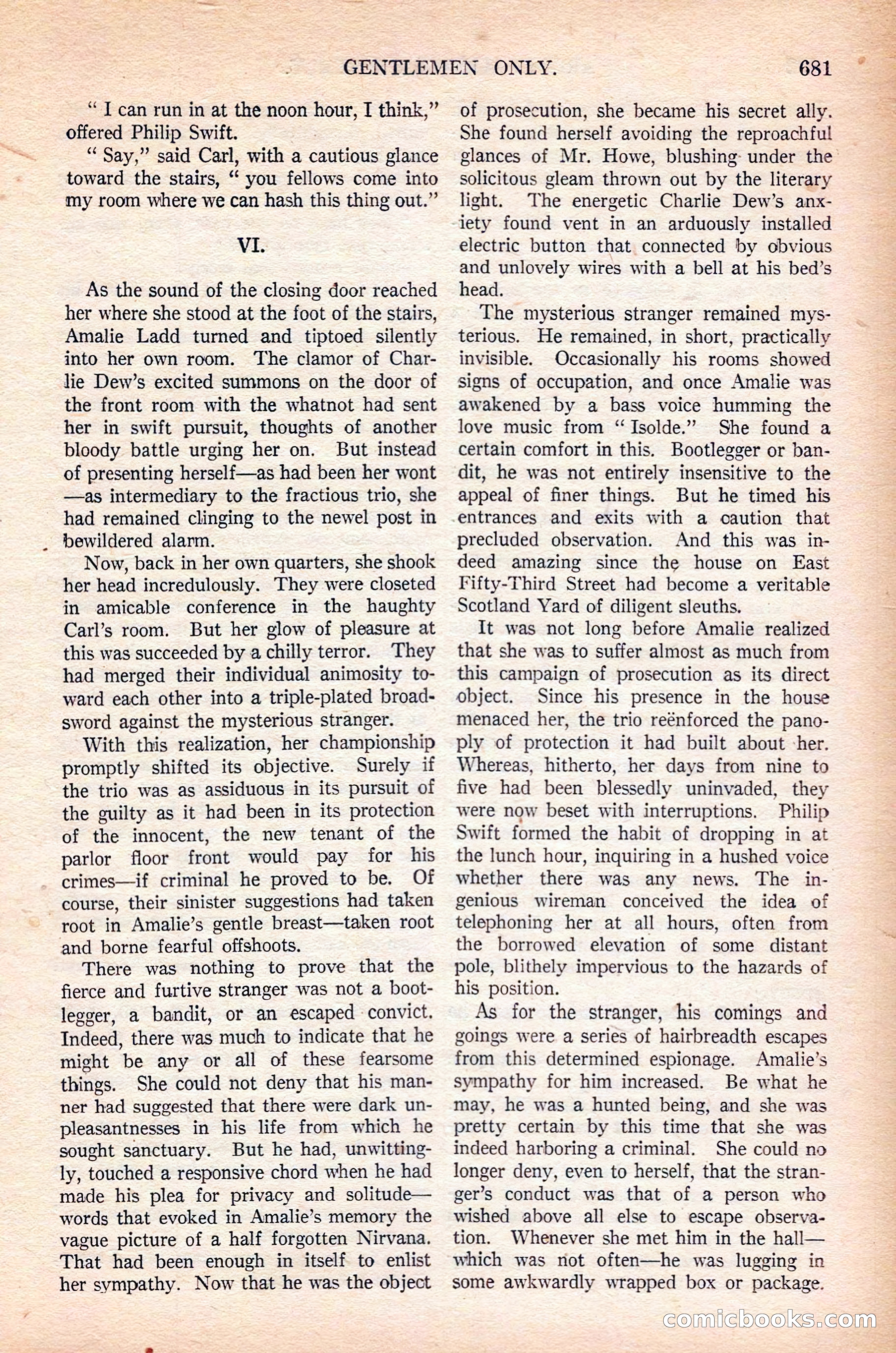
A restored page from Pulp Fiction, 1924. Page through the whole issue in the reader above.
📄 Transcribed text from this page (OCR, searchable)
Machine-transcribed from the original scan — historical spelling and the odd misread are preserved.
GENTLEMEN ONLY. “IT can run in at the noon hour, I think,” offered Philip Swift. 7 “Say,” said Carl, with a cautious glance toward the stairs, “ you fellows come into my room where we can hash this thing out.” VI. As the sound of the closing door reached her where she stood at the foot of the stairs, Amalie Ladd turned and tiptoed silently into her own room. The clamor of Char- lie Dew’s excited summons on the door of the front room with the whatnot had sent her in swift pursuit, thoughts of another bloody battle urging her on. But instead of presenting herself—as had been her wont —as intermediary to the fractious trio, she had remained clinging to the newel post in bewildered alarm. Now, back in her own quarters, she shook her head incredulously. They were closeted in amicable conference in the haughty Carl’s room. But her glow of pleasure at this was succeeded by a chilly terror. They had merged their individual animosity to- ward each other into a triple-plated broad- sword against the mysterious stranger. With this realization, her championship promptly shifted its objective. Surely if the trio was as assiduous in its pursuit of the guilty as it had been in its protection of the innocent, the new tenant of the parlor floor front would pay for his crimes—if criminal he proved to be. Of course, their sinister suggestions had taken root in Amalie’s gentle breast—taken root and borne fearful offshoots. There was nothing to prove that the fierce and furtive stranger was not a boot- legger, a bandit, or an escaped convict. Indeed, there was much to indicate that he might be any or all of these fearsome things. She could not deny that his man- ner had suggested that there were dark un- pleasantnesses in his life from which he sought sanctuary. But he had, unwitting- ly, touched a responsive chord when he had made his plea for privacy and solitude— words that evoked in Amalie’s memory the vague picture of a half forgotten Nirvana. That had been enough in itself to enlist her svmpathy. Now that he was the object 681 of prosecution, she became his secret ally. She found herself avoiding the reproachful glances of Mr. Howe, blushing: under the solicitous gleam thrown out by the literary light. The energetic Charlie Dew’s anx- iety found vent in an arduously installed electric button that connected by obvious and unlovely wires with a bell at his bed’s head. The mysterious stranger remained mys- terious. He remained, in short, practically invisible. Occasionally his rooms showed signs of occupation, and once Amalie was awakened by a bass voice humming the love music from “ Isolde.” She found a certain comfort in this. Bootlegger or ban- dit, he was not entirely insensitive to the appeal of finer things. But he timed his entrances and exits with a oaution that precluded observation. And this was in- deed amazing since the house on East Fifty-Third Street had become a veritable Scotland Yard of diligent sleuths. It was not long before Amalie realized that she was to suffer almost as much from this campaign of prosecution as its direct object. Since his presence in the house menaced her, the trio reénforced the pano- ply of protection it had built about ‘her. Whereas, hitherto, her days from nine to five had been blessedly uninvaded, they were now beset with interruptions. Philip Swift formed the habit of dropping in at the lunch hour, inquiring in a hushed voice whether there was any news. The in- genious wireman conceived the idea of telephoning her at all hours, often from the borrowed elevation of some distant pole, blithely impervious to the hazards of his position. As for the stranger, his comings and goings were a series of hairbreadth escapes from this determined espionage. Amalie’s sympathy for him increased. Be what he may, he was a hunted being, and she was pretty certain by this time that she was indeed harboring a criminal. She could no longer deny, even to herself, that the stran- ger’s conduct was that of a person who wished above all else to escape observa- tion. Whenever she met him in the hall— which was not often—he was lugging in some awkwardly wrapped box or package. ComicloOookS. conn