
Pulp Fiction, 1924 · page 38 of 168
Argosy All-Story Weekly — page 38: what you’re looking at
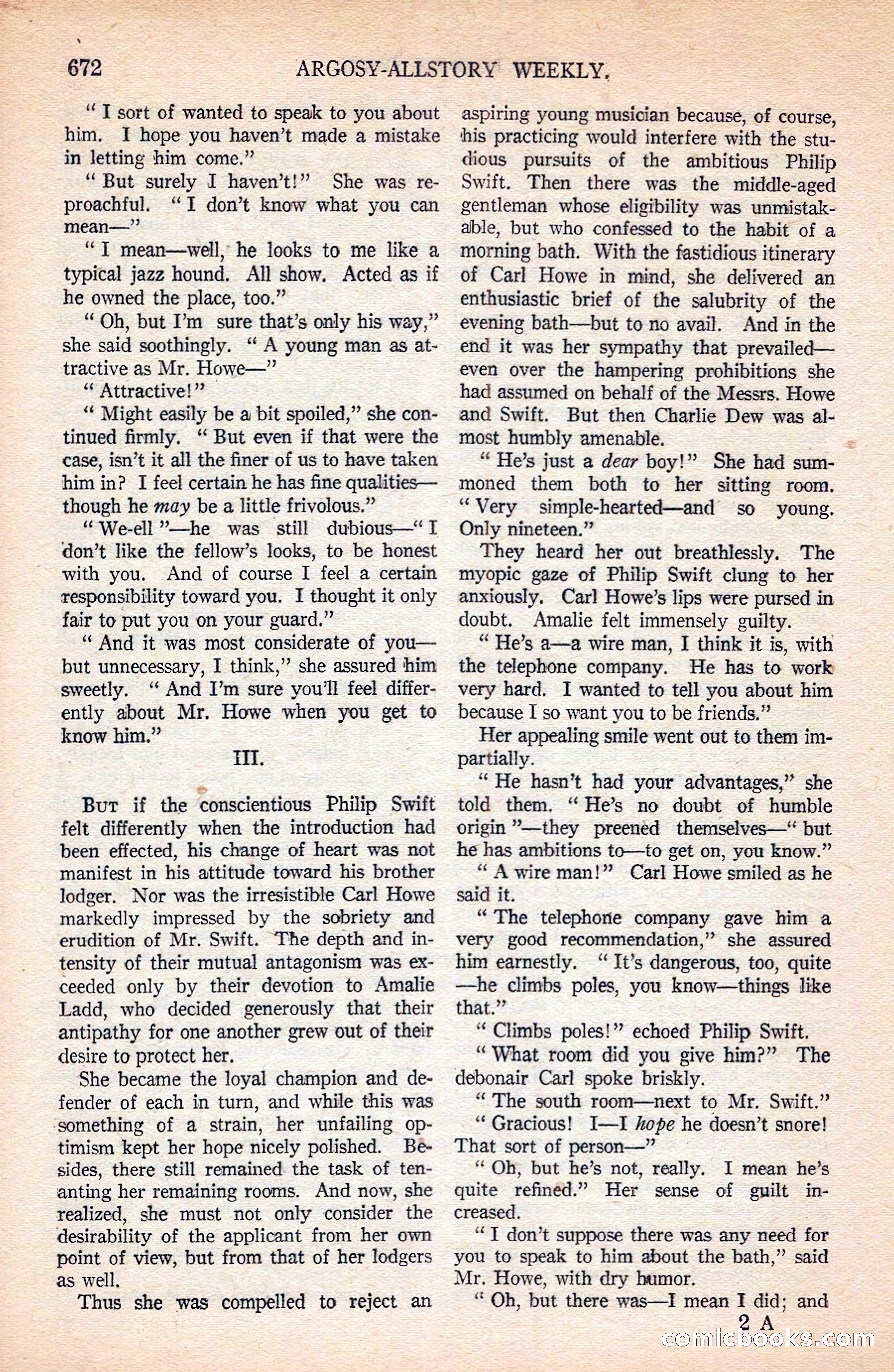
A restored page from Pulp Fiction, 1924. Page through the whole issue in the reader above.
📄 Transcribed text from this page (OCR, searchable)
Machine-transcribed from the original scan — historical spelling and the odd misread are preserved.
‘ 672 “T sort of wanted to speak to you about him. I hope you haven’t made a mistake in letting him come.” “ But surely I haven’t!” She was re- proachful. “I don’t know what you can mean—”’ ‘““T mean—well, he looks to me like a typical jazz hound. All show. Acted as if he owned the place, too.” “Oh, but I’m sure that’s only his way,” she said soothingly. “ A young man as at- tractive as Mr. Howe—” “ Attractive!” ““ Might easily be a bit spoiled,” she con- tinued firmly. ‘“‘ But even if that were the case, isn’t it all the finer of us to have taken him in? I feel certain he has fine qualities— though he may be a little frivolous.” “We-ell "—he was still dubious—“I don’t like the fellow’s looks, to be honest with you. And of course I feel a certain responsibility toward you. I thought it only fair to put you on your guard.” ‘And it was most considerate of you— but unnecessary, I think,” she assured ‘him sweetly. ‘‘ And I’m sure you'll feel differ- ently about Mr. Howe when you get to know him.” | il. Burt if the conscientious Philip Swift felt differently when the introduction had been effected, his change of heart was not manifest in his attitude toward his brother lodger. Nor was the irresistible Carl Howe markedly impressed by the sobriety and erudition of Mr. Swift. The depth and in- tensity of their mutual antagonism was ex- ceeded only by their devotion to Amalie Ladd, who decided generously that their antipathy for one another grew out of their desire to protect her. She became the loyal champion and de- fender of each in turn, and while this was ‘something of a strain, her unfailing op- timism kept her hope nicely polished. Be- sides, there still remained the task of ten- anting her remaining rooms. And now, she realized, she must not only consider the desirability of the applicant from her own point of view, but from that of her lodgers as well. Thus she was compelled to reject an ARGOSY-ALLSTORY WEEKLY. aspiring young musician because, of course, his practicing would interfere with the stu- dious pursuits of the ambitious Philip Swift. Then there was the middle-aged gentleman whose eligibility was unmistak- able, but who confessed to the habit of a morning bath. With the fastidious itinerary of Carl Howe in mind, she delivered an enthusiastic brief of the salubrity of the evening bath—but to no avail. And in the end it was her sympathy that prevailed— even over the hampering prohibitions she had assumed on behalf of the Messrs. Howe and Swift. But then Charlie Dew was al- most humbly amenable. a “ He’s just a dear boy!” She had sum- moned them both to her sitting room. “Very simple-hearted—and so young. Only nineteen.” They heard her out breathlessly. The myopic gaze of Philip Swift clung to her anxiously. Carl Howe’s lips were pursed in doubt. Amalie felt immensely guilty. “ He’s a—a wire man, I think it is, with the telephone company. He has to work very hard. I wanted to tell you about him because I so want you to be friends.” Her appealing smile went out to them im- partially. ; “He hasn’t had your advantages,” she told them. “He’s no doubt of humble origin ”—they preened themselves—‘“ but he has ambitions to—to get on, you know.” “A wire man!” Carl Howe smiled as he said it. “The telephorie company gave him a very good recommendation,” she assured him earnestly. “It’s dangerous, too, quite —he climbs poles, you know—things like that.” “Climbs poles!” echoed Philip Swift. “What room did you give him?” The debonair Carl spoke briskly. “The south room—next to Mr. Swift.” ‘“‘ Gracious! I—TI kope he doesn’t snore! That sort of person—” “Oh, but he’s not, really. I mean he’s quite refined.” Her sense of guilt in- creased. “TI don’t suppose there was any need for you to speak to him about the bath,” said Mr. Howe, with dry humor. “ Oh, but there was—I mean I did; and COMNMIGVOOKXSn(GE)