
Pulp Fiction, 1924 · page 31 of 168
Argosy All-Story Weekly — page 31: what you’re looking at
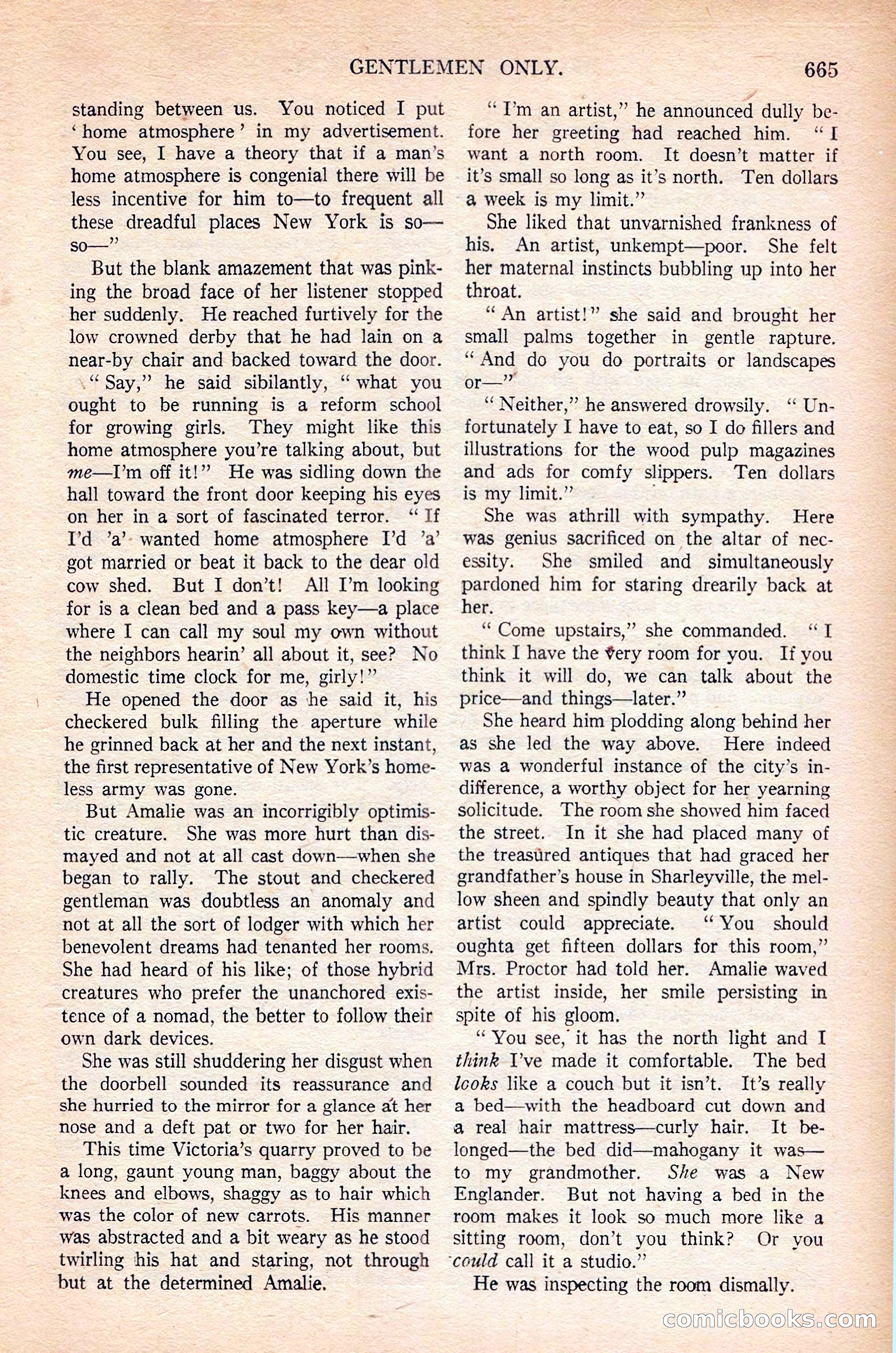
A restored page from Pulp Fiction, 1924. Page through the whole issue in the reader above.
📄 Transcribed text from this page (OCR, searchable)
Machine-transcribed from the original scan — historical spelling and the odd misread are preserved.
GENTLEMEN ONLY. standing between us. You noticed I put ‘home atmosphere’ in my advertisement. You see, I have a theory that if a man’s home atmosphere is congenial there will be less incentive for him to—to frequent all these dreadful places New York is so— Sy But the blank amazement that was pink- ing the broad face of her listener stopped her suddenly. He reached furtively for the low crowned derby that he had lain on a near-by chair and backed toward the door. .“ Say,” he said sibilantly, “what you ought to be running is a reform school for growing girls. They might like this home atmosphere you’re talking about, but me—I’m off it!” He was sidling down the hall toward the front door keeping his eyes on her in a sort of fascinated terror. ‘“‘ If I’d ’a’- wanted home atmosphere I’d ’a’ got married or beat it back to the dear old cow shed. But I don’t! All I’m looking for is a clean bed and a pass key—a place where I can call my soul my own without the neighbors hearin’ all about it, see? No domestic time clock for me, girly!” He opened the door as he said it, his checkered bulk filling the aperture while he grinned back at her and the next instant, the first representative of New York’s home- less army was gone. But Amalie was an incorrigibly optimis- tic creature. She was more hurt than dis- mayed and not at all cast down—when she began to rally. The stout and checkered gentleman was doubtless an anomaly and not at all the sort of lodger with which her benevolent dreams had tenanted her rooms. She had heard of his like; of those hybrid creatures who prefer the unanchored exis- tence of a nomad, the better to follow their own dark devices. She was still shuddering her disgust when the doorbell sounded its reassurance and she hurried to the mirror for a glance at her nose and a deft pat or two for her hair. This time Victoria’s quarry proved to be a long, gaunt young man, baggy about the knees and elbows, shaggy as to hair which was the color of new carrots. His manner was abstracted and a bit weary as he stood twirling his hat and staring, not through but at the determined Amalie. 665 ‘T’m an artist,” he announced dully be- fore her greeting had reached him. “I want a north room. It doesn’t matter if it’s small so long as it’s north. Ten dollars a@ week is my limit.” She liked that unvarnished frankness of his. An artist, unkempt—poor. She felt her maternal instincts bubbling up into her throat. ‘An artist!” she said and brought her small palms together in gentle rapture. ‘“And do you do portraits or landscapes or? ‘““ Neither,” he answered drowsily. ‘“ Un- fortunately I have to eat, so I do fillers and illustrations for the wood pulp magazines and ads for comfy slippers. Ten dollars is my limit.” She was athrill with sympathy. Here was genius sacrificed on the altar of nec- essity. She smiled and simultaneously pardoned him for staring drearily back at her. ‘““Come upstairs,” she commanded. ‘I think I have the ¥ery room for you. If you think it will do, we can talk about the price—and things—later.” She heard him plodding along behind her as She led the way above. Here indeed was a wonderful instance of the city’s in- difference, a worthy object for her yearning solicitude. The room she showed him faced the street. In it she had placed many of the treasured antiques that had graced her grandfather’s house in Sharleyville, the mel- low sheen and spindly beauty that only an artist could appreciate. ‘ You should oughta get fifteen dollars for this room,” Mrs. Proctor had told her. Amalie waved the artist inside, her smile persisting in spite of his gloom. “You see, it has the north light and I think \’ve made it comfortable. The bed lcoks like a couch but it isn’t. It’s really a bed—with the headboard cut down and a real hair mattress—curly hair. It be- longed—the bed did—mahogany it was— to my grandmother. Ske was a New Englander. But not having a bed in the room makes it look so much more like a sitting room, don’t you think? Or you ‘could call it a studio.” He was inspecting the room dismally. GOMIIGIOO KS (S@