
Pulp Fiction, 1924 · page 109 of 168
Argosy All-Story Weekly — page 109: what you’re looking at
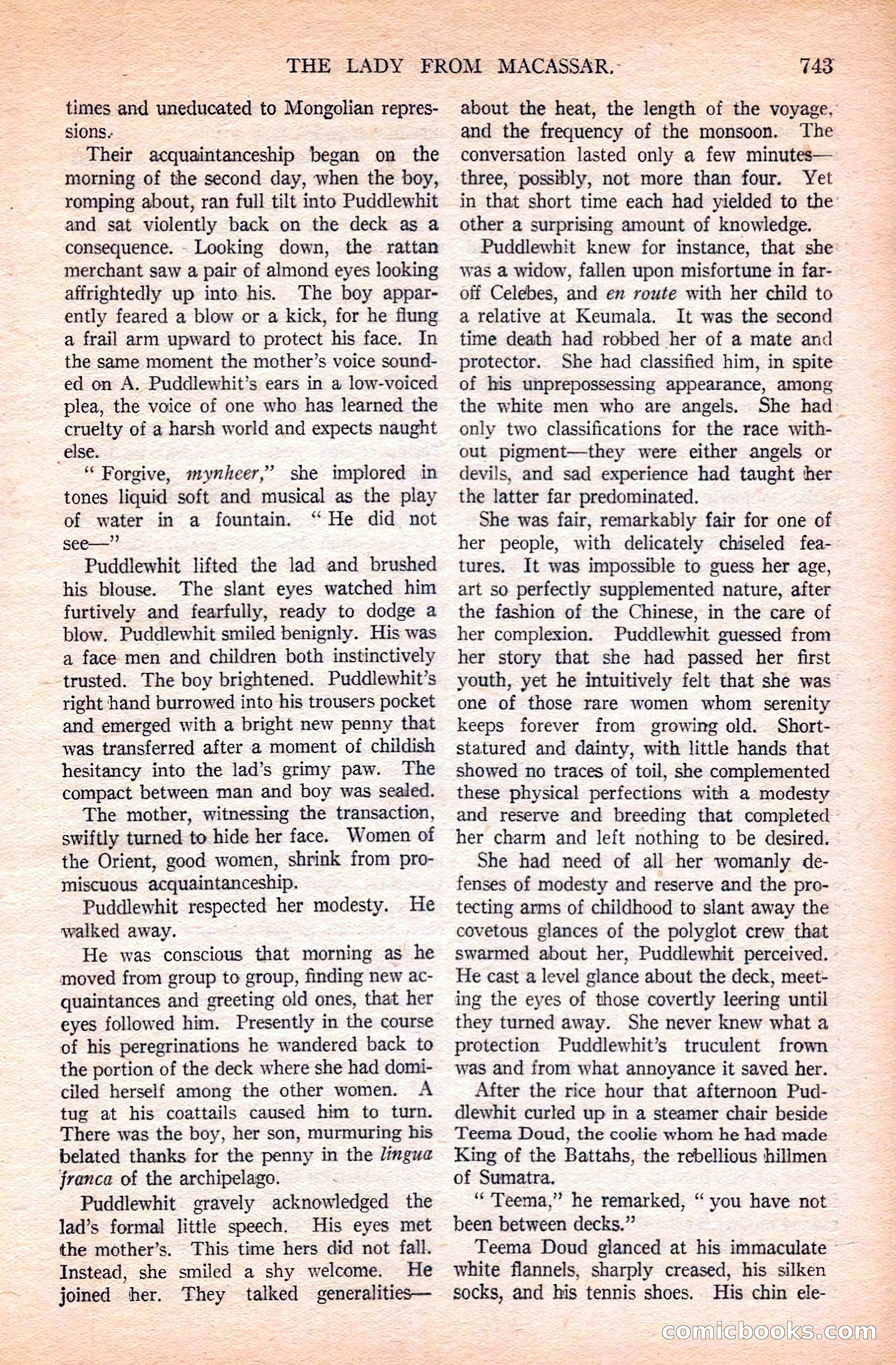
A restored page from Pulp Fiction, 1924. Page through the whole issue in the reader above.
📄 Transcribed text from this page (OCR, searchable)
Machine-transcribed from the original scan — historical spelling and the odd misread are preserved.
a THE LADY FROM MACASSAR.- — times and uneducated to Mongolian repres- sions. 7 Their acquaintanceship began on the morning of the second day, when the boy, romping about, ran full tilt into Puddlewhit and sat violently back on the deck as a consequence. - Looking down, the rattan merchant saw a pair of almond eyes looking affrightedly up into his. The boy appar- ently feared a blow or a kick, for he flung a frail arm upward to protect his face. In the same moment the mother’s voice sound- ed on A. Puddlewhit’s ears in a low-voiced plea, the voice of one who has learned the cruelty of a harsh world and expects naught else. Forgive, mynheer,’ she implored in tones liquid soft and musical as the play of water in a fountain. “ He did not see—” Puddlewhit lifted the lad and brushed his blouse. The slant eyes watched him furtively and fearfully, ready to dodge a blow. Puddlewhit smiled benignly. His was a face men and children both instinctively _ trusted. The boy brightened. Puddlewhit’s right hand burrowed into his trousers pocket and emerged with a bright new penny that was transferred after a moment of childish hesitancy into the lad’s grimy paw. The compact between man and boy was sealed. _ The mother, witnessing the transaction, swiftly turned to hide her face. Women of the Orient, good women, shrink from pro- miscuous acquaintanceship. Puddlewhit respected her modesty. He walked away. He was conscious that morning as he moved from group to group, finding new ac- quaintances and greeting old ones, that her eyes followed him. Presently in the course of his peregrinations he wandered back to the portion of the deck where she had domi- ciled herself among the other women. A tug at his coattails caused him to turn. There was the boy, her son, murmuring his belated thanks for the penny in the lingua jranca of the archipelago. Puddlewhit gravely acknowledged the lad’s formal little speech. His eyes met the mother’s. This time hers did not fall. Instead, she smiled a shy welcome. He joined ther. They talked generalities— 743 about the heat, the length of the voyage, and the frequency of the monsoon. The conversation lasted only a few minutes— three, possibly, not more than four. Yet in that short time each had yielded to the’ other a surprising amount of knowledge. Puddlewhit knew for instance, that she was a widow, fallen upon misfortune in far- off Celebes, and en route with her child to a relative at Keumala. It was the second time death had robbed her of a mate and protector. She had classified him, in spite of his unprepossessing appearance, among the white men who are angels. only two classifications for the race with- out pigment—they were either angels or devils, and sad experience had taught her the latter far predominated. She was fair, remarkably fair for one of her people, with delicately chiseled fea- tures. It was impossible to guess her age, art so perfectly supplemented nature, after the fashion of the Chinese, in the care of her complexion. Puddlewhit guessed from her story that she had passed her first youth, yet he intuitively felt that she was one of those rare women whom serenity keeps forever from growing old. Short- statured and dainty, with little hands that showed no traces of toil, she complemented these physical perfections with a modesty and reserve and breeding that completed her charm and left nothing to be desired. She had need of all her womanly de- fenses of modesty and reserve and the pro- tecting arms of childhood to slant away the covetous glances of the polyglot crew that swarmed about her, Puddlewhit perceived. - He cast a level glance about the deck, meet- ing the eyes of those covertly leering until they turned away. She never knew what a protection Puddlewhit’s truculent frown was and from what annoyance it saved her. After the rice hour that afternoon Pud- dlewhit curled up in a steamer chair beside Teema Doud, the coolie whom he had made King of the Battahs, the rebellious hillmen of Sumatra. ‘“Teema,” he remarked, “ you have not been between decks.” Teema Doud glanced at his immaculate white flannels, sharply creased, his silken socks, and his tennis shoes. His chin ele- oO She had- CORDICLOOKS.EO