
Pulp Fiction, 1924 · page 102 of 168
Argosy All-Story Weekly — page 102: what you’re looking at
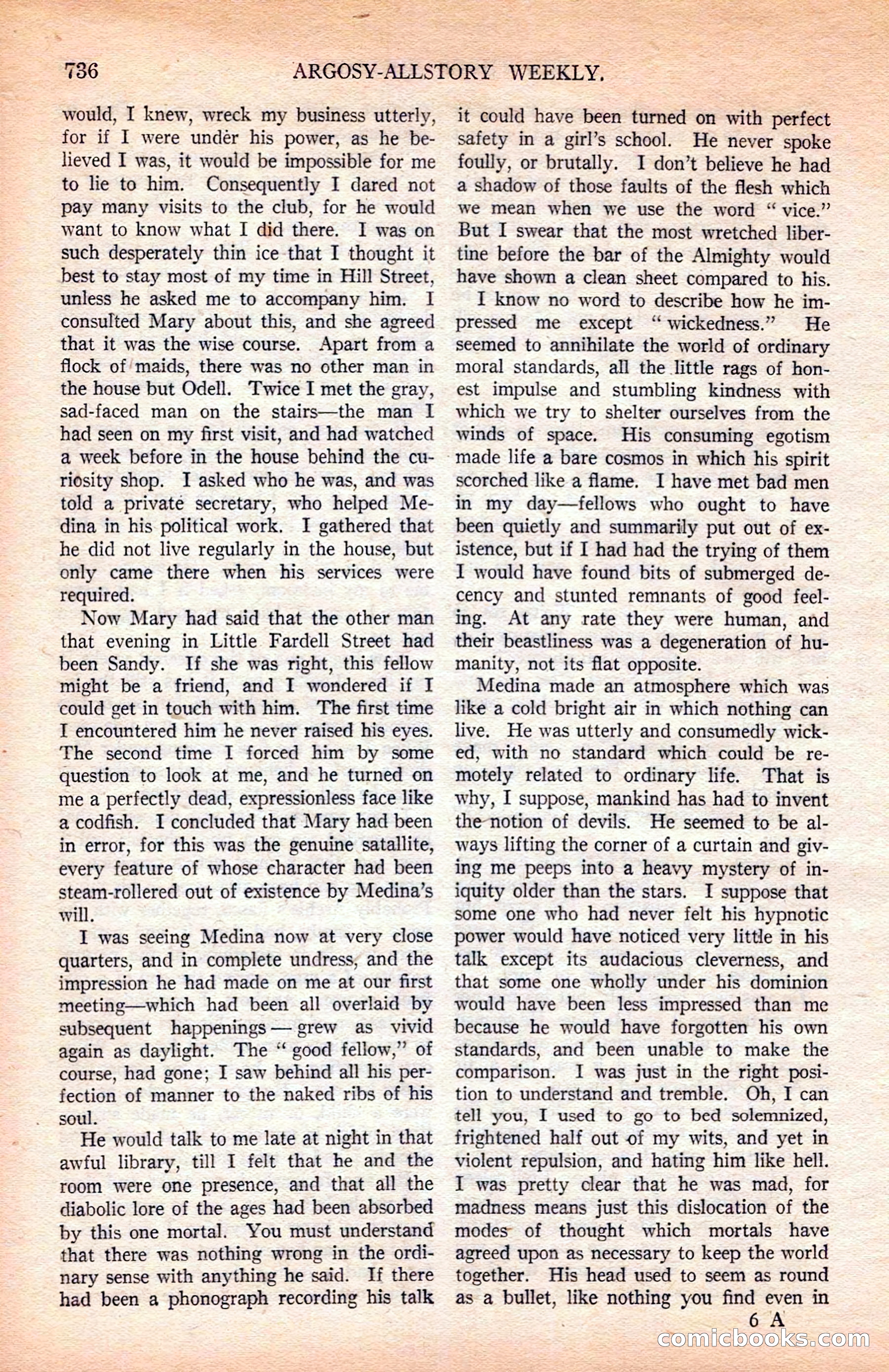
A restored page from Pulp Fiction, 1924. Page through the whole issue in the reader above.
📄 Transcribed text from this page (OCR, searchable)
Machine-transcribed from the original scan — historical spelling and the odd misread are preserved.
would, I knew, wreck my business utterly, for if I were undér his power, as he be- lieved I was, it would be impossible for me to lie to him. Consequently I dared not pay many visits to the club, for he would want to know what I did there. I was on such desperately thin ice that I thought it best to stay most of my time in Hill Street, unless he asked me to accompany him. I consulted Mary about this, and she agreed that it was the wise course. Apart from a flock of maids, there was no other man in the house but Odell. Twice I met the gray, sad-faced man on the stairs—the man I had seen on my first visit, and had watched a week before in the house behind the cu- ridsity shop. I asked who he was, and was told a private secretary, who helped Me- dina in his political work. I gathered that he did not live regularly in the house, but only came there when his services were required. Now Mary had said that the other man - that evening in Little Fardell Street had been Sandy. If she was right, this fellow might be a friend, and I wondered if I could get in touch with him. The first time I encountered him he never raised his eyes. The second time I forced him by some question to look at me, and he turned on me a perfectly dead, expressionless face like a codfish. I concluded that Mary had been in error, for this was the genuine satallite, every feature of whose character had been steam-rollered out of existence by Medina’s will. I was seeing Medina now at very close quarters, and in complete undress, and the impression he had made on me at our first meeting—which had been all overlaid by subsequent happenings— grew as vivid again as daylight. The “ good fellow,” of course, had gone; I saw behind all his per- fection of manner to the naked ribs of his soul. He would talk to me late at night in that awful library, till I felt that he and the room were one presence, and that all the diabolic lore of the ages had been absorbed by this one mortal. You must understand that there was nothing wrong in the ordi- nary sense with anything he said. If there had been a phonograph recording his talk ARGOSY-ALLSTORY WEEKLY. it could have been turned on with perfect safety in a girl’s school. He never spoke foully, or brutally. I don’t believe he had a shadow of those faults of the flesh which we mean when we use the word “ vice.” But I swear that the most wretched liber- tine before the bar of the Almighty would have shown a clean sheet compared to his. I know no word to describe how he im- pressed me except “wickedness.” He seemed to annihilate the world of ordinary moral standards, all the little rags of hon- est impulse and stumbling kindness with which we try to shelter ourselves from the winds of space. His consuming egotism made life a bare cosmos in which his spirit scorched like a flame. I have met bad men in my day—fellows who ought to have been quietly and summarily put out of ex- istence, but if I had had the trying of them I would have found bits of submerged de- cency and stunted remnants of good feel- ing. At any rate they were human, and their beastliness was a degeneration of hu- manity, not its flat opposite. Medina made an atmosphere which was like a cold bright air in which nothing can live. He was utterly and consumedly wick- ed, with no standard which could be re- motely related to ordinary life. That is why, I suppose, mankind has had to invent the-notion of devils. He seemed to be al- ways lifting the corner of a curtain and giv- ing me peeps into a heavy mystery of in- iquity older than the stars. I suppose that some one who had never felt his hypnotic power would have noticed very little in his talk except its audacious cleverness, and that some one wholly under his dominion would have been less impressed than me because he would have forgotten his own standards, and been unable to make the comparison. I was just in the right posi- tion to understand and tremble. Oh, I can tell you, I used to go to bed solemnized, frightened half out of my wits, and yet in violent repulsion, and hating him like hell. I was pretty clear that he was mad, for madness means just this dislocation of the modes’ of thought which mortals have agreed upon as necessary to keep the world together. His head used to seem as round as a bullet, like nothing you find even in 6 A COMME IOOKS (S@)