
Pulp Fiction, 1924 · page 67 of 176
Argosy All-Story Weekly — page 67: what you’re looking at
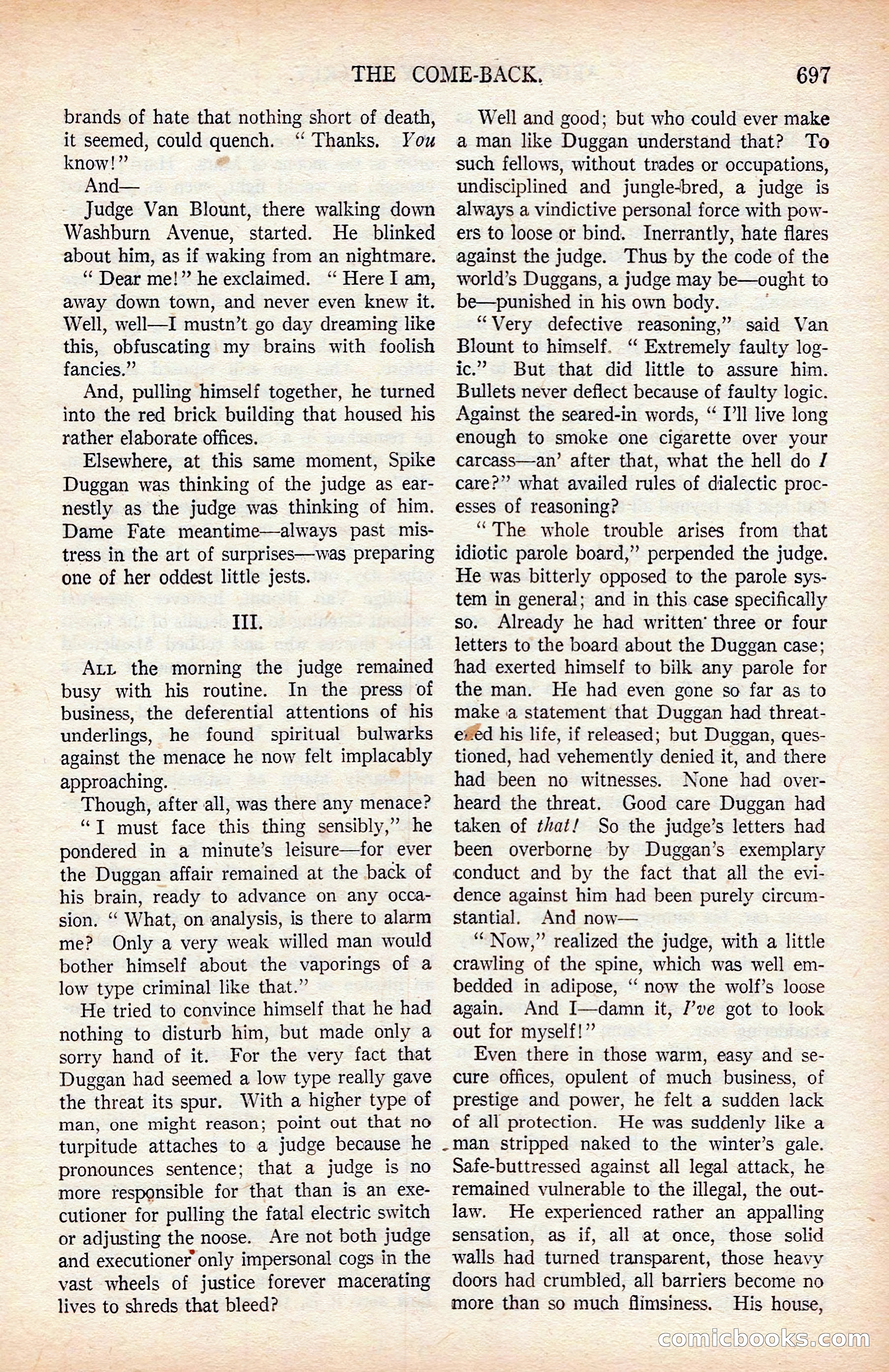
A restored page from Pulp Fiction, 1924. Page through the whole issue in the reader above.
📄 Transcribed text from this page (OCR, searchable)
Machine-transcribed from the original scan — historical spelling and the odd misread are preserved.
THE COME-BACK. brands of hate that nothing short of death, it seemed, could quench. “Thanks. You know!” And— Judge Van Blount, there walking down Washburn Avenue, started. He blinked about him, as if waking from an nightmare. ‘“ Dear me!” he exclaimed. ‘‘ Here I am, away down town, and never even knew it. Well, well—I mustn’t go day dreaming like this, obfuscating my brains with foolish fancies.” And, pulling himself together, he turned into the red brick building that housed his rather elaborate offices. Elsewhere, at this same moment, Spike Duggan was thinking of the judge as ear- nestly as the judge was thinking of him. Dame Fate meantime—always past mis- tress in the art of surprises—was preparing one of her oddest little jests. Il. Att the morning the judge remained busy with his routine. In the press of business, the deferential attentions of his underlings, he found spiritual bulwarks against the menace he now felt implacably approaching. Though, after all, was there any menace? “T must face this thing sensibly,” he pondered in a minute’s leisure—for ever the Duggan affair remained at the back of his brain, ready to advance on any occa- sion. “ What, on analysis, is there to alarm me? Only a very weak willed man would bother himself about the vaporings of a low type criminal like that.” He tried to convince himself that he had nothing to disturb him, but made only a sorry hand of it. For the very fact that Duggan had seemed a low type really gave the threat its spur. With a higher type of man, one might reason; point out that no turpitude attaches to a judge because he pronounces sentence; that a judge is no more responsible for that than is an exe- cutioner for pulling the fatal electric switch or adjusting the noose. Are not both judge and executioner only impersonal cogs in the vast wheels of justice forever macerating lives to shreds that bleed? 697 Well and good; but who could ever make a man like Duggan understand that? To such fellows, without trades or occupations, undisciplined and jungle-bred, a judge is always a vindictive personal force with pow- ers to loose or bind. Inerrantly, hate flares against the judge. Thus by the code of the world’s Duggans, a judge may be—ought to be—punished in his own body. “Very defective reasoning,” said Van Blount to himself. ‘ Extremely faulty log- ic.” But that did little to assure him. Bullets never deflect because of faulty logic. Against the seared-in words, “ I’ll live long enough to smoke one cigarette over your carcass—an’ after that, what the hell do J care?” what availed rules of dialectic proc- esses of reasoning? “The whole trouble arises from that idiotic parole board,” perpended the judge. He was bitterly opposed to the parole sys- tem in general; and in this case specifically so. Already he had written’ three or four letters to the board about the Duggan case; had exerted himself to bilk any parole for the man. He had even gone so far as to make a statement that Duggan had threat- eiled his life, if released; but Duggan, ques- tioned, had vehemently denied it, and there had been no witnesses. None had over- heard the threat. Good care Duggan had taken of that! So the judge’s letters had been overborne by Duggan’s exemplary conduct and by the fact that all the evi- dence against him had been purely circum- stantial. And now— “Now,” realized the judge, with a little crawling of the spine, which was well em- bedded in adipose, ‘‘ now the wolf’s loose again. And I—damn it, /’ve got to look out for myself!” Even there in those warm, easy and se- cure offices, opulent of much business, of prestige and power, he felt a sudden lack of all protection. He was suddenly like a -man stripped naked to the winter’s gale. Safe-buttressed against all legal attack, he remained vulnerable to the illegal, the out- law. He experienced rather an appalling sensation, as if, all at once, those solid walls had turned transparent, those heavy doors had crumbled, all barriers become no more than so much flimsiness. His house, CoOpmicooolkkSsEe©