
Pulp Fiction, 1924 · page 65 of 176
Argosy All-Story Weekly — page 65: what you’re looking at
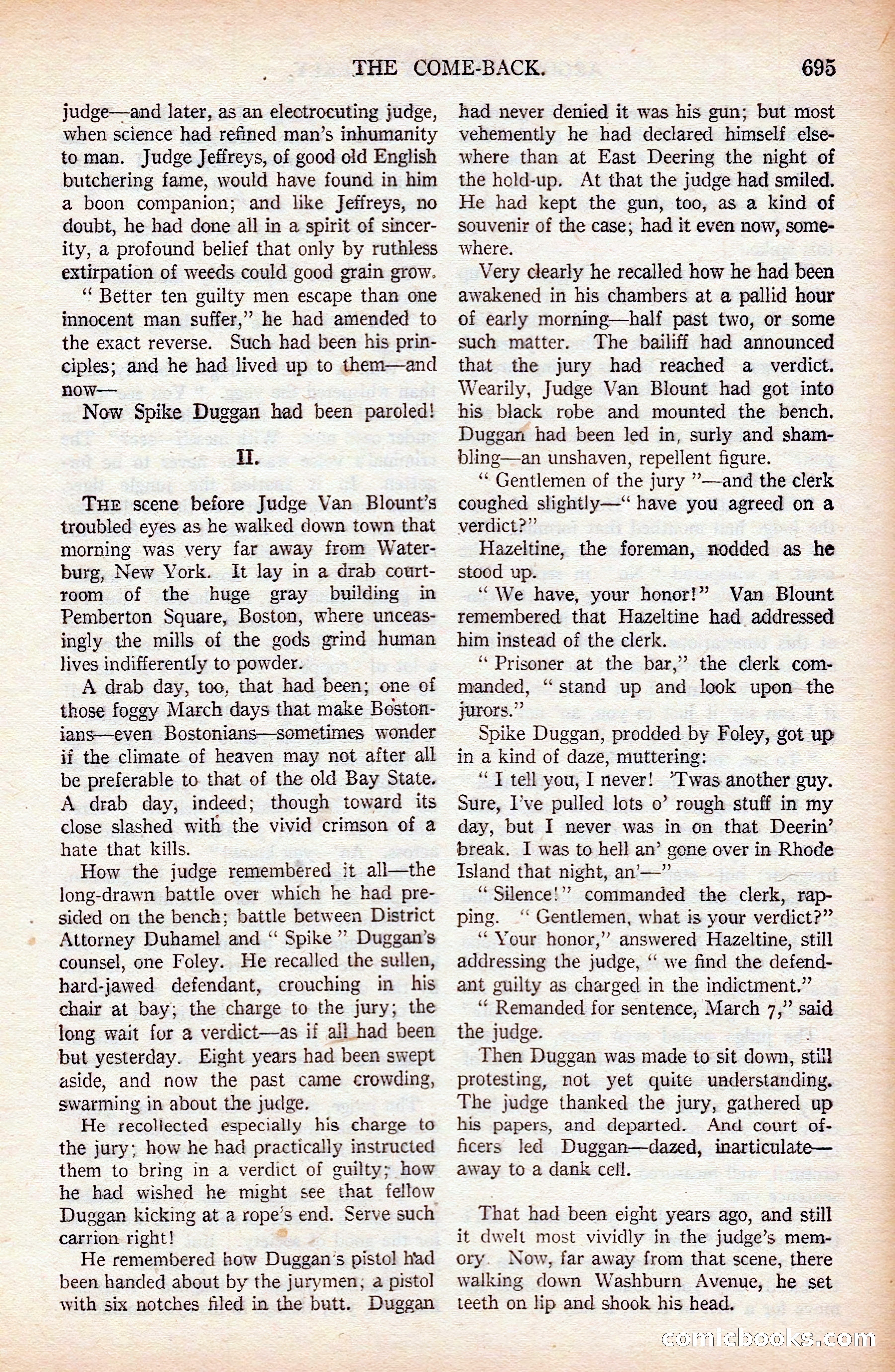
A restored page from Pulp Fiction, 1924. Page through the whole issue in the reader above.
📄 Transcribed text from this page (OCR, searchable)
Machine-transcribed from the original scan — historical spelling and the odd misread are preserved.
THE COME-BACK. judge—and later, as an electrocuting judge, when science had refined man’s inhumanity toman. Judge Jeffreys, of good old English butchering fame, would have found in him a boon companion; and like Jeffreys, no doubt, he had done all in a spirit of sincer- ity, a profound belief that only by ruthless extirpation of weeds could good grain grow. “‘ Better ten guilty men escape than one innocent man suffer,” he had amended to the exact reverse. Such had been his prin- ciples; and he had lived up to them—and now— Now Spike Duggan had been paroled! it. THe scene before Judge Van Blount’s troubled eyes as he walked down town that morning was very far away from Water- burg, New York. It lay in a drab court- room of the huge gray building in Pemberton Square, Boston, where unceas- ingly the mills of the gods grind human lives indifferently to powder. A drab day, too, that had been; one of those foggy March days that make Beston- ians—even Bostonians—sometimes wonder if the climate of heaven may not after all be preferable to that of the old Bay State. A drab day, indeed; though toward its close slashed with the vivid crimson of a hate that kills. How the judge remembered it all—the long-drawn battle over which he had pre- sided on the bench; battle between District Attorney Duhamel and “ Spike ” Duggan’s counsel, one Foley. He recalled the sullen, hard-jawed defendant, crouching in his chair at bay; the charge to the jury; the long wait for a verdict—as if all had been but yesterday. Eight years had been swept aside, and now the past came crowding, swarming in about the judge. He recollected especially his charge to the jury; how he had practically instructed them to bring in a verdict of guilty; how he had wished he might see that fellow Duggan kicking at a rope’s end. Serve such carrion right! He remembered how Duggan’s pistol had been handed about by the jurymen; a pistol with six notches filed in the butt. Duggan 695 had never denied it was his gun; but most vehemently he had declared himself else- where than at East Deering the night of the hold-up. At that the judge had smiled. He had kept the gun, too, as a kind of souvenir of the case; had it even now, some- where. Very clearly he recalled how he had been awakened in his chambers at a pallid hour of early morning—half past two, or some such matter. The bailiff had announced that the jury had reached a_ verdict. Wearily, Judge Van Blount had got into his black robe and mounted the bench. Duggan had been led in, surly and sham- bling—an unshaven, repellent figure. ‘“* Gentlemen of the jury ”—and the clerk coughed slightly—‘‘ have you agreed on a verdict?” Hazeltine, the foreman, nodded as he stood up. ‘We have, your honor!” Van Blount remembered that Hazeltine had addressed him instead of the clerk. ‘Prisoner at the bar,’ the clerk com- manded, “stand up and look upon the yorors.”’ Spike Duggan, prodded by Foley, got up in a kind of daze, muttering: “T tell you, I never! “Iwas another guy. Sure, I’ve pulled lots o’ rough stuff in my day, but I never was in on that Deerin’ break. I was to hell an’ gone over in Rhode Island that night, an’—” , ‘“ Silence!’’ commanded the clerk, rap- ping. “‘ Gentlemen, what is your verdict?” ‘“* Your honor,” answered Hazeltine, still addressing the judge, ‘‘ we find the defend- ant guilty as charged in the indictment.” ‘““ Remanded for sentence, March 7,” said the judge. Then Duggan was made to sit down, still protesting, not yet quite understanding. The judge thanked the jury, gathered up his papers, and departed. And court of- ficers led Duggan—dazed, inarticulate— away to a dank cell. That had been eight years ago, and still it dwelt most vividly in the judge’s mem- ory. Now, far away from that scene, there walking down Washburn Avenue, he set teeth on lip and shook his head. COTMmMicoookkSse@ im