
Pulp Fiction, 1924 · page 22 of 176
Argosy All-Story Weekly — page 22: what you’re looking at
A restored page from Pulp Fiction, 1924. Page through the whole issue in the reader above.
📄 Transcribed text from this page (OCR, searchable)
Machine-transcribed from the original scan — historical spelling and the odd misread are preserved.
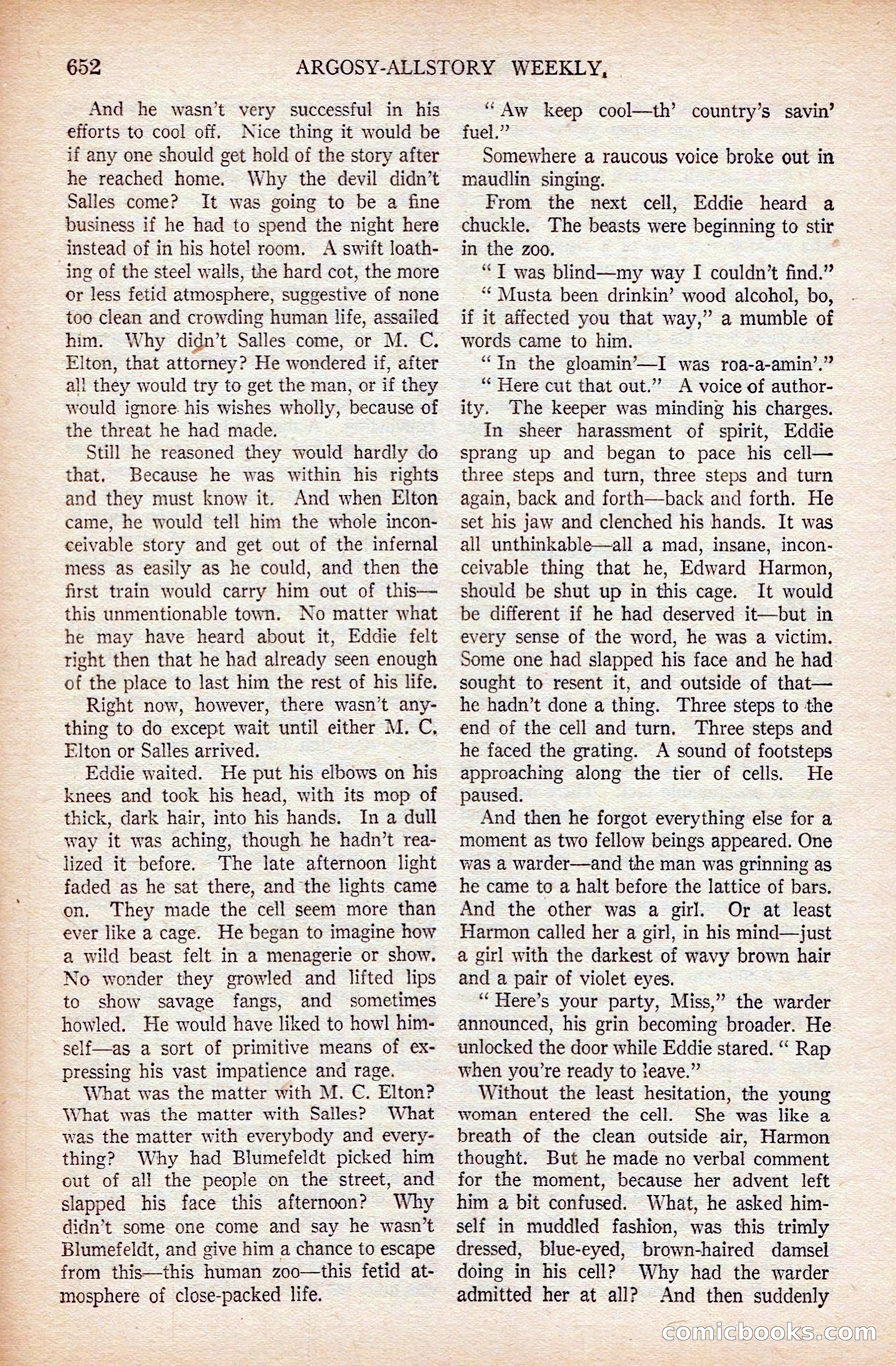
652 And he wasn’t very successful in his efforts to cool off, Nice thing it would be if any one should get hold of the story after he reached home. Why the devil didn’t Salles come? {It was going to be a fine business if he had to spend the night here instead of in his hotel room. A swift loath- ing of the steel wails, the hard cot, the more or less fetid atmosphere, suggestive of none too clean and crowding human life, assailed him. Why didn’t Salles come, or M. C. Elton, that attorney? He wondered if, after all they would try to get the man, or if they would ignore. his wishes wholly, because of the threat he had made. Still he reasoned they would hardly do that. Because he was within his rights and they must know it. And when Elton came, he would tell him the whole incon- ceivable story and get out of the infernal mess as easily as he could, and then the first train would carry him out of this— this unmentionable town. No matter what he may have heard about it, Eddie felt right then that he had already seen enough of the place to last him the rest of his life. Right now, however, there wasn’t any- thing to do except wait until either M. C, Elton or Salles arrived. 3 Eddie waited. He put his elbows on his knees and took his head, with its mop of thick, dark hair, into his hands. In a dull way it was aching, though he hadn’t rea- lized it before. The late afternoon light faded as he sat there, and the lights came on. They made the cell seem more than ever like a cage. He began to imagine how a wild beast felt in a menagerie or show. No wonder they growled and lifted lips to show savage fangs, and sometimes howled. He would have liked to howl him- self—as a sort of primitive means of ex- pressing his vast impatience and rage. What was the matter with M. C. Elton? What was the matter with Salles? What was the matter with everybody and every- thing? Why had Blumefeldt picked him out of all the people on the street, and slapped his face this afternoon? Why didn’t some one come and say he wasn’t Blumefeldt, and give him a chance to escape from this—this human zoo—this fetid at- mosphere of close-packed life. ARGOSY-ALLSTORY WEEKLY, ‘“Aw keep cool—th’ country’s savin’ fuel.” Somewhere a raucous voice broke out in maudlin singing. From the next cell, Eddie heard a chuckle. The beasts were beginning to stir in the zoo. “T was blind—my way I couldn’t find.” ‘“* Musta been drinkin’ wood alcohol, bo, if it affected you that way,” a mumble of words came to him. “In the gloamin’—I was roa-a-amin’.” “‘ Here cut that out.”” A voice of author- ity. The keeper was minding his charges. In sheer harassment of spirit, Eddie sprang up and began to pace his cell— three steps and turn, three steps and turn again, back and forth—back and forth. He set his jaw and clenched his hands. It was all unthinkable—all a mad, insane, incon- ceivable thing that he, Edward Harmon, should be shut up in this cage. It would be different if he had deserved it—but in every sense of the word, he was a victim. Some one had slapped his face and he had sought to resent it, and outside of that— he hadn’t done a thing. Three steps to the end of the cell and turn. Three steps and he faced the grating. A sound of footsteps approaching along the tier of cells. He paused. And then he forgot everything else for a moment as two fellow beings appeared. One was a warder—and the man was grinning as he came to a halt before the lattice of bars. And the other was a girl. Or at least Harmon called her a girl, in his mind—just a girl with the darkest of wavy brown hair and a pair of violet eyes. ‘““Here’s your party, Miss,” the warder announced, his grin becoming broader. He unlocked the door while Eddie stared. “ Rap when you’re ready to ieave.” Without the least hesitation, the young woman entered the cell. She was like a breath of the clean outside air, Harmon thought. But he made no verbal comment for the moment, because her advent left him a bit confused. What, he asked him- self in muddled fashion, was this trimly dressed, blue-eyed, brown-haired damsel doing in his cell? Why had the warder admitted her at all? And then suddenly oO GOmMIGIOOkKS=co