
Pulp Fiction, 1924 · page 153 of 176
Argosy All-Story Weekly — page 153: what you’re looking at
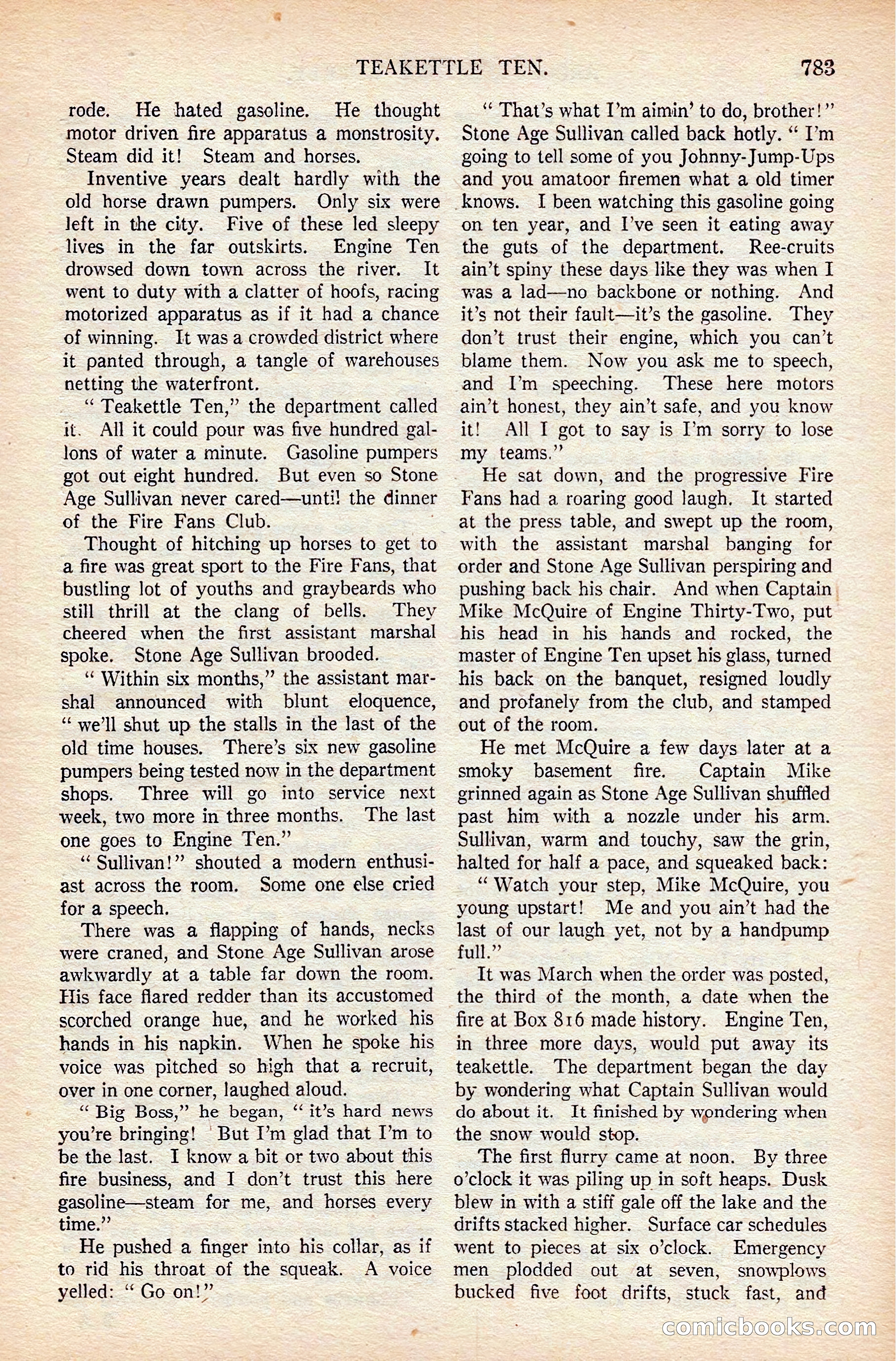
A restored page from Pulp Fiction, 1924. Page through the whole issue in the reader above.
📄 Transcribed text from this page (OCR, searchable)
Machine-transcribed from the original scan — historical spelling and the odd misread are preserved.
TEAKETTLE TEN. rode. He hated gasoline. He thought motor driven fire apparatus a monstrosity. Steam did it! Steam and horses, Inventive years dealt hardly with the old horse drawn pumpers. Only six were left in the city. Five of these led sleepy lives in the far outskirts. Engine Ten drowsed down town across the river. It went to duty with a clatter of hoofs, racing motorized apparatus as if it had a chance of winning. It was a crowded district where it panted through, a tangle of warehouses netting the waleerroor ss Teakettle Ten,” the department called it. All it could pour was five hundred gal- lons of water a minute. Gasoline pumpers got out eight hundred. But even so Stone Age Sullivan never cared—unti! the dinner of the Fire Fans Club. Thought of hitching up horses to get to a fire was great sport to the Fire Fans, that bustling lot of youths and graybeards who still thrill at the clang of bells. They cheered when the first assistant marshal spoke. Stone Age Sullivan brooded. ‘Within six months,” the assistant mar- shal announced with blunt eloquence, ‘“‘ we’ll shut up the stalls in the last of the old time houses. There’s six new gasoline pumpers being tested now in the department shops. Three will go into service next week, two more in three months. The last one goes to Engine Ten.” ‘“‘ Sullivan!”? shouted a modern enthusi- ast across the room. Some one else cried for a speech. There was a flapping of hands, necks were craned, and Stone Age Sullivan arose awkwardly at a table far down the room. His face flared redder than its accustomed scorched orange hue, and he worked his hands in his napkin. When he spoke his voice was pitched so high that a recruit, over in one corner, laughed aloud. “Big Boss,” he began, ‘it’s hard news you’re bringing! ‘But I’m glad that I’m to be the last. I know a bit or two about this fire business, and I don’t trust this here gasoline—steam for me, and horses every time.” He pushed a finger into his collar, as if to rid his throat of the squeak. A voice yelled: “ Go on!” knows. 783 ‘* 'That’s what I’m aimin’ to do, brother!” Stone Age Sullivan called back hotly. “ I’m going to tell some of you Johnny-Jump-Ups and you amatoor firemen what a old timer I been watching this gasoline going on ten year, and I’ve seen it eating away the guts of the department. Ree-cruits ain’t spiny these days like they was when I was a lad—no backbone or nothing. And it’s not their fault—it’s the gasoline. They don’t trust their engine, which you can’t blame them. Now you ask me to speech, and I’m speeching. These here motors ain’t honest, they ain’t safe, and you know it! All I got to say is I’m sorry to lose my teams.” He sat down, and the progressive Fire Fans had a roaring good laugh. It started at the press table, and swept up the room, with the assistant marshal banging for order and Stone Age Sullivan perspiring and pushing back his chair. Mike McQuire of Engine Thirty-Two, put his head in his hands and rocked, the master of Engine Ten upset his glass, turned his back on the banquet, resigned loudly and profanely from the club, and stamped out of the room. He met McQuire a few days later at a smoky basement fire. Captain Mike grinned again as Stone Age Sullivan shuffled past him with a nozzle under his arm. Sullivan, warm and touchy, saw the grin, halted for half a pace, and squeaked back: ‘Watch your step, Mike McQuire, you young upstart! Me and you ain’t had the last of our laugh yet, not by a handpump full.” | It was March when the order was posted, the third of the month, a date when the fire at Box 816 made history. Engine Ten, in three more days, would put away its teakettle. The department began the day by wondering what Captain Sullivan would do about it. It finished by wondering when the snow would stop. The first flurry came at noon. By three o’clock it was piling up in soft heaps. Dusk blew in with a stiff gale off the lake and the drifts stacked higher. Surface car schedules went to pieces at six o’clock. Emergency men plodded out at seven, snowplows bucked five foot drifts, stuck fast, and oO COMmmlcoOolkSse@© And when Captain.