
Pulp Fiction, 1924 · page 148 of 176
Argosy All-Story Weekly — page 148: what you’re looking at
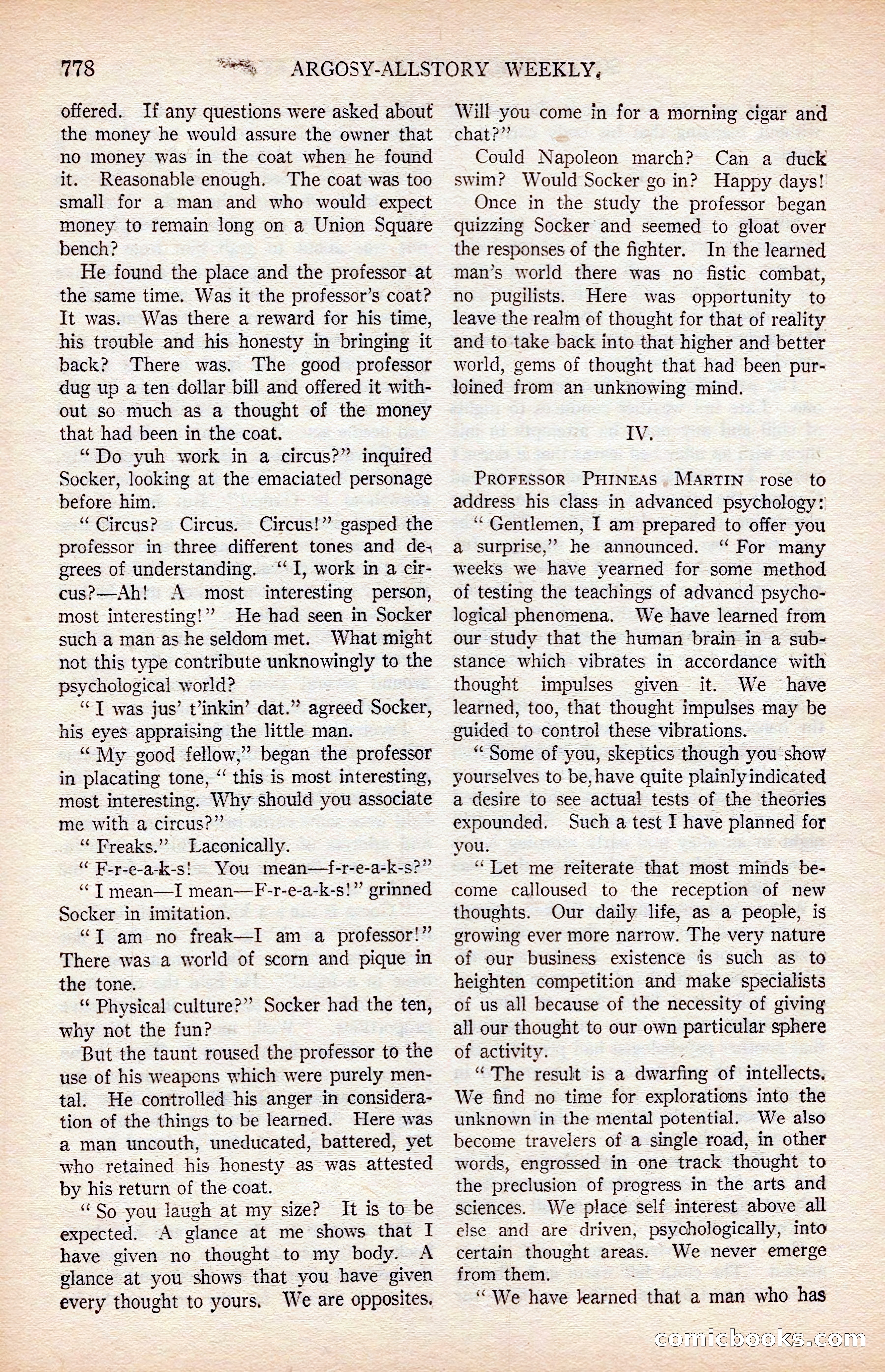
A restored page from Pulp Fiction, 1924. Page through the whole issue in the reader above.
📄 Transcribed text from this page (OCR, searchable)
Machine-transcribed from the original scan — historical spelling and the odd misread are preserved.
offered. If any questions were asked about the money he would assure the owner that no money was in the coat when he found it. Reasonable enough. The coat was too small for a man and who would expect money to remain long on a Union Square bench? He found the place and the professor at the same time. Was it the professor’s coat? It was. Was there a reward for his time, his trouble and his honesty in bringing it back? There was. The good professor dug up a ten dollar bill and offered it with- out so much as a thought of the money that had been in the coat. “Do yuh work in a circus?” inquired Socker, looking at the emaciated personage before him. “ Circus? Circus. Circus!” gasped the professor in three different tones and de, grees of understanding. “I, work in a cir- cus?—Ah! A most interesting person, most interesting!’’ He had seen in Socker such a man as he seldom met. What might not this type contribute unknowingly to the psychological world? ‘““T was jus’ t’inkin’ dat.’ agreed Socker, his eyes appraising the little man. “My good fellow,” began the professor in placating tone, ‘“‘ this is most interesting, most interesting. Why should you associate me with a circus?” “ Freaks.” Laconically. “ F_y-e-a-k-s! You mean—f-r-e-a-k-s?” “ T mean—I mean—F-r-e-a-k-s!”’ grinned Socker in imitation. “T am no freak—I am a professor!” There was a world of scorn and pique im the tone. “ Physical culture?” Socker had the ten, why not the fun? But the taunt roused the professor to the use of his weapons which were purely men- tal. He controlled his anger in considera- tion of the things to be learned. Here was a man uncouth, uneducated, battered, yet who retained his honesty as was attested by his return of the coat. “So you laugh at my size? It is to be expected. -A glance at me shows that I have given no thought to my body. A glance at you shows that you have given every thought to yours. We are opposites. ARGOSY-ALLSTORY WEEKLY, Will you come in for a morning cigar and chat?” Could Napoleon march? Can a duck swim? Would Socker go in? Happy days! Once in the study the professor began quizzing Socker and seemed to gloat over the responses of the fighter. In the learned man’s world there was no fistic combat, no pugilists. Here was opportunity to leave the realm of thought for that of reality and to take back into that higher and better world, gems of thought that had been pur- loined from an unknowing mind. IV. PROFESSOR PHINEAS. MARTIN rose to address his class in advanced psychology: “Gentlemen, I am prepared to offer you a surprise,’ he announced. ‘“ For many weeks we have yearned for some method of testing the teachings of advancd psycho- logical phenomena. We have learned from our study that the human brain in a sub- stance which vibrates in accordance with thought impulses given it. We have learned, too, that thought impulses may be cuided to control these vibrations. “Some of you, skeptics though you show yourselves to be, have quite plainly indicated a desire to see actual tests of the theories expounded. Such a test I have planned for you. “Let me reiterate that most minds be- come calloused to the reception of new thoughts. Our daily life, as a people, is growing ever more narrow. The very nature of our business existence is such as to heighten competition and make specialists of us all because of the necessity of giving all our thought to our own particular sphere of activity. “The result is a dwarfing of intellects. We find no time for explorations into the unknown in the mental potential. We also become travelers of a single road, in other words, engrossed in one track thought to the preclusion of progress in the arts and sciences. We place self interest above all else and are driven, psychologically, into certain thought areas. We never emerge from them. “We have camcd that a man who has GCOMmicbdoo Ss (S@)