
Pulp Fiction, 1924 · page 140 of 176
Argosy All-Story Weekly — page 140: what you’re looking at
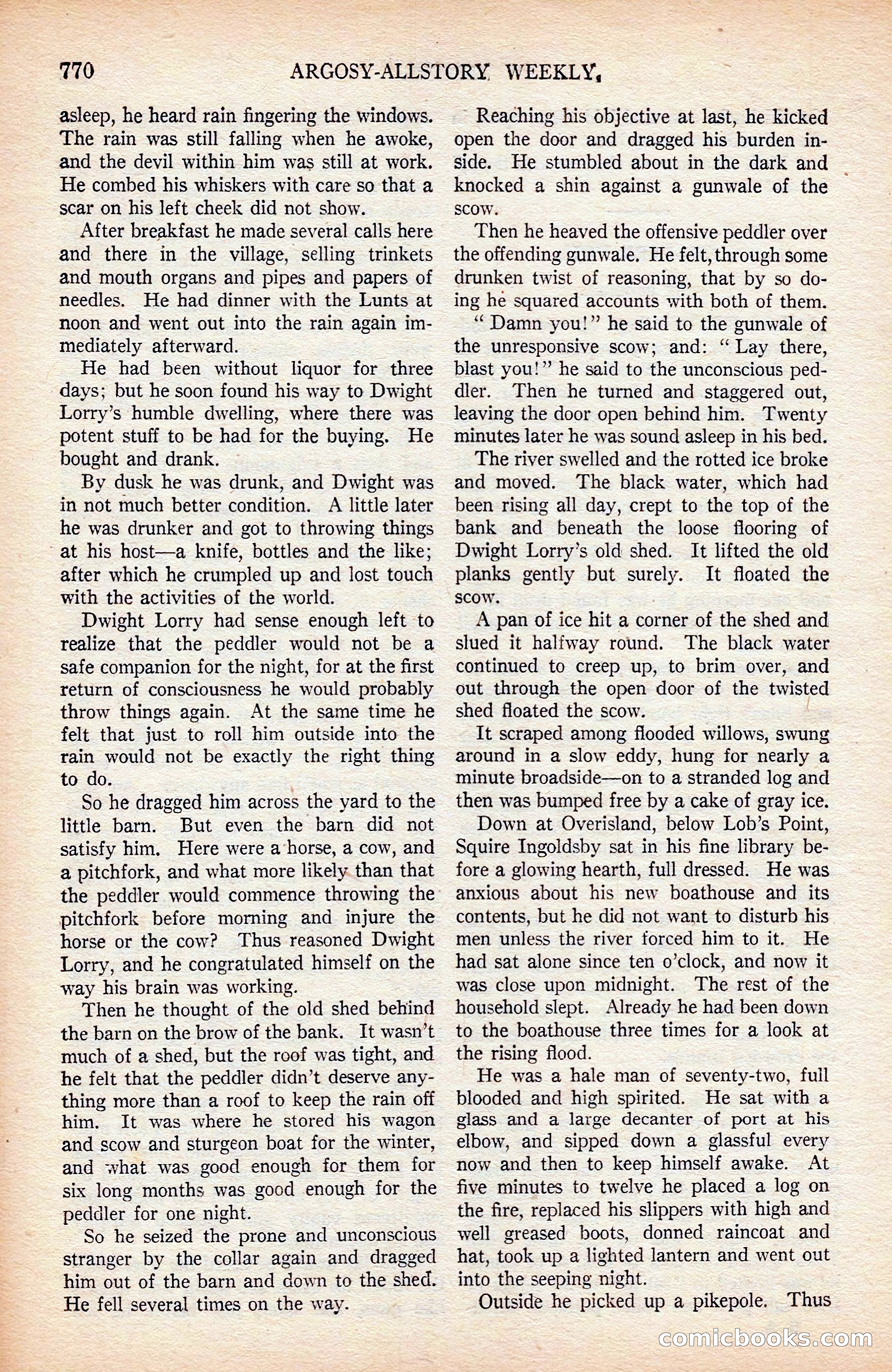
A restored page from Pulp Fiction, 1924. Page through the whole issue in the reader above.
📄 Transcribed text from this page (OCR, searchable)
Machine-transcribed from the original scan — historical spelling and the odd misread are preserved.
770 asleep, he heard rain fingering the windows. The rain was still falling when he awoke, and the devil within him was still at work. He combed his whiskers with care so that a scar on his left cheek did not show. After breakfast he made several calls here and there in the village, selling trinkets and mouth organs and pipes and papers of needles. He had dinner with the Lunts at noon and went out into the rain again im- mediately afterward. He had been without liquor for three days; but he soon found his way to Dwight Lorry’s humble dwelling, where there was potent stuff to be had for the buying. He bought and drank. By dusk he was drunk, and Dwight was in not much better condition. A little later he was drunker and got to throwing things -at his host—a knife, bottles and the like; after which he crumpled up and lost touch with the activities of the world. Dwight Lorry had sense enough left to realize that the peddler would not be a safe companion for the night, for at the first return of consciousness he would probably throw things again. At the same time he felt that just to roll him outside into the rain would not be exactly the right thing to do. So he dragged him across the yard to the little barn. But even the barn did not satisfy him. Here were a‘horse, a cow, and a pitchfork, and what more likely than that the peddler would commence throwing the pitchfork before morning and injure the horse or the cow? Thus reasoned Dwight Lorry, and he congratulated himself on the way his brain was working. Then he thought of the old shed behind the barn on the brow of the bank. It wasn’t much of a shed, but the roof was tight, and he felt that the peddler didn’t deserve any- thing more than a roof to keep the rain off him. It was where he stored his wagon and scow and sturgeon boat for the winter, and what was good enough for them for six long months was good enough for the peddler for one night. So he seized the prone and unconscious stranger by the collar again and dragged him out of the barn and down to the shed. He fell several times on the way. ARGOSY-ALLSTORY. WEEKLY, ~ Reaching his objective at last, he kicked open the door and dragged his burden in- side. knocked a shin against a gunwale of the scow. Then he heaved the offensive peddler over the offending gunwale. He felt, through some drunken twist of reasoning, that by so do- ing he squared accounts with both of them. “Damn you!” he said to the gunwale of the unresponsive scow; and: “ Lay there, blast you!” he said to the unconscious ped- dier. Then he turned and staggered out, leaving the door open behind him. Twenty minutes later he was sound asleep in his bed. The river swelled and the rotted ice broke and moved. The black water, which had been rising all day, crept to the top of the bank and beneath the loose flooring of Dwight Lorry’s old shed. It lifted the old planks gently but surely. It floated the scow. A pan of ice hit a corner of the shed and slued it halfway round. The black water continued to creep up, to brim over, and out through the open door of the twisted shed floated the scow. It scraped among flooded willows, swung around in a slow eddy, hung for nearly a minute broadside—on to a stranded log and then was bumped free by a cake of gray ice. Down at Overisland, below Lob’s Point, Squire Ingoldsby sat in his fine library be- fore a glowing hearth, full dressed. He was anxious about his new boathouse and its contents, but he did not want to disturb his. men unless the river forced him to it. He had sat alone since ten o’clock, and now it was close upon midnight. The rest of the household slept. Already he had been down to the boathouse three times for a look at the rising flood. He was a hale man of seventy-two, fuil blooded and high spirited. He sat with a glass and a large decanter of port at his elbow, and sipped down a glassful every now and then to keep himself awake. At five minutes to twelve he placed a log on the fire, replaced his slippers with high and well greased boots, donned raincoat and hat, took up a lighted lantern and went out into the seeping night. Outside he picked up a pikepole. Thus GOmicbdooks (C@) He stumbled about in the dark and ~