
Pulp Fiction, 1924 · page 131 of 176
Argosy All-Story Weekly — page 131: what you’re looking at
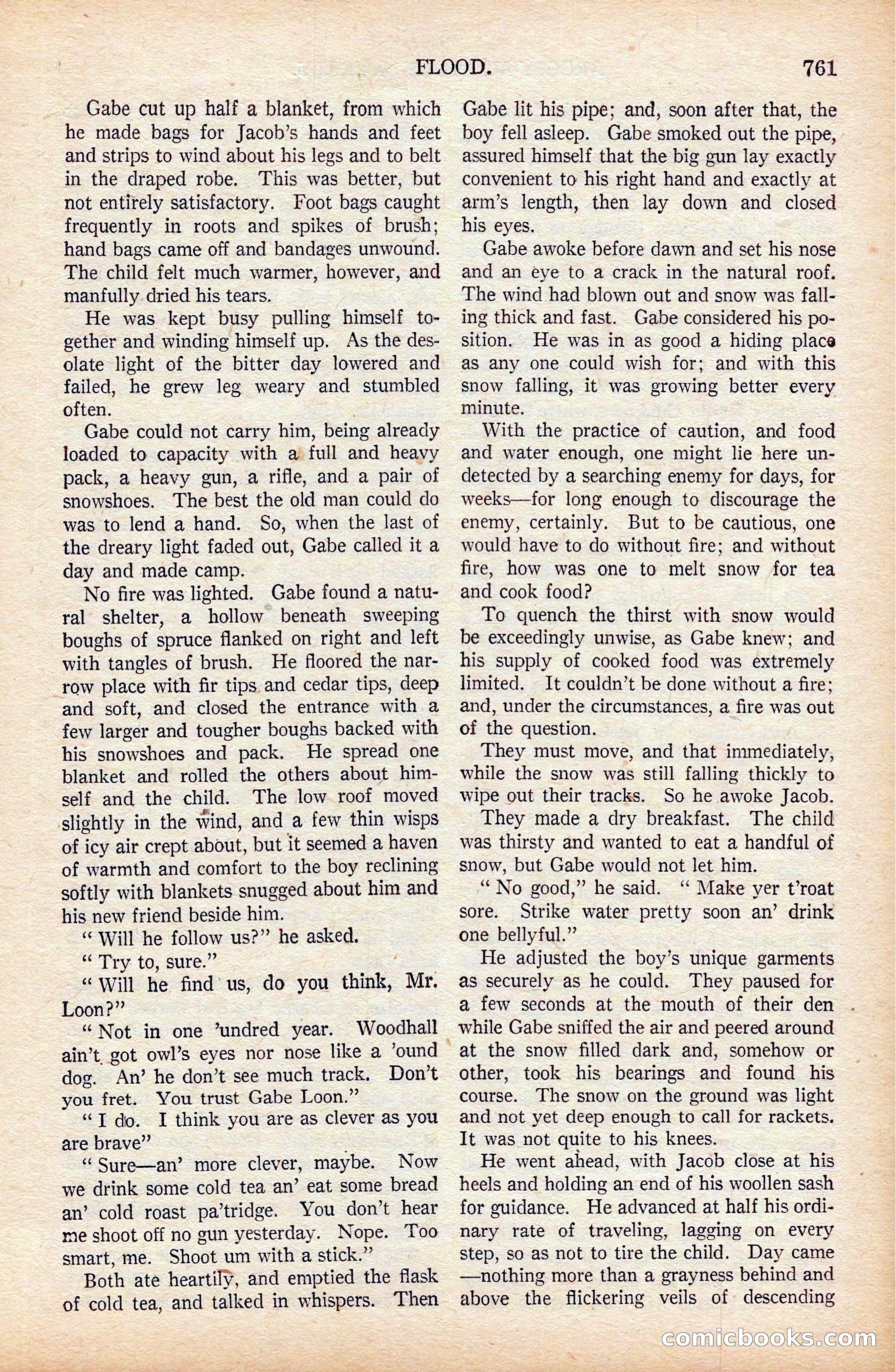
A restored page from Pulp Fiction, 1924. Page through the whole issue in the reader above.
📄 Transcribed text from this page (OCR, searchable)
Machine-transcribed from the original scan — historical spelling and the odd misread are preserved.
FLOOD. Gabe cut up half a blanket, from which he made bags for Jacob’s hands and feet and strips to wind about his legs and to belt in the draped robe. ‘This was better, but not entirely satisfactory. Foot bags caught frequently in roots and spikes of brush; hand bags came off and bandages unwound. The child felt much warmer, however, and manfully dried his tears. He was kept busy pulling himself to- gether and winding himself up. As the des- olate light of the bitter day lowered and failed, he grew leg weary and stumbled often. Gabe could not carry him, being already loaded to capacity with a full and heavy pack, a heavy gun, a rifle, and a pair of snowshoes. The best the old man could do was to lend a hand. So, when the last of the dreary light faded out, Gabe called it a day and made camp. No fire was lighted. Gabe found a natu- ral shelter, a hollow beneath sweeping boughs of spruce flanked on right and left ae tangles of brush. He floored the nar- row place with fir tips and cedar tips, deep and soft, and closed the entrance with a few larger and tougher boughs backed with his snowshoes and pack. He spread one blanket and rolled the others about him- self and the child. The low roof moved slightly in the wind, and a few thin wisps of icy air crept about, but it seemed a haven of warmth and comfort to the boy reclining softly with blankets snugged about him and his new friend beside him. “ Will he follow us?” he asked. ““ Try to, sure.’ “ Will he find’ us, do you think, Mr. Loon?” | , “Not in one ’undred year. Woodhall ain’t. got owl’s eyes nor nose like a ‘ound dog. An’ he don’t see much track. Don’t you fret. You trust Gabe Loon.” “TJ do. I think you are as clever as you are brave” ‘‘Syre—an’ more clever, maybe. Now we drink some cold tea an’ eat some bread an’ cold roast pa’tridge. You don’t hear me shoot off no gun yesterday. Nope. Too smart, me. Shoot um with a stick.” Both ate heartily, and emptied the flask of cold tea, and talked in whispers. Then 761 Gabe lit his pipe; and, soon after that, the boy fell asleep. Gabe smoked out the pipe, assured himself that the big gun lay exactly convenient to his right hand and exactly at arm’s length, then lay down and closed his eyes. Gabe awoke before dawn and set his nose and an eye to a crack in the natural roof. The wind had blown out and snow was fall- ing thick and fast. Gabe considered his po- sition. He was in as good a hiding place as any one could wish for; and with this snow falling, it was growing better every minute. With the practice of caution, and food and water enough, one might lie here un- detected by a searching enemy for days, for weeks—for long enough to discourage the enemy, certainly. But to be cautious, one would have to do without fire; and without fire, how was one to melt snow for tea and cook food? To quench the thirst with snow would be exceedingly unwise, as Gabe knew; and his supply of cooked food was extremely limited. It couldn’t be done without a fire; and, under the circumstances, a fire was out of the question. They must move, and that immediately, while the snow was still falling thickly to Wipe out their tracks. So he awoke Jacob. They made a dry breakfast. The child was thirsty and wanted to eat a handful of snow, but Gabe would not let him. “No good,” he said. ‘‘ Make yer t’roat sore. Strike water pretty soon an’ drink one bellyful.” He adjusted the boy’s unique garments as securely as he could. They paused for a few seconds at the mouth of their den while Gabe sniffed the air and peered around at the snow filled dark and, somehow or other, took his bearings and found his course. The snow on the ground was light and not yet deep enough to call for rackets. It was not quite to his knees. He went ahead, with Jacob close at his heels and holding an end of his woollen sash for guidance. He advanced at half his ordi- nary rate of traveling, lagging on every step, so as not to tire the child. Day came —nothing more than a grayness behind and above the flickering veils of descending oO CORMICLOOC <S) (S@)