
Pulp Fiction, 1924 · page 71 of 172
Argosy All-Story Weekly, April 19, 1924 — page 71: what you’re looking at
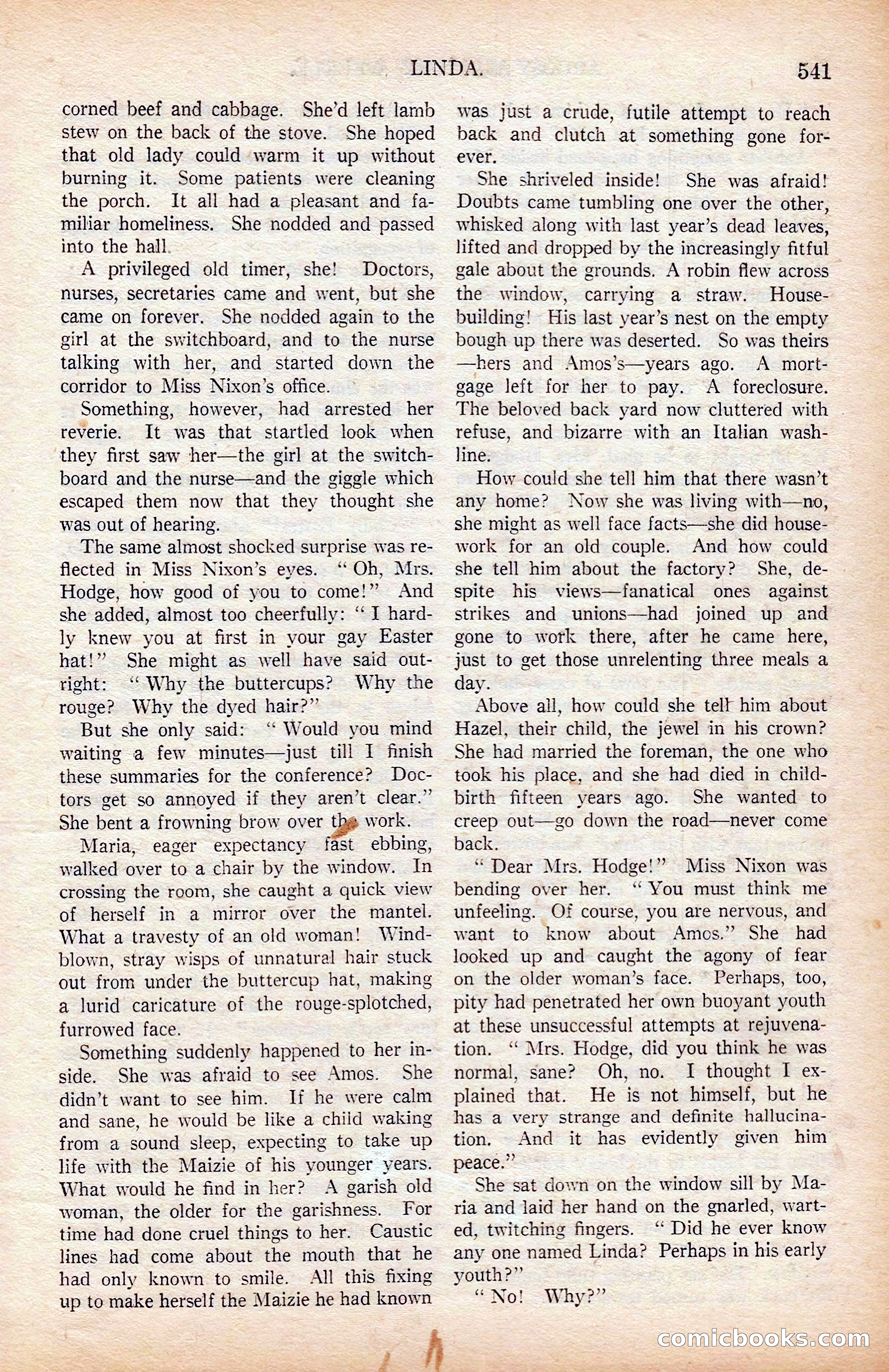
A restored page from Pulp Fiction, 1924. Page through the whole issue in the reader above.
📄 Transcribed text from this page (OCR, searchable)
Machine-transcribed from the original scan — historical spelling and the odd misread are preserved.
LINDA. corned beef and cabbage. She’d left larnb stew on the back of the stove. She hoped that old lady could warm it up without burning it. Some patients were cleaning the porch. It all had a pleasant and fa- miliar homeliness. She nodded and passed into the hall. A privileged old timer, she! Doctors, nurses, secretaries came and went, but she came on forever. She nodded again to the girl at the switchboard, and to the nurse talking with her, and started down the corridor to Miss Nixon’s office. Something, however, had arrested her reverie. It was that startled look when they first saw her—the girl at the switch- board and the nurse—and the giggle which escaped them now that they thought she was out of hearing. The same almost shocked surprise was re- flected in Miss Nixon’s eyes. ‘‘ Oh, Mrs. Hodge, how good of you to come!” And she added, almost too cheerfully: “ J hard- ly knew you at first in your gay Easter hat!” She might as well have said out- right: ‘‘ Why the buttercups? Why the rouge? Why the dyed hair?” But she only said: “ Would you mind waiting a few minutes—just till I finish these summaries for the conference? Doc- tors get so annoyed if they aren’t clear.” She bent a frowning brow over th@ work. Maria, eager expectancy fast ebbing, walked over to a chair by the window. In crossing the room, she caught a quick view of herself in a mirror over the mantel. What a travesty of an old woman! Wind- blown, stray wisps of unnatural hair stuck out from under the buttercup hat, making a lurid caricature of the rouge-splotched, furrowed face. Something suddenly happened to her in- side. She was afraid to see Amos. She didn’t want to see him. If he were calm and sane, he would be like a child waking from a sound sleep, expecting to take up life with the Maizie of his younger years. What would he find in her? A garish old woman, the older for the garishness. For time had done cruel things to her. Caustic lines had come about the mouth that he had only known to smile. All this fixing up to make herself the Maizie he had known fh 541 was just a crude, futile attempt to reach back and clutch at something gone for- ever. She shriveled inside! She was afraid! Doubts came tumbling one over the other, whisked along with last year’s dead leaves, lifted and dropped by the increasingly fitful gale about the grounds. A robin flew across the window, carrying a straw. House- building! His last year’s nest on the empty bough up there was deserted. So was theirs —hers and Amos’s—years ago. A mort- gage left for her to pay. <A foreclosure. The beloved back yard now cluttered with . refuse, and bizarre with an ItaHan wash- line. How could she tell him that there wasn’t any home? Now she was living with—no, she might as well face facts—she did house- work for an old couple. And how could she tell him about the factory? She, de- spite his views—fanatical ones against strikes and unions—had joined up and gone to work there, after he came here, just to get those unrelenting three meals a day. Above all, how could she telt him about Hazel, their child, the jewel in his crown? She had married the foreman, the one who took his place, and she had died in child- birth fifteen years ago. She wanted to creep out—go down the road—never come back. “Dear Mrs. Hodge!” Miss Nixon was bending over her. ‘‘ You must think me unfeeling. Of course, you are nervous, and want to know about Amos.” She had looked up and caught the agony of fear on the older woman’s face. Perhaps, too, pity had penetrated her own buoyant youth at these unsuccessiul attempts at rejuvena- tion. “‘ Mrs. Hodge, did you think he was normal, sane? Oh, no. I thought I ex- plained that. He is not himself, but he tion. And it has evidently given him peace.” She sat down on the window sill by Ma- ria and laid her hand on the gnarled, wart- ed, twitching fingers. ‘“ Did he ever know any one named Linda? Perhaps in his early youth?” “No! Why?” (S@) Eomichbooks