
Pulp Fiction, 1924 · page 66 of 172
Argosy All-Story Weekly, April 19, 1924 — page 66: what you’re looking at
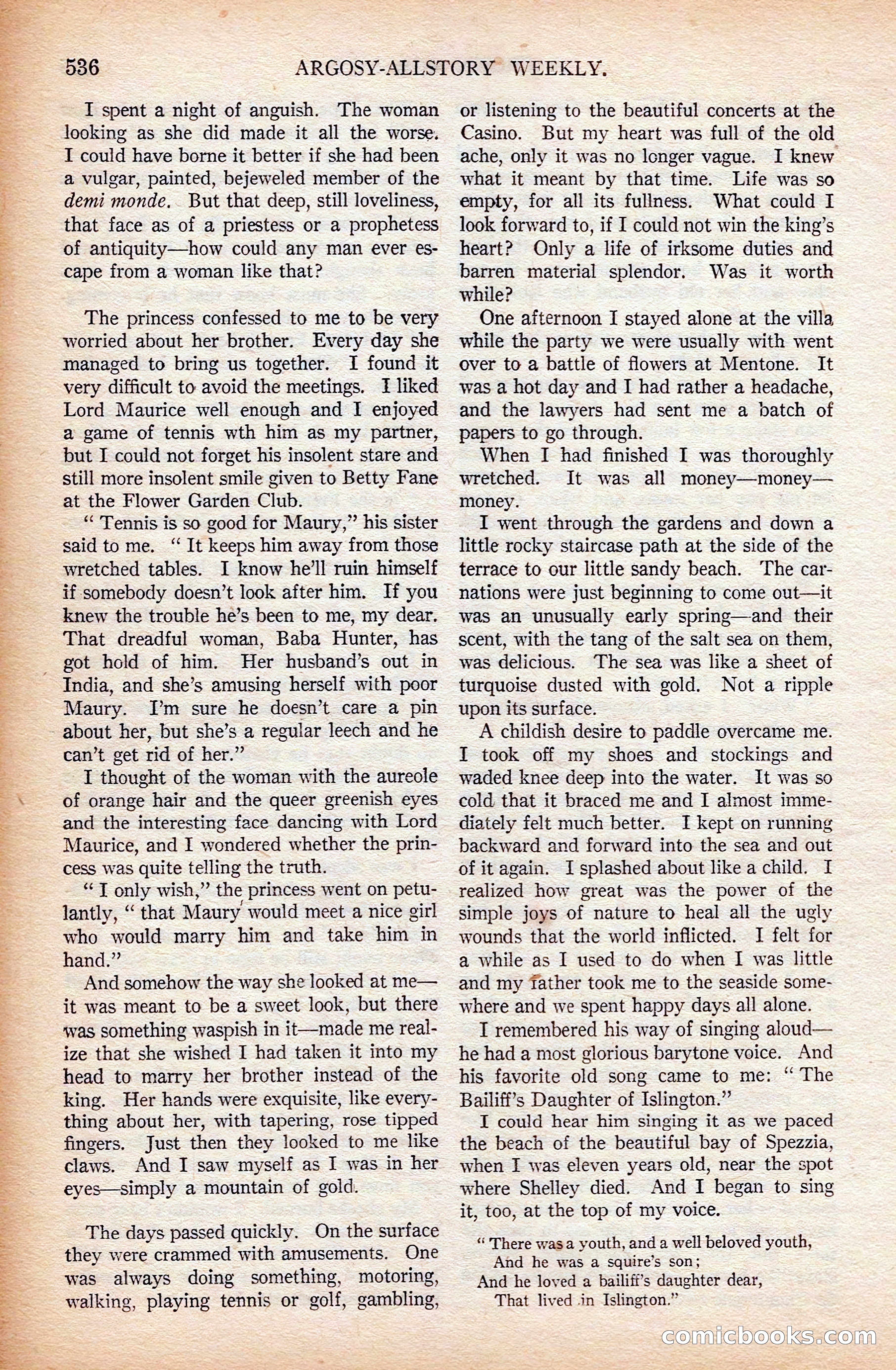
A restored page from Pulp Fiction, 1924. Page through the whole issue in the reader above.
📄 Transcribed text from this page (OCR, searchable)
Machine-transcribed from the original scan — historical spelling and the odd misread are preserved.
ra! hee woral ye , FURY ih fae ’ aie aed tad 2M i tai Ley pO ta > me ais ths 536 I spent a night of anguish. The woman looking as she did made it all the worse. I could have borne it better if she had been a vulgar, painted, bejeweled member of the demi monde, But that deep, still loveliness, that face as of a priestess or a prophetess of antiquity—how could any man ever es- cape from a woman like that? The princess confessed to me to be very worried about her brother. Every day she managed to bring us together. I found it very difficult to avoid the meetings. 1 liked Lord Maurice well enough and I enjoyed a game of tennis wth him as my partner, but I could not forget his insolent stare and still more insolent smile given to Betty Fane at the Flower Garden Club. “ Tennis is so good for Maury,” his sister said to me. ‘“ It keeps him away from those wretched tables. I know he'll ruin himself if somebody doesn’t look after him. If you knew the trouble he’s been to me, my dear. That dreadful woman, Baba Hunter, has _ got hold of him. Her husband’s out in India, and she’s amusing herself with poor Maury. I’m sure he doesn’t care a pin about her, but she’s a regular leech and he can’t get rid of her.” I thought of the woman with the aureole of orange hair and the queer greenish eyes and the interesting face dancing with Lord Maurice, and I wondered whether the prin- cess was quite telling the truth. “T only wish,” the princess went on petu- lantly, “that Maury would meet a nice girl who would marry him and take him in hand.” And somehow the way she looked at me— it was meant to be a sweet look, but there was something waspish in it—made me real- ize that she wished I had taken it into my head to marry her brother instead of the king. Her hands were exquisite, like every- thing about her, with tapering, rose tipped fingers. Just then they looked to me like claws. And I saw myself as I was in her eyes—simply a mountain of gold. The days passed quickly. On the surface they were crammed with amusements. One was always doing something, motoring, walking, playing tennis or golf, gambling, ARGOSY-ALLSTORY WEEKLY. or listening to the beautiful concerts at the Casino. But my heart was full of the old ache, only it was no longer vague. I knew what it meant by that time. Life was so empty, for all its fullness. What could I look forward to, if I could not win the king’s heart? Only a life of irksome duties and barren material splendor. Was it worth while? One afternoon I stayed alone at the villa while the party we were usually with went over to a battle of flowers at Mentone. It was a hot day and I had rather a headache, and the lawyers had sent me a batch of papers to go through. When I had finished I was thoroughly wretched. It was all money—money— money. I went through the gardens and down a little rocky staircase path at the side of the terrace to our little sandy beach. ‘The car- nations were just beginning to come out—it was an unusually early spring—and their scent, with the tang of the salt sea on them, was delicious. The sea was like a sheet of turquoise dusted with gold. Not a ripple upon its surface. A childish desire to paddle overcame me. I took off my shoes and stockings and waded knee deep into the water. It was so cold that it braced me and I almost imme- diately felt much better. I kept on running backward and forward into the sea and out of itagain. I splashed about like a child. [ realized how great was the power of the simple joys of nature to heal all the ugly wounds that the world inflicted. I felt for a while as I used to do when I was little and my Tather took me to the seaside some- where and we spent happy days all alone. T remembered his way of singing aloud— he had a most glorious barytone voice. And his favorite old song came to me: “ The Bailiff’s Daughter of Islington.” I could hear him singing it as we paced the beach of the beautiful bay of Spezzia, when I was eleven years old, near the spot where Shelley died. And I began to sing it, too, at the top of my voice. “ There was a youth, and a well beloved youth, And he was a squire’s son; And he loved a bailiff’s daughter dear, That lived in Islington.” oO Gomichook (S@)