
Pulp Fiction, 1924 · page 63 of 172
Argosy All-Story Weekly, April 19, 1924 — page 63: what you’re looking at
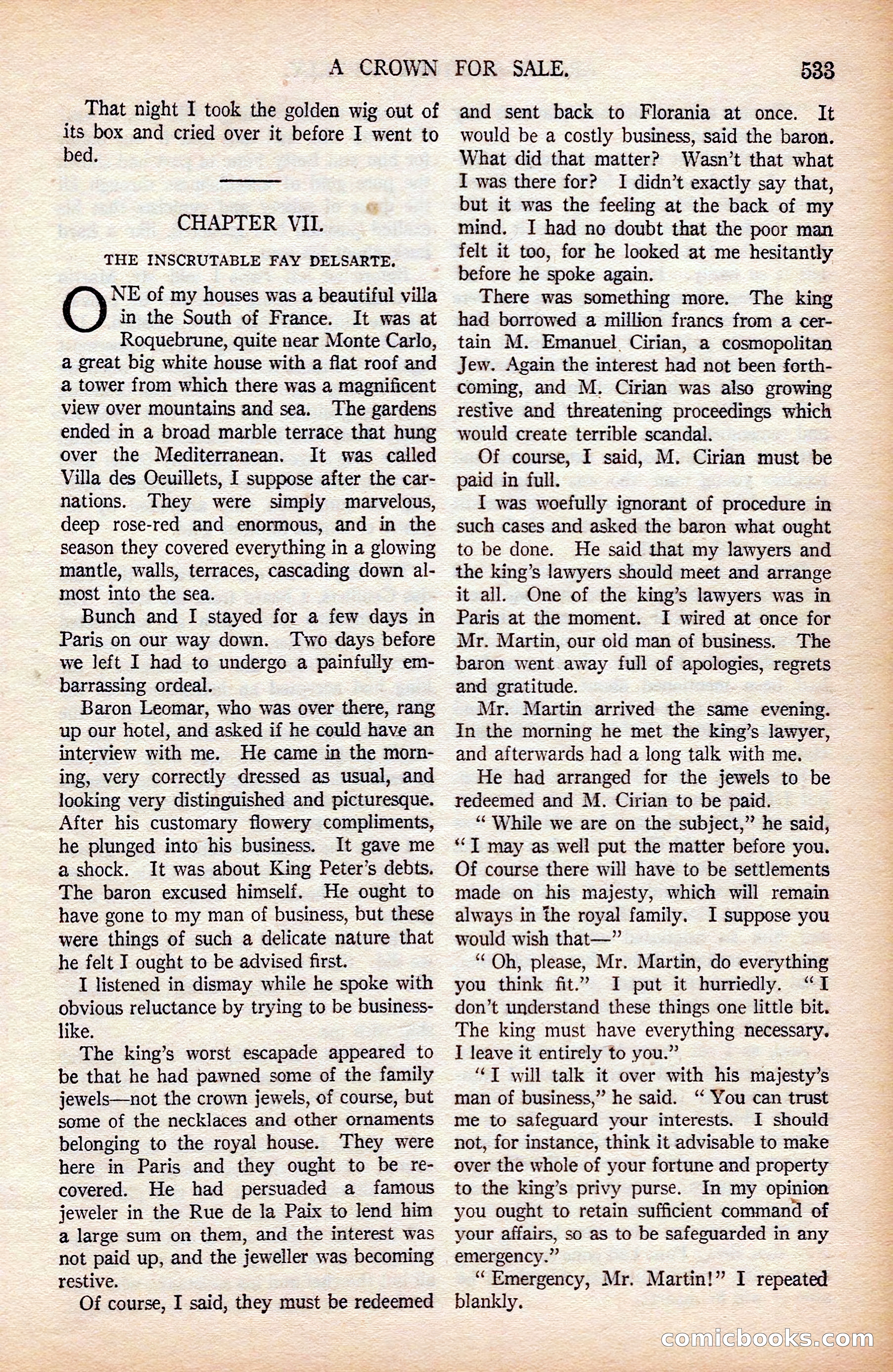
A restored page from Pulp Fiction, 1924. Page through the whole issue in the reader above.
📄 Transcribed text from this page (OCR, searchable)
Machine-transcribed from the original scan — historical spelling and the odd misread are preserved.
A CROWN That night I took the golden wig out of its box and cried over it before I went to bed. ES CHAPTER VIL. THE INSCRUTABLE FAY DELSARTE. NE of my houses was a beautiful villa in the South of France. It was at Roquebrune, quite near Monte Carlo, a great big white house with a flat roof and a tower from which there was a magnificent view over mountains and sea. The gardens ended in a broad marble terrace that hung over the Mediterranean. It was cailed Villa des Oeuillets, I suppose after the car- nations. They were simply marvelous, deep rose-red and enormous, and in the season they covered everything in a glowing mantle, walls, terraces, cascading down al- most into the sea. Bunch and I stayed for a few days in Paris on our way down. Two days before we left I had to undergo a painfully em- barrassing ordeal. Baron Leomar, who was over there, rang up our hotel, and asked if he could have an interview with me. He came in the morn- ing, very correctly dressed as usual, and looking very distinguished and picturesque. After his customary flowery compliments, he plunged into his business. It gave me a shock. It was about King Peter’s debts. The baron excused himself. He ought to have gone to my man of business, but these were things of such a delicate nature that he felt I ought to be advised first. I listened in dismay while he spoke with obvious reluctance by trying to be business- like. The king’s worst escapade appeared to be that he had pawned some of the family jewels—not the crown jewels, of course, but some of the necklaces and other ornaments belonging to the royal house. They were here in Paris and they ought to be re- covered. He had persuaded a famous jeweler in the Rue de la Paix to lend him a large sum on them, and the interest was not paid up, and the jeweller was becoming restive. Of course, I said, they must be redeemed FOR SALE, 533 and sent back to Florania at once. It would be a costly business, said the baron. What did that matter? Wasn’t that what T was there for? I didn’t exactly say that, but it was the feeling at the back of my mind. J had no doubt that the poor man felt it too, for he looked at me hesitantly before he spoke again. There was something more. The king had borrowed a million francs from a cer- tain M. Emanuel Cirian, a cosmopolitan Jew. Again the interest had not been forth- coming, and M. Cirian was also growing restive and threatening proceedings which would create terrible scandal. Of course, I said, M. Cirian must be paid in full. I was woefully ignorant of procedure in such cases and asked the baron what ought to be done. He said that my lawyers and the king’s lawyers should meet and arrange it all. One of the king’s lawyers was in Paris at the moment. I wired at once for Mr. Martin, our old man of business. The baron went away full of apologies, regrets and gratitude. Mr. Martin arrived the same evening. In the morning he met the king’s lawyer, and afterwards had a long talk with me. He had arranged for the jewels to be redeemed and M. Cirian to be paid. “While we are on the subject,” he said, “TI may as well put the matter before you. Of course there will have to be settlements made on his majesty, which will remain always in the royal family. I suppose you would wish that—” “Oh, please, Mr. Martin, do everything you think fit.” I put it hurriedly. “I don’t understand these things one little bit. The king must have everything necessary. J leave it entirely to you.” ‘““T will talk it over with his majesty’s man of business,” he said. ‘ You can trust me to safeguard your interests. I should not, for instance, think it advisable to make over the whole of your fortune and property to the king’s privy purse. In my opinion you ought to retain sufficient command of your affairs, so as to be safeguarded in any emergency.” ‘Emergency, Mr. Martin!” I repeated blankly. EoOmichbooks (C©)