
Pulp Fiction, 1924 · page 25 of 172
Argosy All-Story Weekly, April 19, 1924 — page 25: what you’re looking at
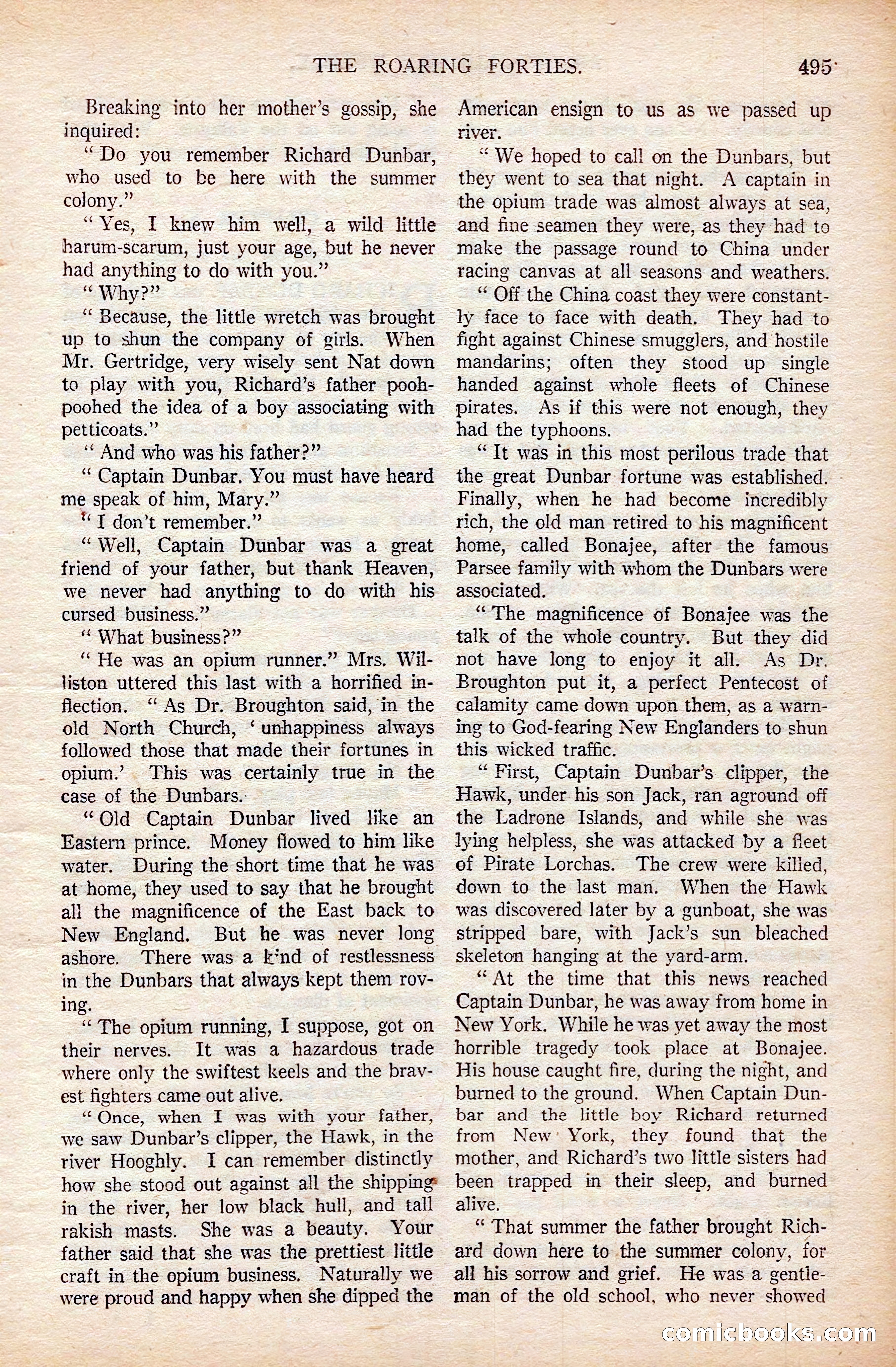
A restored page from Pulp Fiction, 1924. Page through the whole issue in the reader above.
📄 Transcribed text from this page (OCR, searchable)
Machine-transcribed from the original scan — historical spelling and the odd misread are preserved.
THE ROARING FORTIES. Breaking into her mother’s gossip, she inquired: “Do you remember Richard Dunbar, who used to be here with the summer colony.” “Yes, I knew him well, a wild little harum-scarum, just your age, but he never had anything to do with you.” “ Because, the little wretch was brought up to shun the company of girls. When Mr. Gertridge, very wisely sent Nat down to play with you, Richard’s father pooh- poohed the idea of a boy associating with petticoats.” ‘“ And who was his father?” ‘“‘ Captain Dunbar. You must have heard me speak of him, Mary.” © T don’t remember.” “Well, Captain Dunbar was a great friend of your father, but thank Heaven, we never had anything to do with his cursed business.” ‘“ What business?” ‘““He was an opium runner.” Mrs. Wil- liston uttered this last with a horrified in- flection. ‘As Dr. Broughton said, in the old North Church, ‘unhappiness always followed those that made their fortunes in opium.’ This was certainly true in the case of the Dunbars..: “Old Captain Dunbar lived like an Eastern prince. Money flowed to him like water. During the short time that he was at home, they used to say that he brought all the magnificence of the East back to New England. But he was never long ashore. There was a k*nd of restlessness in the Dunbars that always kept them rov- ing. ‘The opium running, I suppose, got on their nerves. It was a hazardous trade where only the swiftest keels and the brav- est fighters came out alive. ‘““Once, when I was with your father, we saw Dunbar’s clipper, the Hawk, in the river Hooghly. I can remember distinctly how she stood out against all the shipping in the river, her low black hull, and tall rakish masts. She was a beauty. Your father said that she was the prettiest little craft in the opium business. Naturally we were proud and happy when she dipped the American ensign to us as we passed up river. ‘* We hoped to cal! on the Dunbars, but they went to sea that night. A captain in the opium trade was almost always at sea, and fine seamen they were, as they had to make the passage round to China under racine canvas at all seasons and weathers. “ Off the China coast they were constant- ly face to face with death. They had to fight against Chinese smugglers, and hostile mandarins; often they stood up single handed against whole fleets of Chinese pirates. As if this were not enough, thev had the typhoons. “It was in this most perilous trade that the great Dunbar fortune was established. - Finally, when he had become incredibly rich, the old man retired to his magnificent home, called Bonajee, after the famous Parsee family with whom the Dunbars were associated. “The magnificence of Bonajee was the talk of the whole country. But they did not have long to enjoy it all. As Dr. Broughton put it, a perfect Pentecost of calamity came down upon them, as a warn- ing to God-fearing New Englanders to shun this wicked traffic. “First, Captain Dunbar’s clipper, the Hawk, under his son Jack, ran aground off the Ladrone Islands, and while she was lying helpless, she was attacked by a fleet of Pirate Lorchas. The crew were killed, down to the last man. When the Hawk was discovered later by a gunboat, she was stripped bare, with Jack’s sun bleached skeleton hanging at the yard-arm. ‘““At the time that this news reached Captain Dunbar, he was away from home in New York. While he was yet away the most horrible tragedy took place at Bonajee. His house caught fire, during the night, and burned to the ground. When Captain Dun- bar and the little boy Richard returned from New’ York, they found that the mother, and Richard’s two little sisters had been trapped in their sleep, and burned alive. “That summer the father brought Rich- ard down here to the summer colony, for all his sorrow and grief. He was a gentle- man of the old school, who never showed oO 495° S Gomichbookssco