
Pulp Fiction, 1924 · page 160 of 172
Argosy All-Story Weekly, April 19, 1924 — page 160: what you’re looking at
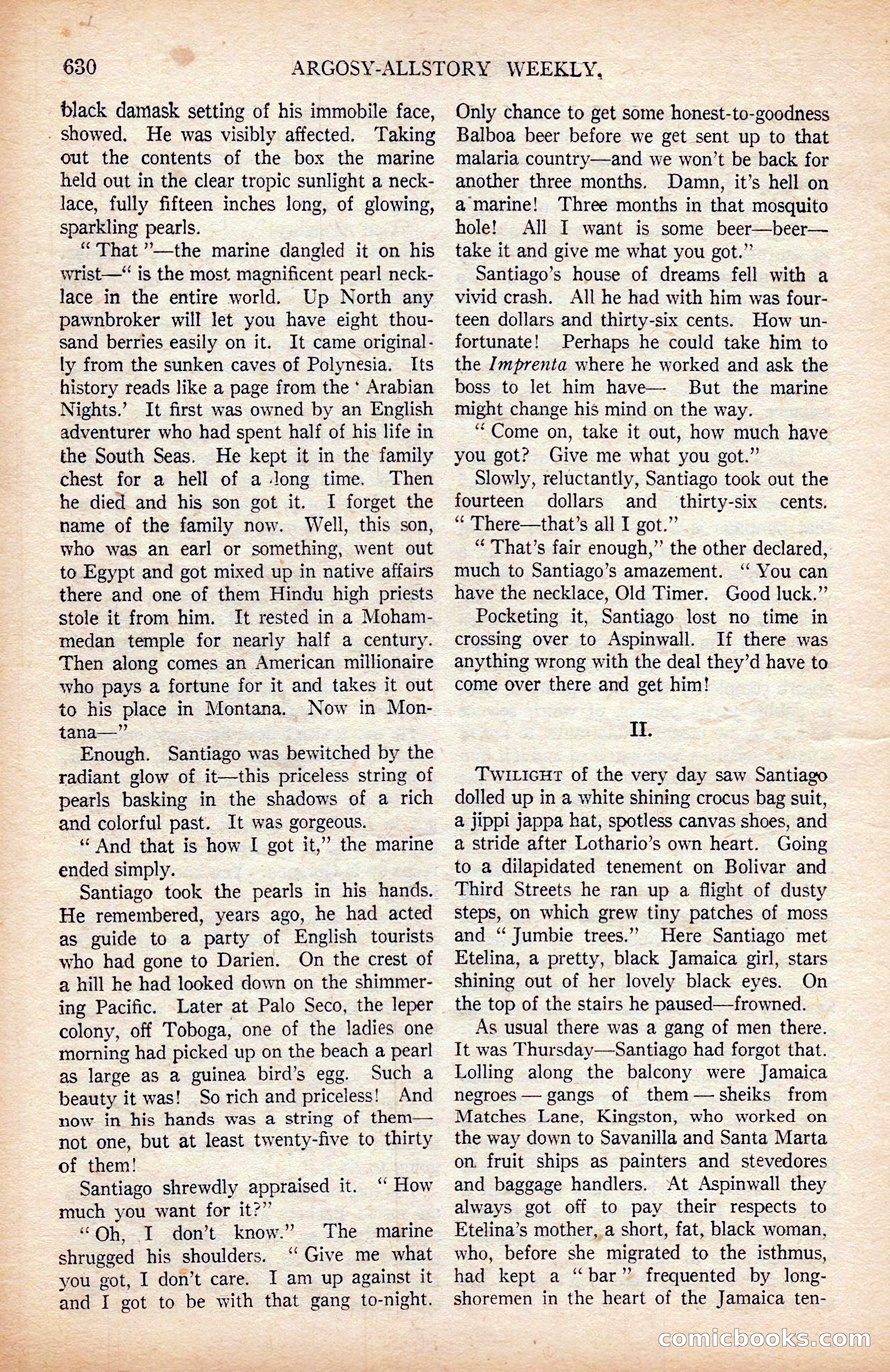
A restored page from Pulp Fiction, 1924. Page through the whole issue in the reader above.
📄 Transcribed text from this page (OCR, searchable)
Machine-transcribed from the original scan — historical spelling and the odd misread are preserved.
630 black damask setting of his immobile face, . Showed. He was visibly affected. Taking out the contents of the box the marine held out in the clear tropic sunlight a neck- lace, fully fifteen inches long, of glowing, sparkling pearls. “That ”’—the marine dangled it on his wrist—“ is the most magnificent pearl neck- lace in the entire world. Up North any pawnbroker will let you have eight thou- sand berries easily on it. It came original- ly from the sunken caves of Polynesia. Its history reads like a page from the * Arabian Nights.’ It first was owned by an English adventurer who had spent half of his life in the South Seas. He kept it in the family chest for a hell of a long time. Then he died and his son got it. I forget the name of the family now. Well, this son, who was an earl or something, went out to Egypt and got mixed up in native affairs there and one of them Hindu high priests stole it from him. It rested in a Moham- medan temple for nearly half a century. Then along comes an American millionaire who pays a fortune for it and takes it out to his place in Montana. Now in Mon- tana—” Enough. Santiago was bewitched by the radiant glow of it—this priceless string of pearls basking in the shadows of a rich and colorful past. It was gorgeous. ‘‘ And that is how I got it,” the marine ended simply. Santiago took the pearls in his hands. He remembered, years ago, he had acted as guide to a party of English tourists who had gone to Darien. On the crest of a hill he had looked down on the shimmer- ing Pacific. Later at Palo Seco, the leper colony, off Toboga, one of the ladies one morning had picked up on the beach a pearl as large as a guinea bird’s egg. Such a beauty it was! So rich and priceless! And now in his hands was a string of them— not one, but at least twenty-five to thirty of them! Santiago shrewdly appraised it. much you want for it?” “Oh, I don’t know.” The marine shrugged his shoulders. ‘ Give me what you got, I don’t care. I am up against it and I got to be with that gang to-night. * How ARGOSY-ALLSTORY WEEKLY, Only chance to get some honest-to-goodness Balboa beer before we get sent up to that malaria country—and we won’t be back for another three months. Damn, it’s hell on a marine! Three months in that mosquito hole! All I want is some beer—beer— take it and give me what you got.” Santiago’s house of dreams fell with a vivid crash. All he had with him was four- teen dollars and thirty-six cents. How un- fortunate! Perhaps he could take him to the Imprenta where he worked and ask the boss to let him have— But the marine might change his mind on the way. “Come on, take it out, how much have you got? Give me what you got.” Slowly, reluctantly, Santiago took out the fourteen dollars and _ thirty-six cents. “ There—that’s all I got.” “That’s fair enough,” the other declared, much to Santiago’s amazement. ‘ You can have the necklace, Old Timer. Good luck.” Pocketing it, Santiago lost no time in crossing over to Aspinwall. If there was anything wrong with the deal they’d have to come over there and get him! Il. TwiLicHt of the very day saw Santiago dolled up in a white shining crocus bag suit, a jippi jappa hat, spotless canvas shoes, and a stride after Lothario’s own heart. Going to a dilapidated tenement on Bolivar and Third Streets he ran up a flight of dusty steps, on which grew tiny patches of moss and “ Jumbie trees.” Here Santiago met Etelina, a pretty, black Jamaica girl, stars shining out of her lovely black eyes. On the top of the stairs he paused—frowned. As usual there was a gang of men there. It was Thursday—Santiago had forgot that. Lolling along the balcony were Jamaica negroes — gangs of them—sheiks from Matches Lane, Kingston, who worked on the way down to Savanilla and Santa Marta on. fruit ships as painters and stevedores and baggage handlers. At Aspinwall they always got off to pay their respects to Etelina’s mother, a short, fat, black woman, who, before she migrated to the isthmus, had kept a “bar” frequented by long- shoremen in the heart of the Jamaica ten- Gomichbooks:.co