
Pulp Fiction, 1924 · page 140 of 172
Argosy All-Story Weekly, April 19, 1924 — page 140: what you’re looking at
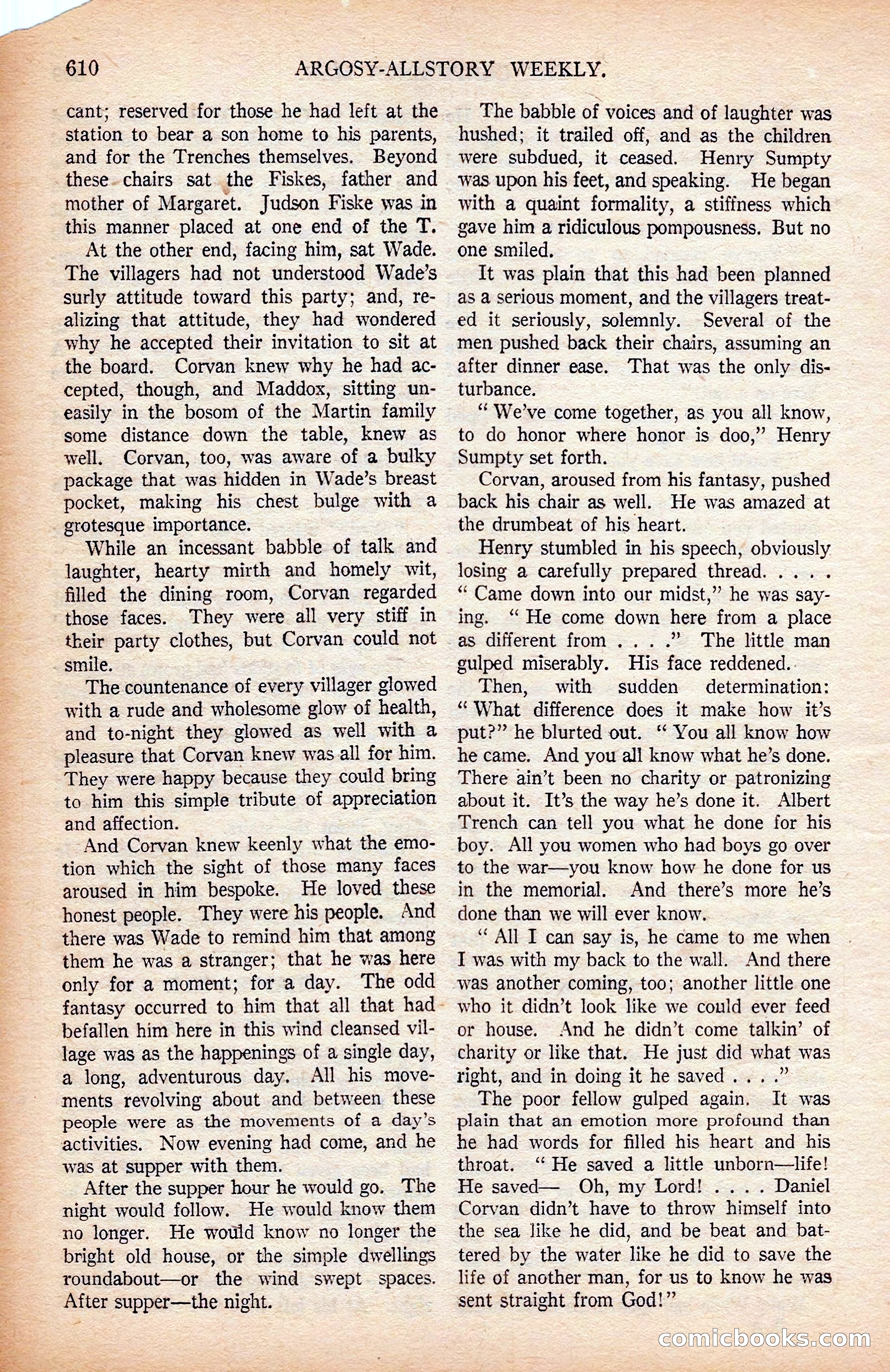
A restored page from Pulp Fiction, 1924. Page through the whole issue in the reader above.
📄 Transcribed text from this page (OCR, searchable)
Machine-transcribed from the original scan — historical spelling and the odd misread are preserved.
610 cant; reserved for those he had left at the station to bear a son home to his parents, and for the Trenches themselves. Beyond these. chairs sat the Fiskes, father and mother of Margaret. Judson Fiske was in this manner placed at one end of the T. At the other end, facing him, sat Wade. The villagers had not understood Wade’s surly attitude toward this party; and, re- alizing that attitude, they had wondered why he accepted their invitation to sit at the board. Corvan knew why he had ac- cepted, though, and Maddox, sitting un- easily in the bosom of the Martin family some distance down the table, knew as well. Corvan, too, was aware of a bulky package that was hidden in Wade’s breast pocket, making his chest bulge with a grotesque importance. While an incessant babble of talk and laughter, hearty mirth and homely wit, filled the dining room, Corvan regarded those faces. They were all very stiff in their party clothes, but Corvan could not smile. The countenance of every villager glowed with a rude and wholesome glow of health, and to-night they glowed as well with a pleasure that Corvan knew was all for him. They were happy because they could bring to him this simple tribute of appreciation and affection. And Corvan knew keenly what the emo- tion which the sight of those many faces aroused in him bespoke. He loved these honest people. They were his people. And there was Wade to remind him that among them he was a stranger; that he was here only for a moment; for a day. The odd fantasy occurred to him that all that had- befallen him here in this wind cleansed vil- lage was as the happenings of a single day, a long, adventurous day. All his move- ments revolving about and between these people were as the movements of a day’s activities. Now evening had come, and he was at supper with them. After the supper hour he would go. The night would follow. He would know them no longer. He wotild know no longer the bright old house, or the simple dwellings roundabout—or the wind swept spaces. After supper—the night. ARGOSY-ALLSTORY WEEKLY, The babble of voices and of laughter was hushed; it trailed off, and as the children were subdued, it ceased. Henry Sumpty was upon his feet, and speaking. He began with a quaint formality, a stiffness which gave him a ridiculous pompousness. But no one smiled. It was plain that this had been planned as a Serious moment, and the villagers treat- ed it seriously, solemnly. Several of the men pushed back their chairs, assuming an after dinner ease. That was the only dis- turbance. “We've come together, as you all know, to do honor where honor is doo,” Henry Sumpty set forth. Corvan, aroused from his fantasy, pushed back his chair as well. He was amazed at the drumbeat of his heart. Henry stumbled in his speech, obviously losing a carefully prepared thread. .... ‘““ Came down into our midst,” he was say- ing. ‘He come down here from a place as different from... .” The little man gulped miserably. His face reddened.. Then, with sudden determination: “What difference does it make how it’s put?” he blurted out. ‘‘ You all know how he came. And you all know what he’s done. There ain’t been no charity or patronizing about it. It’s the way he’s done it. Albert Trench can tell you what he done for his boy. All you women who had boys go over to the war—you know how he done for us in the memorial. And there’s more he’s done than we will ever know. ‘‘ All I can say is, he came to me when I was with my back to the wall. And there was another coming, too; another little one who it didn’t look like we could ever feed or house. And he didn’t come talkin’ of charity or like that. He just did what was right, and in doing it he saved... .” The poor fellow gulped again. It was plain that an emotion more profound than he had words for filled his heart and his throat. ‘‘ He saved a little unborn—life! He saved— Oh, my Lord! .... Daniel Corvan didn’t have to throw himself into the sea like he did, and be beat and bat- tered by the water like he did to save the life of another man, for us to know he was sent straight from God!” Eomichbooks:co