
Pulp Fiction, 1924 · page 115 of 172
Argosy All-Story Weekly, April 19, 1924 — page 115: what you’re looking at
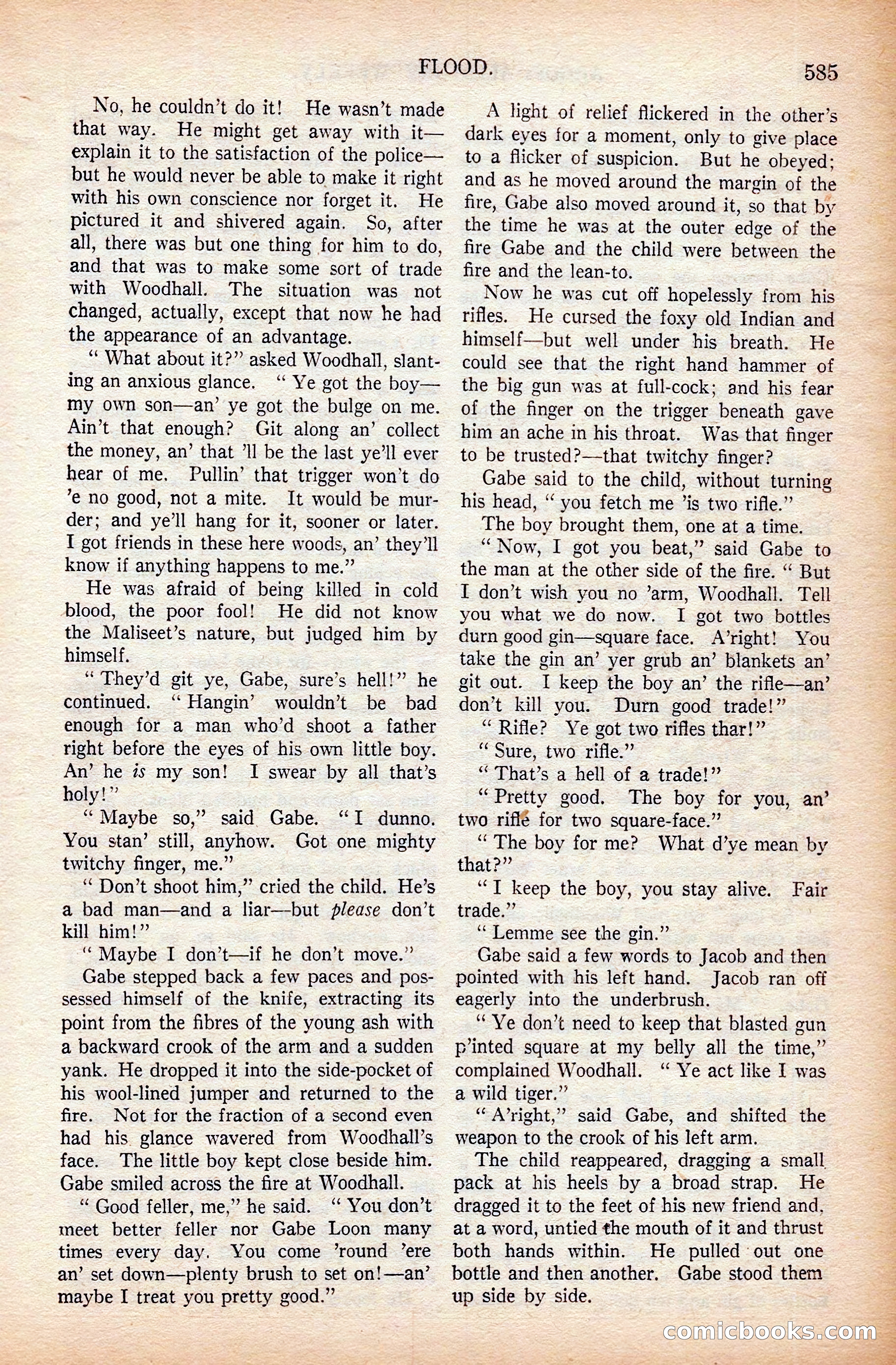
A restored page from Pulp Fiction, 1924. Page through the whole issue in the reader above.
📄 Transcribed text from this page (OCR, searchable)
Machine-transcribed from the original scan — historical spelling and the odd misread are preserved.
FLOOD. No, he couldn’t do it! He wasn’t made that way. He might get away with it— explain it to the satisfaction of the police— but he would never be able to make it right with his own conscience nor forget it. He pictured it and shivered again. So, after all, there was but one thing for him to do, and that was to make some sort of trade with Woodhall. The situation was not changed, actually, except that now he had the appearance of an advantage. ‘ What about it?” asked Woodhall, slant- ing an anxious glance. “ Ye got the boy— my own son—an’ ye got the bulge on me. Ain’t that enough? Git along an’ collect the money, an’ that ’ll be the last ye’ll ever hear of me. Pullin’ that trigger won’t do ’e no good, not a mite. It would be mur- der; and ye’ll hang for it, sooner or later. I got friends in these here woods, an’ they'll know if anything happens to me.” He was afraid of being killed in cold blood, the poor fool! He did not know the Maliseet’s nature, but judged him by himself. “ They’d git ye, Gabe, sure’s hell!” he continued. ‘“‘ Hangin’ wouldn’t be bad enough for a man who’d shoot a father right before the eyes of his own little boy. An’ he is my son! I swear by all that’s holy!” ‘““Maybe so,” said Gabe. ‘I dunno. You stan’ still, anyhow. Got one mighty twitchy finger, me.” ‘“ Don’t shoot him,” cried the child. He’s a bad man—and a liar—but please don’t kill him!” ‘“ Maybe I don’t—if he don’t move.” Gabe stepped back a few paces and pos- sessed himself of the knife, extracting its point from the fibres of the young ash with a backward crook of the arm and a sudden yank. He dropped it into the side-pocket of his wool-lined jumper and returned to the fire. Not for the fraction of a second even had his. glance wavered from Woodhall’s face. The little boy kept close beside him. Gabe smiled across the fire at Woodhall. “ Good feller, me,” he said. ‘‘ You don’t meet better feller nor Gabe Loon many times every day. You come ’round ’ere an’ set down—plenty brush to set on!—an’ maybe I treat you pretty good.” 585 A light of relief flickered in the other’s dark eyes for a moment, only to give place to a flicker of suspicion. But he obeyed: and as he moved around the margin of the fire, Gabe also moved around it, so that by the time he was at the outer edge of the fire Gabe and the child were between the fire and the lean-to. Now he was cut off hopelessly from his rifles. He cursed the foxy old Indian and himself—but well under his breath. He could see that the right hand hammer of the big gun was at full-cock; and his fear of the finger on the trigger beneath gave him an ache in his throat. Was that finger to be trusted?—that twitchy finger? Gabe said to the child, without turning his head, ‘“‘ you fetch me ’is two rifle.” The boy brought them, one at a time. “Now, I got you beat,” said Gabe to the man at the other side of the fire. “ But I don’t wish you no ’arm, Woodhall. Tell you what we do now. I got two bottles durn good gin—square face. A’right! You take the gin an’ yer erub an’ blankets an’ git out. I keep the boy an’ the rifle—an’ don’t kill you. Durn good trade!” “Rifle? Ye got two rifles thar!” “Sure, two rifle.” “That’s a hell of a trade!” ‘Pretty good. The boy for you, an’ two riffle for two square-face.” ‘The boy for me? What d’ye mean by that?” ‘“T keep the boy, you stay alive. trade.” ‘“Lemme see the gin.” Gabe said a few words to Jacob and then pointed with his left hand. Jacob ran off eagerly into the underbrush. ‘Ye don’t need to keep that blasted gun pinted square at my belly all the time,” complained Woodhall. “ Ye act like I was a wild tiger.’ ‘““ A’right,” said Gabe, and shifted the weapon to the crook of his left arm. The child reappeared, dragging a small pack at his heels by a broad strap. He dragged it to the feet of his new friend and, at a word, untied the mouth of it and thrust both hands within. He pulled ‘out one bottle and then another. Gabe stood them up side by side. Fair S GCOMiIichboo com se “< ae”,