
Pulp Fiction, 1924 · page 104 of 172
Argosy All-Story Weekly, April 19, 1924 — page 104: what you’re looking at
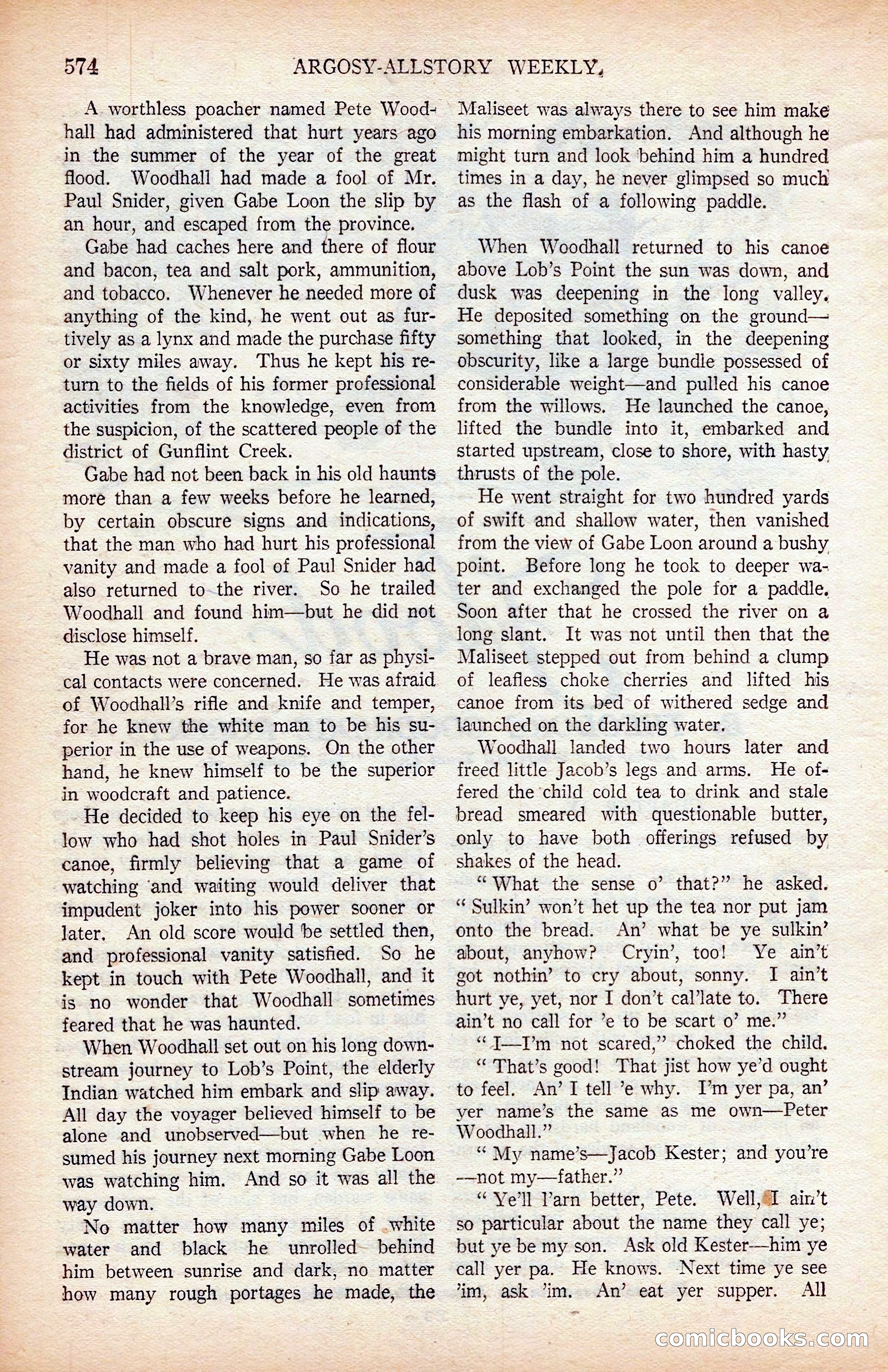
A restored page from Pulp Fiction, 1924. Page through the whole issue in the reader above.
📄 Transcribed text from this page (OCR, searchable)
Machine-transcribed from the original scan — historical spelling and the odd misread are preserved.
o74 A worthless poacher named Pete Wood- hall had administered that hurt years ago in the summer of the year of the great flood. Woodhall had made a fool of Mr. Paul Snider, given Gabe Loon the slip by an hour, and escaped from the province. Gabe had caches here and there of flour and bacon, tea and salt pork, ammunition, and tobacco. Whenever he needed more of anything of the kind, he went out as fur- tively as a lynx and made the purchase fifty or sixty miles away. Thus he kept his re- turn to the fields of his former professional activities from the knowledge, even from the suspicion, of the scattered people of the district of Gunflint Creek. Gabe had not been back in his old haunts more than a few weeks before he learned, by certain obscure signs and indications, that the man who had hurt his professional vanity and made a fool of Paul Snider had also returned to-the river. So he trailed Woodhall and found him—but he did not disclose himself. He was not a brave man, so far as physi- cal contacts were concerned. He was afraid of Woodhall’s rifle and knife and temper, for he knew the white man to be his su- perior in the use of weapons. On the other hand, he knew himself to be the superior in woodcraft and patience. He decided to keep his eye on the fel- low who had shot holes in Paul Snider’s canoe, firmly believing that a game of watching ‘and waiting would deliver that impudent joker into his power sooner or later, An old score would be settled then, and professional vanity satisfied. So he kept in touch with Pete Woodhall, and it is no wonder that Woodhall sometimes feared that he was haunted. When Woodhall set out on his long down- stream journey to Lob’s Point, the elderly Indian watched him embark and slip away. All day the voyager believed himself to be alone and unobserved—but when he re- sumed his journey next morning Gabe Loon was watching him. And so it was all the way down. No matter how many miles of .white water and black he wunrolled- behind him between sunrise and dark, no matter how many rough portages he made, the ARGOSY-ALLSTORY WEEKLY. Maliseet was always there to see him make his morning embarkation. And although he might turn and look behind him a hundred times in a day, he never glimpsed so much as the flash of a following paddle. When Woodhall returned to his canoe above Lob’s Point the sun was down, and dusk was deepening in the long valley. He deposited something on the ground— something that looked, in the deepening obscurity, like a large bundle possessed of considerable weight—and pulled his canoe from the willows. He launched the canoe, lifted the bundle into it, embarked and started upstream, close to shore, with hasty thrusts of the pole. He went straight for two hundred yards of swift and shallow water, then vanished from the view of Gabe Loon around a bushy point. Before long he took to deeper wa- ter and exchanged the pole for a paddle, Soon after that he crossed the river on a long slant. It was not until then that the Maliseet stepped out from behind a clump of leafless choke cherries and lifted his canoe from its bed of withered sedge and launched on the darkling water. Woodhall landed two hours later and freed little Jacob’s legs and arms. He of- fered the child cold tea to drink and stale bread smeared with questionable butter, only to have both offerings refused by shakes of the head. “What the sense o’ that?” he asked. “ Sulkin’ won’t het up the tea nor put jam onto the bread. An’ what be ye sulkin’ about, anyhow? Cryin’, too! Ye ain’t got nothin’ to cry about, sonny. I ain't hurt ye, yet, nor I don’t cal’late to. There ain’t no call for ’e to be scart 0’ me.” “‘T—T’m not scared,” choked the child. “ That’s good! That jist how ye’d ought to feel. An’ I tell °e why. I’m yer pa, an’ yer name’s the same as me own—Peter Woodhall.” “ My name’s—Jacob Kester; and you're ——not my—father.”’ “Vell Varn better, Pete. Well, I ain’t so particular about the name they call ye; but ye be my son. Ask old Kester—him ye call yer pa. He knows. Next time ye see ‘im, ask ’im, An’ eat yer supper. All a oO EComichbooks (S@) S|