
Pulp Fiction, 1923 · page 34 of 176
Argosy All-Story Weekly — page 34: what you’re looking at
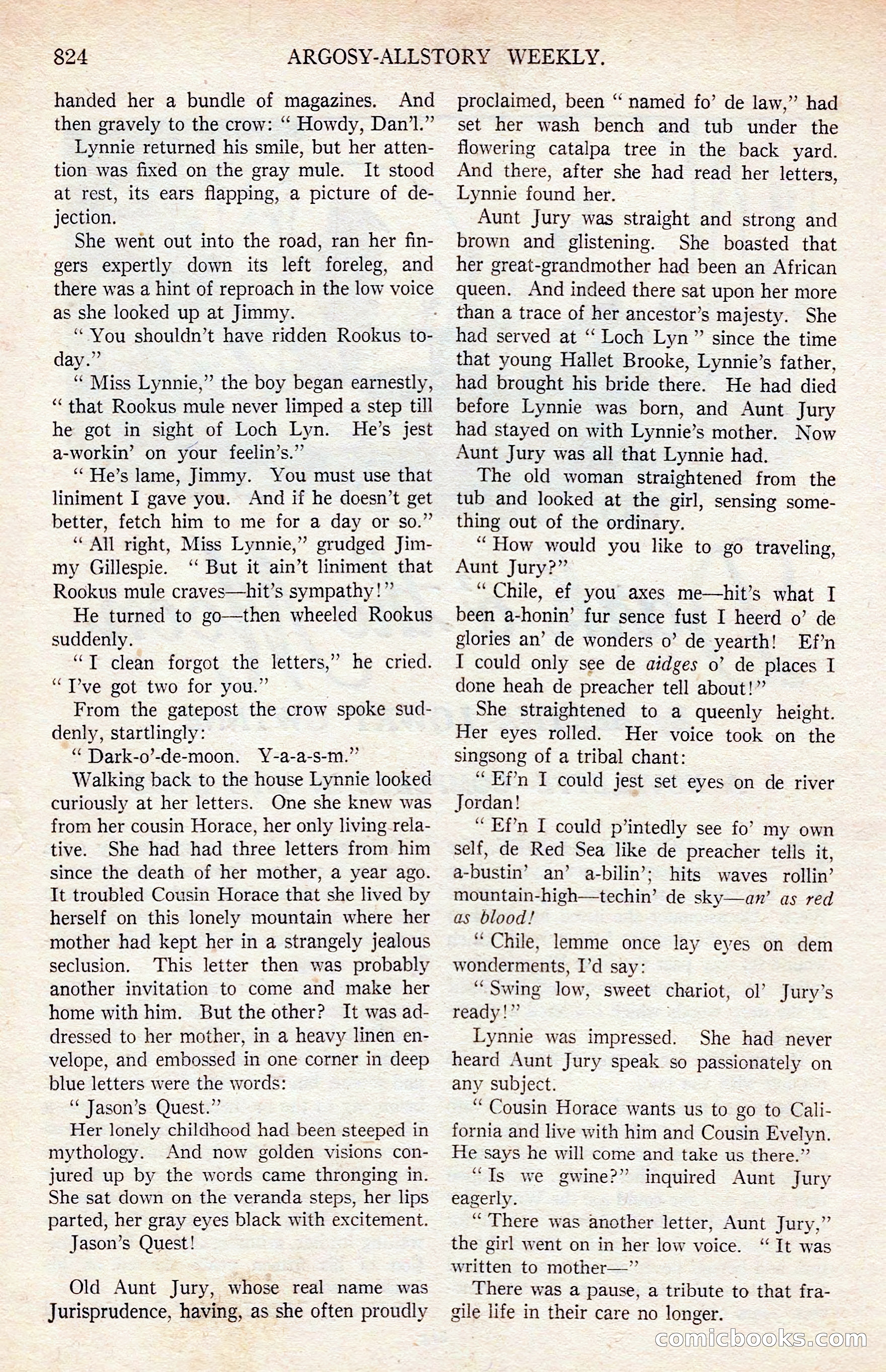
A restored page from Pulp Fiction, 1923. Page through the whole issue in the reader above.
📄 Transcribed text from this page (OCR, searchable)
Machine-transcribed from the original scan — historical spelling and the odd misread are preserved.
$24 handed her a bundle of magazines. And then gravely to the crow: “ Howdy, Dan’l.” Lynnie returned his smile, but her atten- tion was fixed on the gray mule. It stood at rest, its ears flapping, a picture of de- jection, She went out into the road, ran her fin- gers expertly down its left foreleg, and there was a hint of reproach in the low voice as she looked up at Jimmy. “You shouldn’t have ridden Rookus to- day.” ‘““ Miss Lynnie,” the boy began earnestly, “that Rookus mule never limped a step till he got in sight of Loch Lyn. He’s jest a-workin’ on your feelin’s.” ‘““ He’s lame, Jimmy. You must use that liniment I gave you. And if he doesn’t get better, fetch him to me for a day or so.” ‘“ All right, Miss Lynnie,” grudged Jim- my Gillespie. ‘‘ But it ain’t liniment that Rookus mule craves—hit’s sympathy!” He turned to go—then wheeled Rookus suddenly. “T clean forgot the letters,” he cried. ‘“T’ve got two for you.” From the gatepost the crow spoke sud- denly, startlingly: “Dark-o’-de-moon. Y-a-a-s-m.”’ Walking back to the house Lynnie looked curiously at her letters. One she knew was from her cousin Horace, her only living-rela- tive. She had had three letters from him since the death of her mother, a year ago. It troubled Cousin Horace that she lived by herself on this lonely mountain where her mother had kept her in a strangely jealous seclusion. This letter then was probably another invitation to come and make her home with him. But the other? It was ad- dressed to her mother, in a heavy linen en- velope, and embossed in one corner in deep blue letters were the words: ‘““ Jason’s Quest.” Her lonely childhood had been steeped in mythology. And now golden visions con- jured up by the words came thronging in. She sat down on the veranda steps, her lips parted, her gray eyes black with excitement. Jason’s Quest! Old Aunt Jury, whose real name was Jurisprudence, having, as she often proudly ARGOSY-ALLSTORY WEEKLY. proclaimed, been “ named fo’ de law,” had set her wash bench and tub under the flowering catalpa tree in the back yard. And there, after she had read her letters, Lynnie found her. Aunt Jury was straight and strong and brown and glistening. She boasted that her great-grandmother had been an African queen. And indeed there sat upon her more than a trace of her ancestor’s majesty. She had served at “‘ Loch Lyn” since the time that young Hallet Brooke, Lynnie’s father, had brought his bride there. He had died before Lynnie was born, and Aunt Jury had stayed on with Lynnie’s mother. Now Aunt Jury was all that Lynnie had. The old woman straightened from the tub and looked at the girl, sensing some- thing out of the ordinary. “How would you like to go traveling, Aunt Jury?” ‘“ Chile, ef you axes me—hit’s what I been a-honin’ fur sence fust I heerd 0’ de glories an’ de wonders o’ de yearth! Ef’n I could only see de aidges o’ de places I done heah de preacher tell about!” She straightened to a queenly height. Her eyes rolled. Her voice took on the singsong of a tribal chant: “ Ei’n I could jest set eyes on de river Jordan! “ Ef’n I could p’intedly see fo’ my own self, de Red Sea like de preacher tells it, a-bustin’ an’ a-bilin’: hits waves rollin’ mountain-high—techin’ de sky—an’ as red as blood! “Chile, lemme once lay eyes on dem wonderments, I’d say: “Swing low, sweet chariot, ol’ Jury’s ready!” . Lynnie was impressed. She had never heard Aunt Jury speak so passionately on any subject. ‘Cousin Horace wants us to go to Calli- fornia and live with him and Cousin Evelyn. He says he will come and take us there.” “Is we gwine?” inquired Aunt Jury eagerly. “There was another letter, Aunt Jury,” the girl went on in her low voice. “ It was written to mother—” There was a pause, a tribute to that fra- gile life in their care no longer. Conmiclo@o@ S (CO)