
Pulp Fiction, 1923 · page 115 of 176
Argosy All-Story Weekly — page 115: what you’re looking at
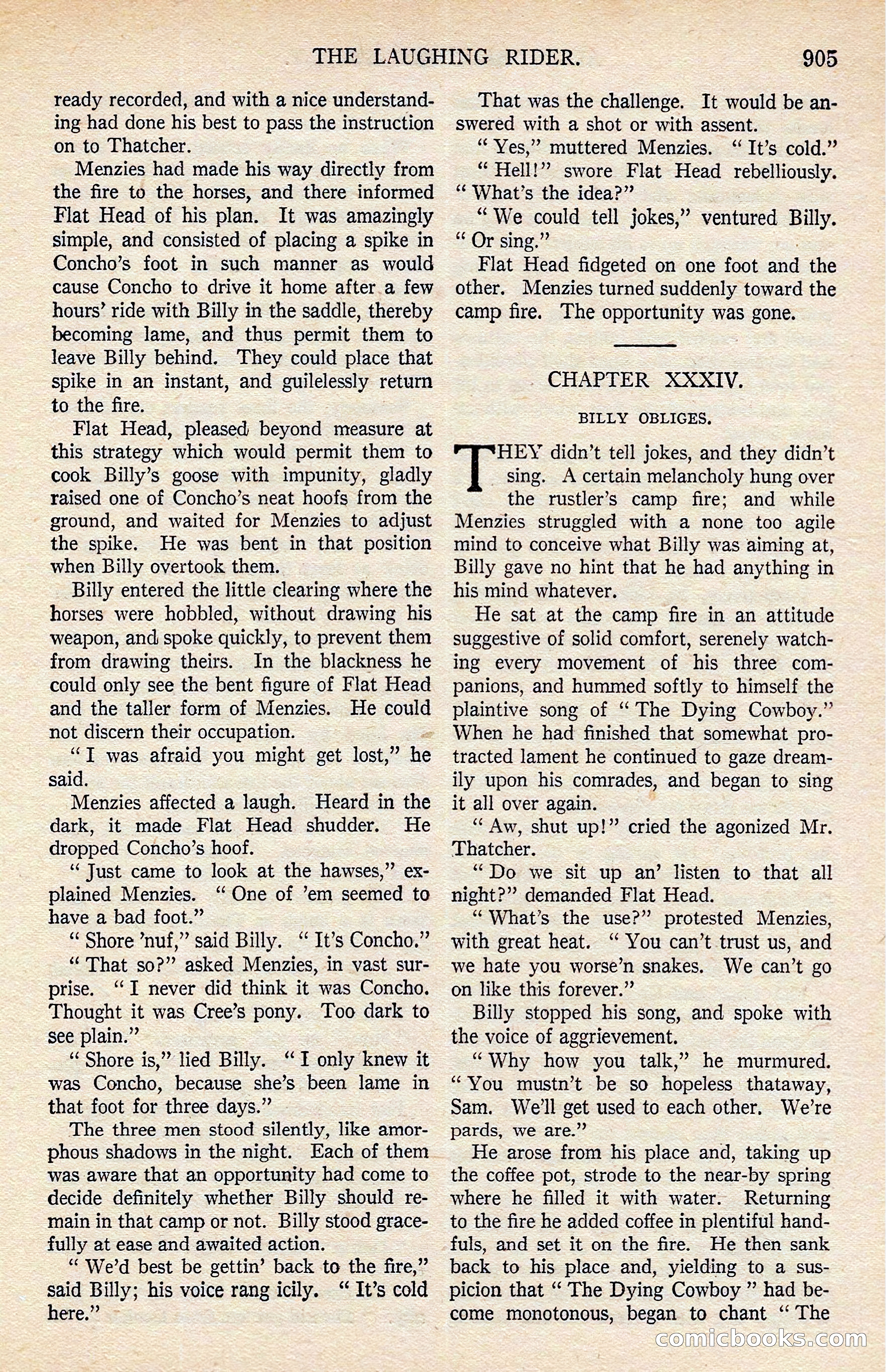
A restored page from Pulp Fiction, 1923. Page through the whole issue in the reader above.
📄 Transcribed text from this page (OCR, searchable)
Machine-transcribed from the original scan — historical spelling and the odd misread are preserved.
THE LAUGHING RIDER. ready recorded, and with a nice understand- ing had done his best to pass the instruction on to Thatcher. Menzies had made his way directly from the fire to the horses, and there informed Flat Head of his plan. It was amazingly simple, and consisted of placing a spike in Concho’s foot in such manner as would cause Concho to drive it home after.a few hours’ ride with Billy in the saddle, thereby becoming lame, and thus permit them to leave Billy behind. They could place that spike in an instant, and guilelessly return to the fire. Flat Head, pleased beyond measure at this strategy which would permit them to cook Billy’s goose with impunity, gladly raised one of Concho’s neat hoofs from the ground, and waited for Menzies to adjust the spike. He was bent in that position when Billy overtook them. Billy entered the little clearing where the horses were hobbled, without drawing his weapon, and spoke quickly, to prevent them from drawing theirs. In the blackness he could only see the bent figure of Flat Head and the taller form of Menzies. He could not discern their occupation. ‘“T was afraid you might get lost, ? ie said. Menzies affected a laugh. Heard in the dark, it made Flat Head shudder. He dropped Concho’s hoof. ‘“‘ Just came to look at the hawses,” ex- plained Menzies. ‘One of ’em seemed to have a bad foot.” “ Shore ’nuf,” said Billy. ‘“‘ It’s Concho.” ‘“‘ That so?” asked Menzies, in vast sur- prise. ‘I never did think it was Concho. Thought it was Cree’s pony. Too dark to see plain.” ‘Shore is,” lied Billy. ‘I only knew it was Concho, because she’s been lame in that foot for three days.” - The three men stood silently, like amor- phous shadows in the night. Each of them was aware that an opportunity had come to decide definitely whether Billy should re- main in that camp or not. Billy stood grace- fully at ease and awaited action. ““ We'd best be gettin’ back to the fire,” said Billy; his voice rang icily. “ It’s cold here.” 905 That was the challenge. It would be an- swered with a shot or with assent. “Yes,” muttered Menzies. ‘It’s cold.” “Hell!” swore Flat Head rebelliously. ‘* What’s the idea?” “We could tell jokes,” ventured Billy. “ Or sing.” Flat Head fidgeted on one foot aad the other. Menzies turned suddenly toward the camp fire. The opportunity was gone. CHAPTER XXXIV. BILLY OBLIGES. T*HEY didn’t tell jokes, and they didn’t _ sing. A certain melancholy hung over the rustler’s camp fire; and while Menzies struggled with a none too agile mind to conceive what Billy was aiming at, Billy gave no hint that he had anything in his mind whatever. He sat at the camp fire in an attitude suggestive of solid comfort, serenely watch- ing every movement of his three com- panions, and hummed softly to himself the plaintive song of ‘The Dying Cowboy.” When he had finished that somewhat pro- tracted lament he continued to gaze dream- ily upon his comrades, and began to sing it all over again. ‘““ Aw, shut up!” cried the agonized Mr. Thatcher. ‘“Do we sit up an’ listen to that all night?” demanded Flat Head. ‘“‘What’s the use?” protested Menzies, with great heat. “ You can’t trust us, and we hate you worse’n snakes. We can’t go on like this forever.” Billy stopped his song, the voice of aggrievement. “Why how you talk,” he murmured. ‘You mustn’t be so hopeless thataway, Sam. We'll get used to each other. We’re pards, we are.” He arose from his place and, taking up the coffee pot, strode to the near-by spring where he filled it with water. Returning to the fire he added coffee in plentiful hand- fuls, and set it on the fire. He then sank back to his place and, yielding to a sus- picion that ‘“ The Dying Cowboy ” had be- come monotonous, began to chant “ The COM COOOKS and spoke with (CO) im