
Pulp Fiction, 1923 · page 109 of 176
Argosy All-Story Weekly — page 109: what you’re looking at
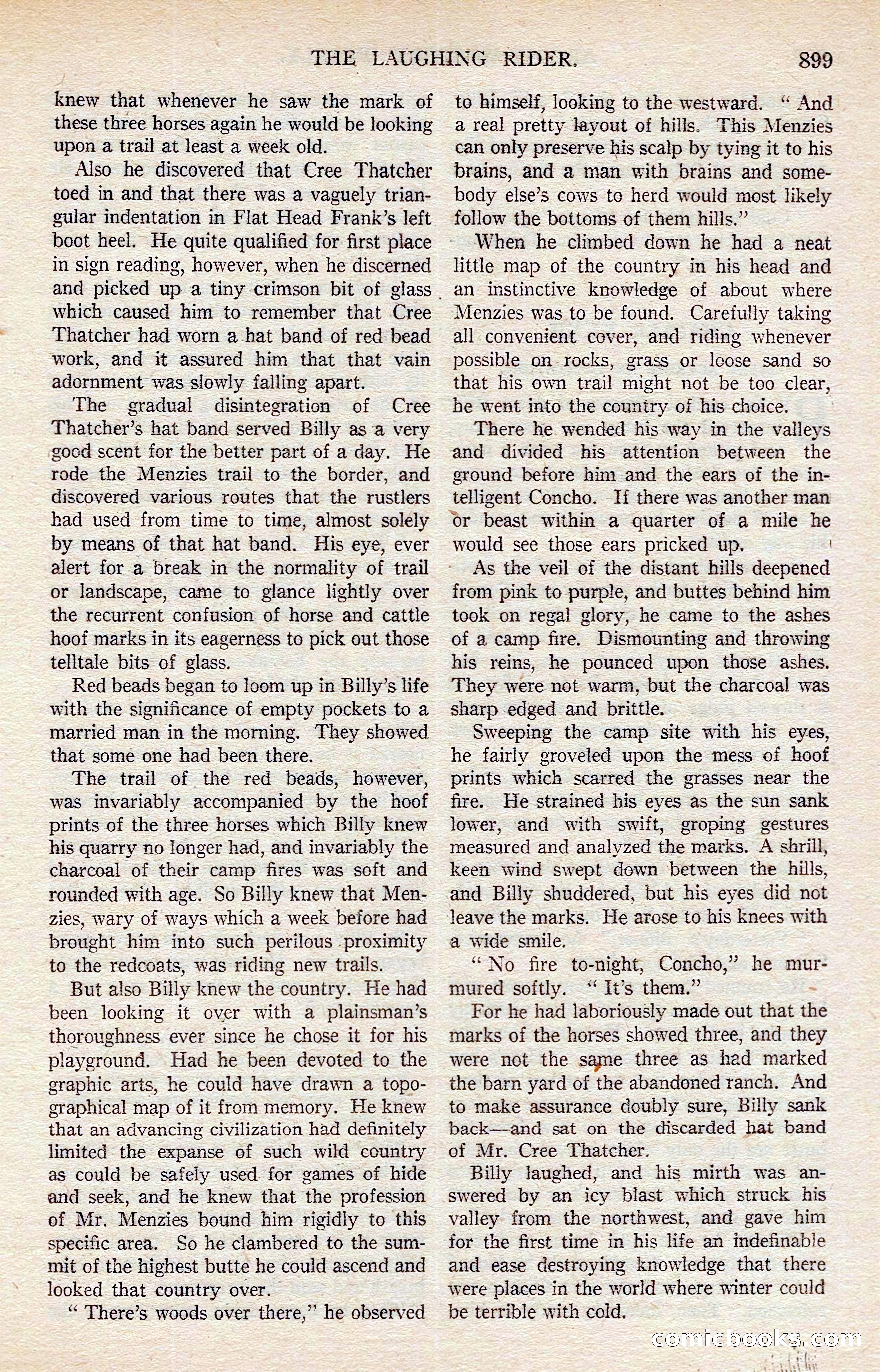
A restored page from Pulp Fiction, 1923. Page through the whole issue in the reader above.
📄 Transcribed text from this page (OCR, searchable)
Machine-transcribed from the original scan — historical spelling and the odd misread are preserved.
THE LAUGHING RIDER. knew that whenever he saw the mark of these three horses again he would be looking upon a trail at least a week old. Also he discovered that Cree Thatcher toed in and that there was a vaguely trian- gular indentation in Flat Head Frank’s left boot heel. He quite qualified for first place In sign reading, however, when he discerned and picked up a tiny crimson bit of glass which caused him to remember that Cree Thatcher had worn a hat band of red bead work, and it assured him that that vain adornment was slowly falling apart. The gradual disintegration of Cree Thatcher’s hat band served Billy as a very good scent for the better part of a day. He rode the Menzies trail to the border, and discovered various routes that the rustlers had used from time to time, almost solely by means of that hat band. His eye, ever alert for a break in the normality of trail or landscape, came to glance lightly over the recurrent confusion of horse and cattle hoof marks in its eagerness to pick out those telltale bits of glass. Red beads began to loom up in Billy’s life with the significance of empty pockets to a married man in the morning. They showed that some one had been there. The trail of the red beads, however, was invariably accompanied by the hoof prints of the three horses which Billy knew his quarry no longer had, and invariably the charcoal of their camp fires was soft and rounded with age. So Billy knew that Men- zies, wary of ways which a week before had brought him into such perilous -proximity to the redcoats, was riding new trails. But also Billy knew the country. He had been looking it over with a plainsman’s thoroughness ever since he chose it for his playground. Had he been devoted to the graphic arts, he could have drawn a topo- graphical map of it from memory. He knew that an advancing civilization had definitely limited the expanse of such wild country as could be safely used for games of hide and seek, and he knew that the profession of Mr. Menzies bound him rigidly to this specific area. So he clambered to the sum- mit of the highest butte he could ascend and looked that country over. ‘“ There’s woods over there,” he observed leave the marks. 399 to himself, looking to the westward. “ And a real pretty layout of hills. This Menzies can only preserve his scalp by tying it to his brains, and a man with brains and some- body else’s cows to herd would most likely follow the bottoms of them hills.” When he climbed down he had a neat little map of the country in his head and an instinctive knowledge of about where Menzies was to be found. Carefully taking all convenient cover, and riding whenever possible on rocks, grass or loose sand so that his own trail might not be too clear, he went into the couniry of his choice. There he wended his way in the valleys and divided his attention between the ground before him and the ears of the in- telligent Concho. If there was another man or beast within a quarter of a mile he would see those ears pricked up. As the veil of the distant hills deepened from pink to purple, and buttes behind him took on regal glory, he came to the ashes of a camp fire. Dismounting and throwing his reins, he pounced upon those ashes. They were not warm, but the charcoal was sharp edged and brittle. Sweeping the camp site with his eyes, he fairly eroveled upon the mess of hoof prints which scarred the grasses near the fire. He strained his eyes as the sun sank lower, and with swift, groping gestures measured and analyzed the marks. A shrill, keen wind swept down between the hills, and Billy shuddered, but his eyes did not He arose to his knees with a wide smile. “No fire to-night, Concho,” he mur- mured softly. ‘ It’s them.” For he had laboriously made out that the marks of the horses showed three, and they were not the same three as had marked the barn yard of the abandoned ranch. And to make assurance doubly sure, Billy sank back—and sat on the discarded hat band of Mr. Cree Thatcher. Billy laughed, and his mirth was an- swered by an icy blast which struck his valley from the northwest, and gave him for the first time in his life an indefinable and ease destroying knowledge that there were places in the world where winter could be terrible with cold. (CO) COMMICOOOKS