
Pulp Fiction, 1923 · page 58 of 178
Argosy All-Story Weekly — page 58: what you’re looking at
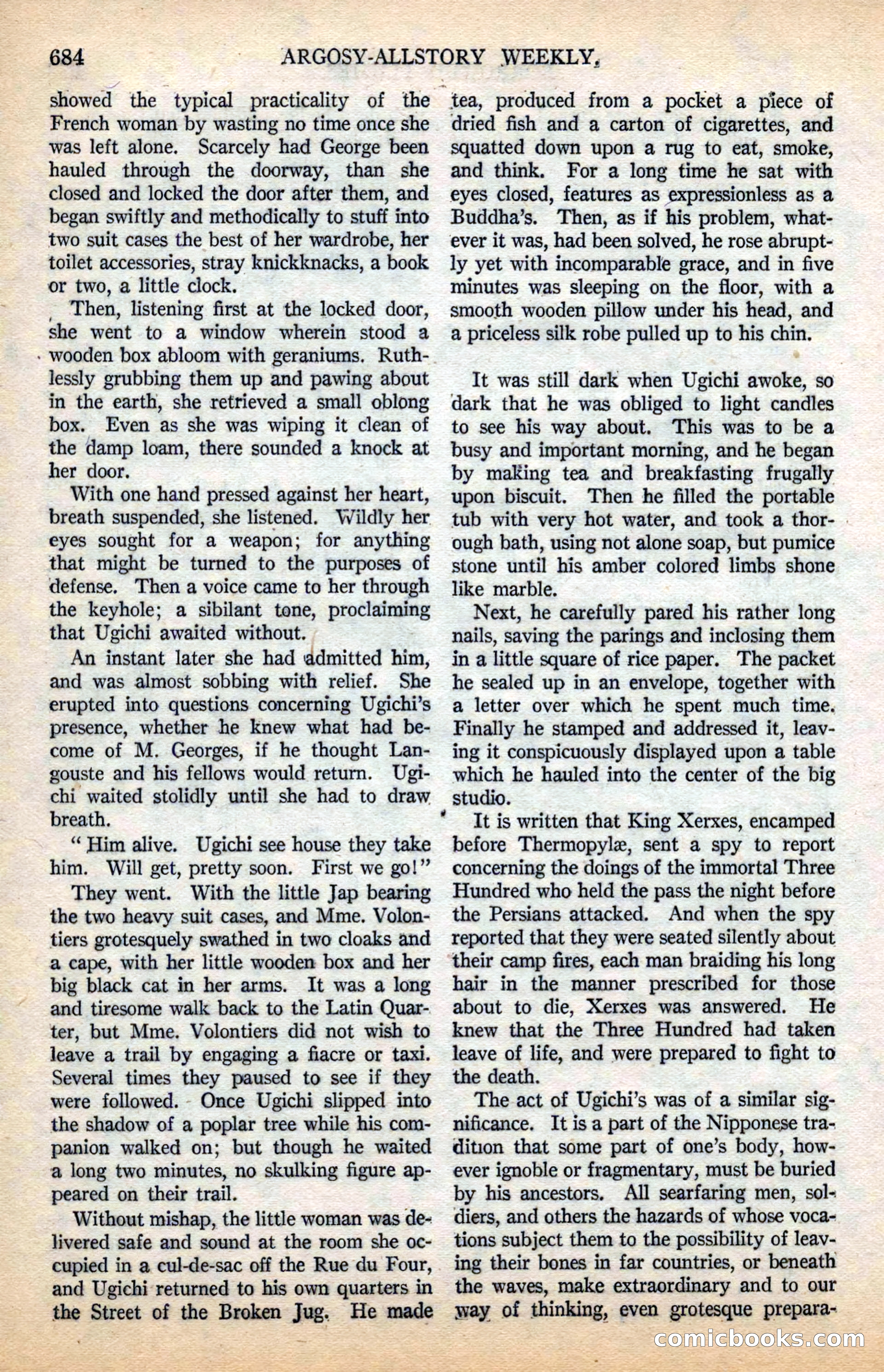
A restored page from Pulp Fiction, 1923. Page through the whole issue in the reader above.
📄 Transcribed text from this page (OCR, searchable)
Machine-transcribed from the original scan — historical spelling and the odd misread are preserved.
634 showed the typical practicality of the French woman by wasting no time once she was left alone. Scarcely had George been hauled through the doorway, than she closed and locked the door after them, and began swiftly and methodically to stuff into two suit cases the best of her wardrobe, her toilet accessories, stray knickknacks, a book or two, a little clock. _ Then, listening first at the locked door, she went to a window wherein stood a - wooden box abloom with geraniums. Ruth- lessly grubbing them up and pawing about in the earth, she retrieved a small oblong box. Even as she was wiping it clean of the damp loam, there sounded a knock at her door. With one hand pressed against her heart, breath suspended, she listened. Wildly her eyes sought for a weapon; for anything that might be turned to the purposes of defense. Then a voice came to her through the keyhole; a sibilant tone, proclaiming that Ugichi awaited without. An instant later she had admitted him, and was almost sobbing with relief. She erupted into questions concerning Ugichi’s presence, whether he knew what had be- come of M. Georges, if he thought Lan- gouste and his fellows would return. Ugi- chi waited stolidly until she had to draw breath. “ Him alive. Ugichi see house they take him. Will get, pretty soon. First we go!” They went. With the little Jap bearing the two heavy suit cases, and Mme. Volon- tiers grotesquely swathed in two cloaks and a cape, with her little wooden box and her big black cat in her arms. It was a long and tiresome walk back to the Latin Quar- ter, but Mme. Volontiers did not wish to leave a trail by engaging a fiacre or taxi. Several times they paused to see if they were followed. - Once Ugichi slipped into the shadow of a poplar tree while his com- panion walked on; but though he waited a long two minutes, no skulking figure ap- peared on their trail. Without mishap, the little woman was de- livered safe and sound at the room she oc- cupied in a cul-de-sac off the Rue du Four, and Ugichi returned to his own quarters in the Street of the Broken Jug. He made es ARGOSY-ALLSTORY WEEKLY, “tea, produced from a pocket a piece of dried fish and a carton of cigarettes, and squatted down upon a rug to eat, smoke, and think. For a long time he sat with eyes closed, features as expressionless as a Buddha’s. Then, as if his problem, what- ever it was, had been solved, he rose abrupt- ly yet with incomparable grace, and in five minutes was sleeping on the floor, with a smooth wooden pillow under his head, and a priceless silk robe pulled up to his chin. It was still dark when Ugichi awoke, so dark that he was obliged to light candles to see his way about. This was to be a busy and important morning, and he began by making tea and breakfasting frugally upon biscuit. Then he filled the portable tub with very hot water, and took a thor- . ough bath, using not alone soap, but pumice stone until his amber colored limbs shone like marble. Next, he carefully pared his rather long nails, saving the parings and inclosing them in a little square of rice paper. The packet he sealed up in an envelope, together with a letter over which he spent much time. Finally he stamped and addressed it, leav- ing it conspicuously displayed upon a table which he hauled into the center of the big studio. It is written that King Xerxes, encamped before Thermopyle, sent a spy to report concerning the doings of the immortal Three Hundred who held the pass the night before the Persians attacked. And when the spy reported that they were seated silently about their camp fires, each man braiding his long hair in the manner prescribed for those about to die, Xerxes was answered. He knew that the Three Hundred had taken leave of life, and were prepared to fight to the death. The act of Ugichi’s was of a similar sig- nificance. It is a part of the Nipponese tra- dition that some part of one’s body, how- ever ignoble or fragmentary, must be buried by his ancestors. All searfaring men, sol- diers, and others the hazards of whose voca- tions subject them to the possibility of leav- ing their bones in far countries, or beneath the waves, make extraordinary and to our way of thinking, even grotesque prepara- : comicbooks,com —