
Pulp Fiction, 1923 · page 47 of 178
Argosy All-Story Weekly — page 47: what you’re looking at
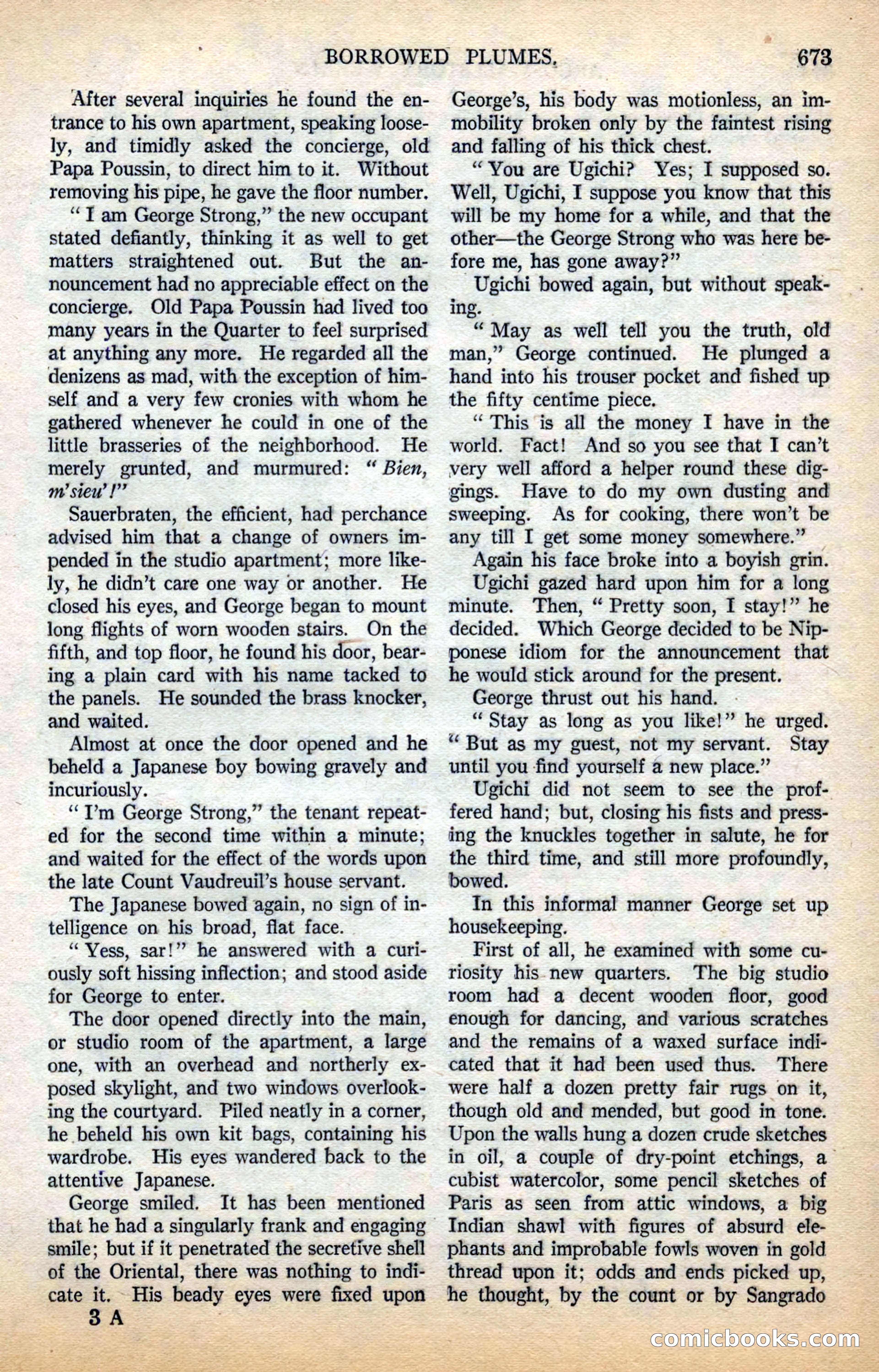
A restored page from Pulp Fiction, 1923. Page through the whole issue in the reader above.
📄 Transcribed text from this page (OCR, searchable)
Machine-transcribed from the original scan — historical spelling and the odd misread are preserved.
BORROWED PLUMES, After several inquiries he found the en- trance to his own apartment, speaking loose- ly, and timidly asked the concierge, old Papa Poussin, to direct him to it. Without removing his pipe, he gave the floor number. “T am George Strong,” the new occupant stated defiantly, thinking it as well to get matters straightened out. But the an- nouncement had no appreciable effect on the concierge. Old Papa Poussin had lived too many years in the Quarter to feel surprised at anything any more. He regarded all the denizens as mad, with the exception of him- self and a very few cronies with whom he gathered whenever he could in one of the little brasseries of the neighborhood. He merely grunted, and murmured: “ Bien, m’siew !”’ Sauerbraten, the efficient, had perchance advised him that a change of owners im- pended in the studio apartment; more like- ly, he didn’t care one way or another. He closed his eyes, and George began to mount long flights of worn wooden stairs. On the fifth, and top floor, he found his door, bear- ing a plain card with his name tacked to the panels. He sounded the brass knocker, and waited. Almost at once the door opened and he beheld a Japanese boy bowing gravely and incuriously. ‘“T’m George Strong,” the tenant repeat- ed for the second time within a minute; and waited for the effect of the words upon the late Count Vaudreuil’s house servant. The Japanese bowed again, no sign of in- telligence on his broad, flat face. “Yess, sar!’ he answered with a curi- ously soft hissing inflection; and stood aside for George to enter. The door opened directly into the main, or studio room of the apartment, a large one, with an overhead and northerly ex- posed skylight, and two windows overlook- ing the courtyard. Piled neatly in a corner, he beheld his own kit bags, containing his wardrobe. His eyes wandered back to the attentive Japanese. George smiled. It has been mentioned that he had a singularly frank and engaging © smile; but if it penetrated the secretive shell of the Oriental, there was nothing to indi- cate it. His beady eyes were fixed upon 3 A 673 George’s, his body was motionless, an im- mobility broken only by the faintest rising and falling of his thick chest. “You are Ugichi? Yes; I supposed so. Well, Ugichi, I suppose you know that this will be my home for a while, and that the other—the George Strong who was here be- fore me, has gone away?” Ugichi bowed again, but without speak- ing. “ May as well tell you the truth, old man,” George continued. He plunged a hand into his trouser pocket and fished up the fifty centime piece. “This is all the money I have in the world. Fact! And so you see that I can’t very well afford a helper round these dig- gings. Have to do my own dusting and sweeping. As for cooking, there won’t be any till I get some money somewhere.” — Again his face broke into a boyish grin. Ugichi gazed hard upon him for a long minute. Then, “ Pretty soon, I stay!” he decided. Which George decided to be Nip- ponese idiom for the announcement that he would stick around for the present. George thrust out his hand. - “Stay as long as you like!” he urged. “ But as my guest, not my servant. Stay until you find yourself a new place.” Ugichi did not seem to see the prof- fered hand; but, closing his fists and press- ing the knuckles together in salute, he for the third time, and still more profoundly, bowed. In this informal manner George set up housekeeping. First of all, he examined with some cu- riosity his-new quarters. The big studio room had a decent wooden floor, good enough for dancing, and various scratches and the remains of a waxed surface indi- cated that it had been used thus. There were half a dozen pretty fair rugs on it, though old and mended, but good in tone. Upon the walls hung a dozen crude sketches in oil, a couple of dry-point etchings, a cubist watercolor, some pencil sketches of Paris as seen from attic windows, a big Indian shawl with figures of absurd ele- phants and improbable fowls woven in gold thread upon it; odds and ends picked up, he thought, by the count or by Sangrado “comicbooks.com es te