
Pulp Fiction, 1923 · page 39 of 178
Argosy All-Story Weekly — page 39: what you’re looking at
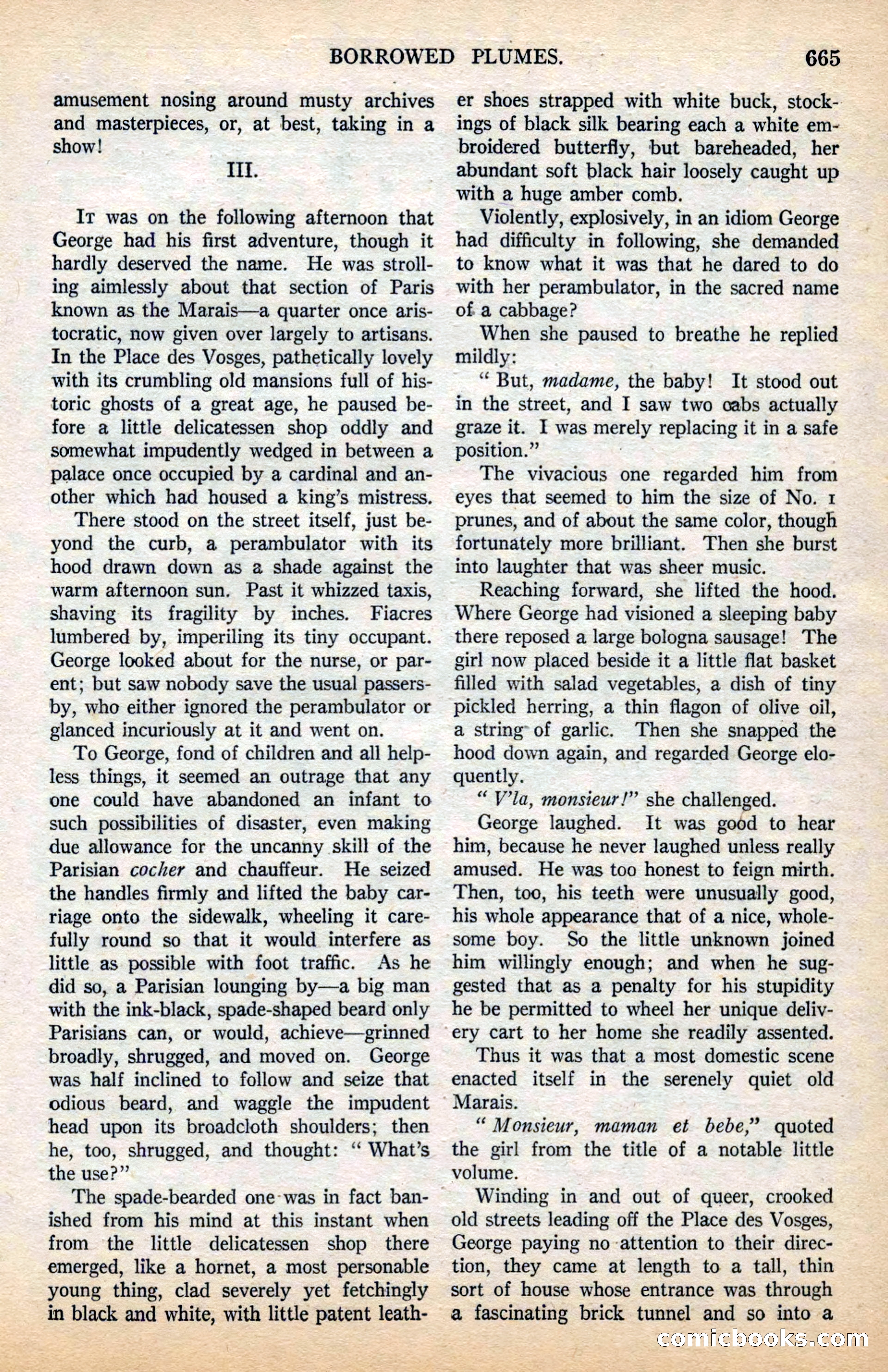
A restored page from Pulp Fiction, 1923. Page through the whole issue in the reader above.
📄 Transcribed text from this page (OCR, searchable)
Machine-transcribed from the original scan — historical spelling and the odd misread are preserved.
BORROWED PLUMES. amusement nosing around musty archives and masterpieces, or, at best, taking in a show! Til. It was on the following afternoon that George had his first adventure, though it hardly deserved the name. He was stroll- ing aimlessly about that section of Paris known as the Marais—a quarter once aris- tocratic, now given over largely to artisans. In the Place des Vosges, pathetically lovely with its crumbling old mansions full of his- toric ghosts of a great age, he paused be- fore a little delicatessen shop oddly and somewhat impudently wedged in between a palace once occupied by a cardinal and an- other which had housed a king’s mistress. There stood on the street itself, just be- yond the curb, a perambulator with its hood drawn down as a shade against the warm afternoon sun. Past it whizzed taxis, shaving its fragility by inches. Fiacres lumbered by, imperiling its tiny occupant. George looked about for the nurse, or par- ent; but saw nobody save the usual passers- by, who either ignored the perambulator or glanced incuriously at it and went on. To George, fond of children and all help- less things, it seemed an outrage that any one could have abandoned an infant to such possibilities of disaster, even making due allowance for the uncanny skill of the Parisian cocher and chauffeur. He seized the handles firmly and lifted the baby car- riage onto the sidewalk, wheeling it care- fully round so that it would interfere as little as possible with foot traffic. As he did so, a Parisian lounging by—a big man with the ink-black, spade-shaped beard only Parisians can, or would, achieve—grinned broadly, shrugged, and moved on. George was half inclined to follow and seize that odious beard, and waggle the impudent head upon its broadcloth shoulders; then he, too, shrugged, and thought: ‘‘ What’s the use?”’ The spade-bearded one-was in fact ban- ished from his mind at this instant when from the little delicatessen shop there emerged, like a hornet, a most personable young thing, clad severely yet fetchingly in black and white, with little patent leath- 665 er shoes strapped with white buck, stock- ings of black silk bearing each a white em- broidered butterfly, but bareheaded, her abundant soft black hair loosely caught up with a huge amber comb. Violently, explosively, in an idiom George had difficulty in following, she demanded to know what it was that he dared to do with her perambulator, in the sacred name of a cabbage? When she paused to breathe he replied mildly: “ But, madame, the baby! It stood out in the street, and I saw two oabs actually graze it. I was merely replacing it in a safe position.” : 3 The vivacious one regarded him from eyes that seemed to him the size of No. 1 prunes, and of about the same color, though fortunately more brilliant. Then she burst into laughter that was sheer music. Reaching forward, she lifted the hood. Where George had visioned a sleeping baby there reposed a large bologna sausage! The girl now placed beside it a little flat basket filled with salad vegetables, a dish of tiny pickled herring, a thin flagon of olive oil, a string’ of garlic. Then she snapped the hood down again, and regarded George elo- quently. “V’la, monsteur!” she challenged. George laughed. It was good to hear him, because he never laughed unless really amused. He was too honest to feign mirth. Then, too, his teeth were unusually good, his whole appearance that of a nice, whole- some boy. So the little unknown joined him willingly enough; and when he sug- gested that as a penalty for his stupidity he be permitted to wheel her unique deliv- ery cart to her home she readily assented. Thus it was that a most domestic scene enacted itself in the serenely quiet old Marais. “ Monsieur, maman et bebe,” quoted the girl from the title of a notable little volume. Winding in and out of queer, crooked old streets leading off the Place des Vosges, George paying no-attention to their direc- tion, they came at length to a tall, thin sort of house whose entrance was through a fascinating brick tunnel and so into a Eomichbooks;€o