
Pulp Fiction, 1923 · page 33 of 178
Argosy All-Story Weekly — page 33: what you’re looking at
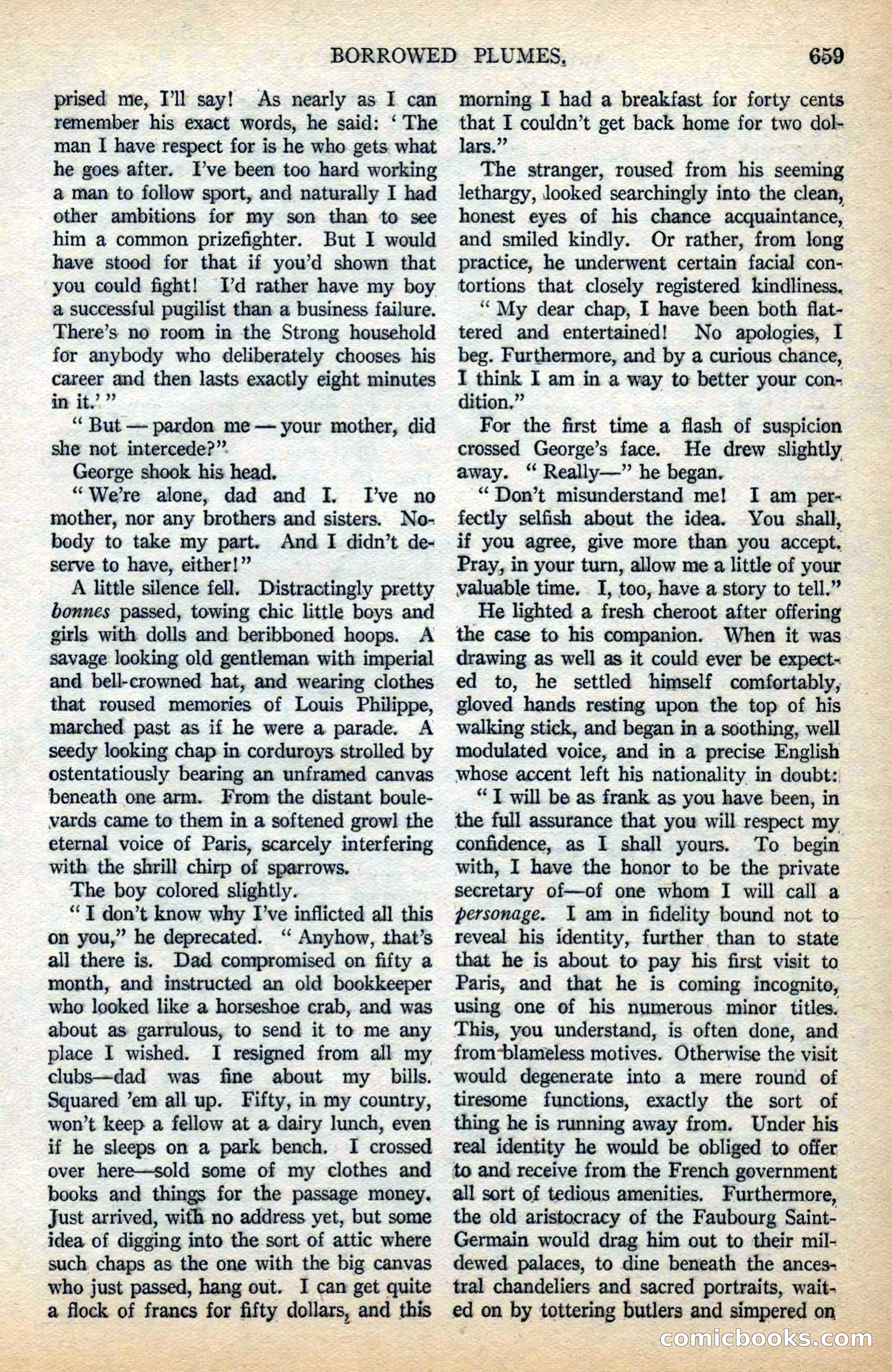
A restored page from Pulp Fiction, 1923. Page through the whole issue in the reader above.
📄 Transcribed text from this page (OCR, searchable)
Machine-transcribed from the original scan — historical spelling and the odd misread are preserved.
BORROWED PLUMES, prised me, I'll say! As nearly as I can remember his exact words, he said: ‘ The man I have respect for is he who gets what he goes after. I’ve been too hard working a man to follow sport, and naturally I had other ambitions for my son than to see him a common prizefighter. But I would have stood for that if you’d shown that you could fight! Id rather have my boy a successful pugilist than a business failure. There’s no room in the Strong household for anybody who deliberately chooses his career and then lasts exactly eight minutes in it.” ‘“‘ But — pardon me — your mother, did she not intercede?” George shook his head. “We're alone, dad and I. Ive no mother, nor any brothers and sisters. No- body to take my part. And I didn’t de- serve to have, either!” A little silence fell. Distractingly pretty bonnes passed, towing chic little boys and girls with dolls and beribboned hoops. A savage looking old gentleman with imperial and bell-crowned hat, and wearing clothes that roused memories of Louis Philippe, marched past as if he were a parade. A seedy looking chap in corduroys strolled by ostentatiously bearing an unframed canvas beneath one arm. From the distant boule- vards came to them in a softened growl the eternal voice of Paris, scarcely interfering with the shrill chirp of sparrows. The boy colored slightly. “I don’t know why I’ve inflicted all this on you,” he deprecated. ‘“ Anyhow, that’s all there is. Dad compromised on fifty a month, and instructed an old bookkeeper who looked like a horseshoe crab, and was about as garrulous, to send it to me any place I wished. I resigned from all my clubs—dad was fine about my bills. Squared ’em all up. Fifty, in my country, won’t keep a fellow at a dairy lunch, even if he sleeps on a park bench. I crossed over here—sold some of my clothes and books and things for the passage money. Just arrived, with no address yet, but some idea of digging into the sort of attic where such chaps as the one with the big canvas who just passed, hang out. I can get quite a flock of francs for fifty dollars, and this 659 morning I had a breakfast for forty cents that I couldn’t get back home for two ) Hol lars. >? The stranger, roused from his seeming lethargy, looked searchingly into the clean, honest eyes of his chance acquaintance, and smiled kindly. Or rather, from long practice, he underwent certain facial con- tortions that closely registered kindliness. “My dear chap, I have been both flat- tered and entertained! No apologies, I beg. Furthermore, and by a curious chance, I think I am in a way to better your con- dition.” For the first time a flash of suspicion crossed George’s face. He drew slightly away. ‘“ Really—” he began. “Don’t misunderstand me! I am per- fectly selfish about the idea. You shall, if you agree, give more than you accept. Pray, in your turn, allow me a little of your valuable time. I, too, have a story to tell.” He lighted a fresh ‘cheroot after offering the case to his companion. When it was drawing as well as it could ever be expect- ed to, he settled himself comfortably, gloved hands resting upon the top of his walking stick, and began i in a soothing, well modulated voice, and in a precise English whose accent left his nationality in doubt: “ T will be as frank as you have been, in the full assurance that you will respect my confidence, as I shall yours. To begin with, I have the honor to be the private secretary of—of one whom I will call a personage. I am in fidelity bound not to reveal his identity, further than to state that he is about to pay his first visit to Paris, and that he is coming incognito, using one of his numerous minor titles. This, you understand, is often done, and — from-blameless motives. Otherwise the visit would degenerate into a mere round of tiresome functions, exactly the sort of thing he is running away from. Under his real identity he would be obliged to offer — to and receive from the French government all sort of tedious amenities. Furthermore, the old aristocracy of the Faubourg Saint- Germain would drag him out to their mil- dewed palaces, to dine beneath the ances- — tral chandeliers and sacred portraits, wait- ed on by tottering butlers and simpered on comicbooks-con os