
Pulp Fiction, 1923 · page 26 of 178
Argosy All-Story Weekly — page 26: what you’re looking at
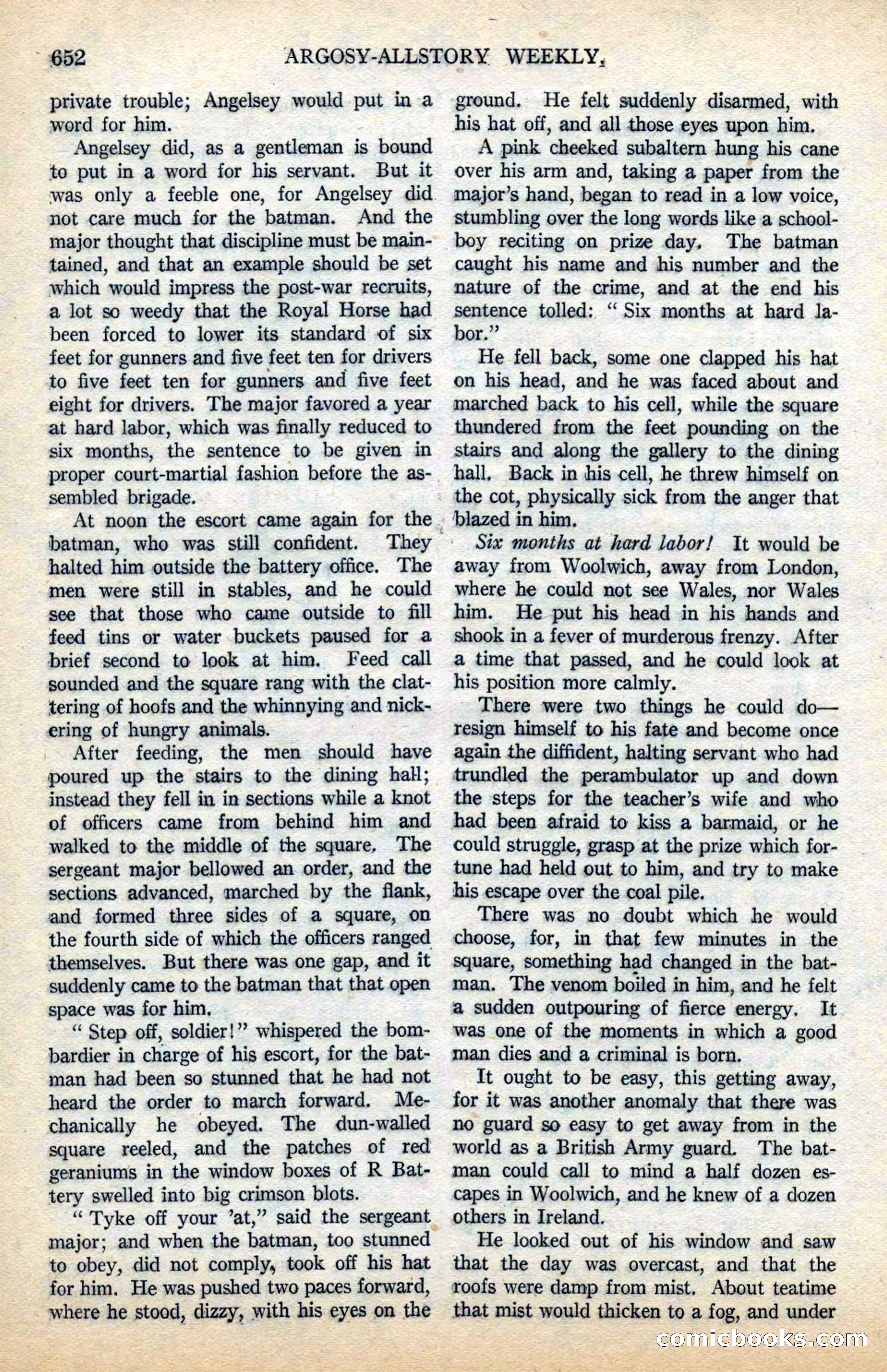
A restored page from Pulp Fiction, 1923. Page through the whole issue in the reader above.
📄 Transcribed text from this page (OCR, searchable)
Machine-transcribed from the original scan — historical spelling and the odd misread are preserved.
~ 652 private trouble; Angelsey would put in a word for him. Angelsey did, as a gentleman is bound to put in a word for his servant. But it was only a feeble one, for Angelsey did not care much for the batman. And the major thought that discipline must be main- tained, and that an example should be set which would impress the post-war recruits, a lot so weedy that the Royal Horse had been forced to lower its standard of six feet for gunners and five feet ten for drivers to five feet ten for gunners and five feet eight for drivers. The major favored a year at hard labor, which was finally reduced to six months, the sentence to be given in proper court-martial fashion before the as-_ sembled brigade. At noon the escort came again for the. They batman, who was still confident. halted him outside the battery office. The men were still in stables, and he could see that those who came outside to fill feed tins or water buckets paused for a brief second to look at him. Feed call sounded and the square rang with the clat- tering of hoofs and the whinnying and nick- ering of hungry animals. After feeding, the men should have poured up the stairs to the dining hal; instead they fell in in sections while a knot of officers came from behind him and walked to the middle of the square, The sergeant major bellowed an order, and the sections advanced, marched by the flank, and formed three sides of a square, on the fourth side of which the officers ranged themselves. But there was one gap, and it suddenly came to the batman that that open space was for him, t Step off, soldier!’’ whispered the bom- bardier in charge of his escort, for the bat- man had been so stunned that he had not heard the order to march forward. Me- chanically he obeyed. The dun-walled square reeled, and the patches of red geraniums in the window boxes of R Bat- tery swelled into big crimson blots. “Tyke off your ’at,” said the sergeant. major; and when the batman, too stunned to obey, did not comply, took off his hat for him. He was pushed two paces forward, where he stood, dizzy, with his eyes on the ARGOSY-ALLSTORY WEEKLY, ground. He felt suddenly disarmed, with his hat off, and all those eyes upon him. A pink cheeked subaltern hung his cane over his arm and, taking a paper from the major’s hand, began to read in a low voice, stumbling over the long words like a school- boy reciting on prize day, The batman caught his name and his number and the nature of the crime, and at the end his sentence tolled: “‘ Six months at hard la- bor.” He fell back, some one clapped his hat on his head, and he was faced about and marched back to his cell, while the square thundered from the feet pounding on the stairs and along the gallery to the dining hall, Back in his cell, he threw himself on the cot, physically sick from the anger that blazed in him, Six months at hard labor! It would be away from Woolwich, away from London, where he could not see Wales, nor Wales him. He put his head in his hands and shook in a fever of murderous frenzy. After a time that passed, and he could look at his position more calmly. There were two things he could do— resign himself to his fate and become once again the diffident, halting servant who had trundled the perambulator up and down the steps for the teacher’s wife and who had been afraid to kiss a barmaid, or he could struggle, grasp at the prize which for- tune had held out to him, and try to make his escape over the coal pile. There was no doubt which he would choose, for, in that few minutes in the square, something had changed in the bat- man. The venom boiled in him, and he felt a sudden outpouring of fierce energy. It was one of the moments in which a good man dies and a criminal is born. It ought to be easy, this getting away, for it was another anomaly that there was no guard so easy to get away from in the world as a British Army guard. The bat- man could call to mind a half dozen es- capes in Woolwich, and he knew of a dozen others in Ireland. He looked out of his window and saw that the day was overcast, and that the roofs were damp from mist. About teatime that mist would thicken to a fog, and under (eoynnlikele 900) ‘SEO